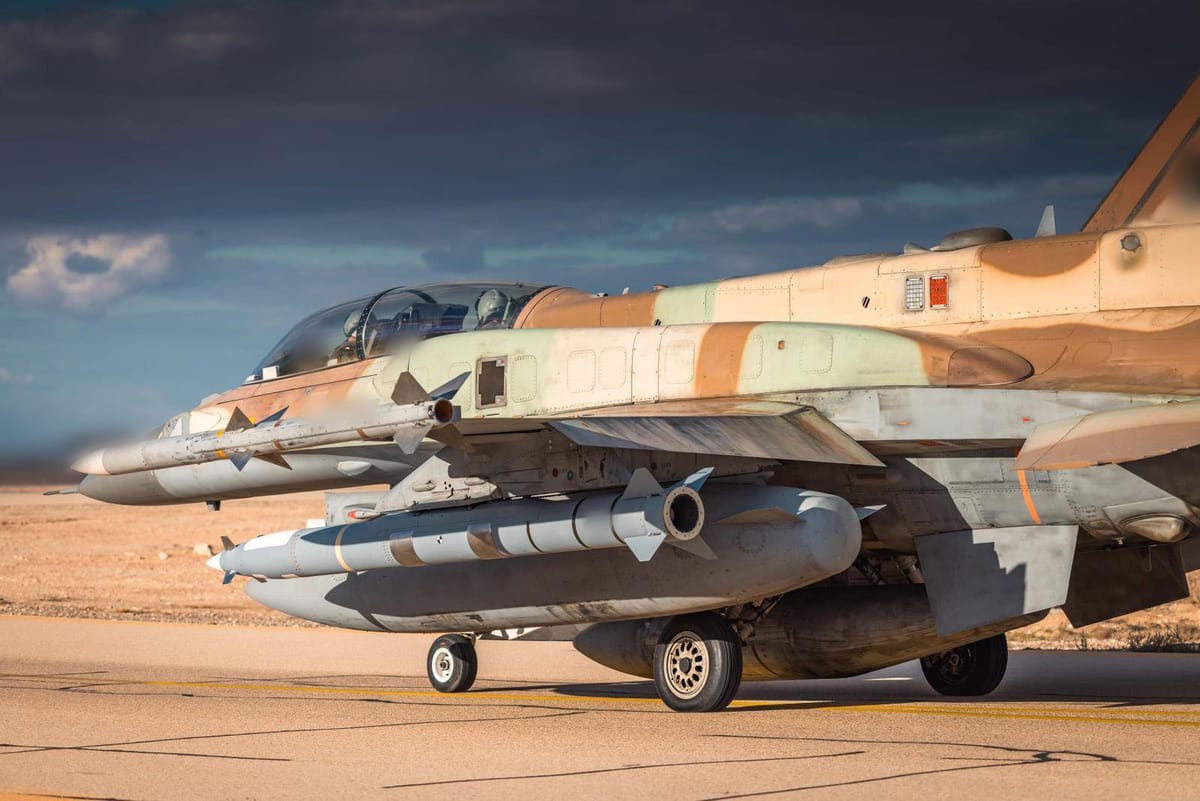
Of the hundreds of nuclear warheads in America's operational arsenal, only one was designed from the outset for a unique mission: to penetrate the ground and turn the surrounding rock itself into a weapon. It is the B61-11, the only nuclear weapon in the active U.S. arsenal built to destroy deeply buried bunkers.
Most nuclear bombs are designed to detonate in the air or on the surface. The B61-11 is meant to bury itself in the ground before exploding, sending a powerful seismic shock through the earth that collapses tunnels and underground facilities without striking them directly.
The weapon has returned to the center of debate in Washington. According to U.S. reports, the administration has examined military options against a heavily fortified underground Iranian nuclear facility near Natanz known as Pickaxe Mountain, which is carved some 100 meters deep into solid granite.
Military analysts say that even America's most powerful conventional bunker-buster, the 13.6-ton GBU-57 Massive Ordnance Penetrator, would struggle to fully destroy a facility at that depth. The B61-11 is the only weapon in the U.S. arsenal assessed as capable, at least in theory, of generating a shock wave strong enough underground to collapse it.
The B61-11 is a variable-yield weapon. Its maximum yield is estimated at 340 to 400 kilotons, more than 20 times the power of the bomb dropped on Hiroshima. It is designed to be delivered by strategic bombers, chiefly the B-2 Spirit stealth bomber. The exact number in the U.S. stockpile is classified, though open-source estimates put it at fewer than 100.
Despite its "earth-penetrating" label, the bomb does not burrow dozens of meters into the ground. It penetrates only about three to six meters into soil or rock. Its advantage lies in what is known as shock coupling: transferring the energy of the explosion directly into the ground rather than losing it to the air. The result is a massive seismic shock that can bring down tunnels and bunkers far below.
According to CNN, the U.S. military has drawn up extensive strike plans against Iran, including the possible use of the GBU-43/B, known as the Mother of All Bombs, and President Donald Trump has instructed the military to prepare a range of strike packages targeting energy infrastructure and major nuclear sites. The plans reportedly call for using the MOAB against Pickaxe Mountain, but U.S. military sources have raised doubts about its ability to reach deep into granite, and professional assessments suggest the B61-11 may be the only weapon capable of doing so.
End of U.S. Aid
The renewed attention to the B61-11 comes as U.S. security assistance to Israel faces a major shift. This week, Trump said the United States would end its roughly $4 billion in annual military aid to Israel by the end of the year, describing it as a deal reached with Prime Minister Benjamin Netanyahu and saying Israel no longer needs the money. A spokesperson for Netanyahu said Israel was not aware of such an agreement and would seek clarification. The current 10-year memorandum of understanding between the two countries runs through 2028.
Trump stressed that Israel would still be able to purchase American weapons, so the immediate impact is less a halt to arms supplies than a change in how they are financed. Much of the aid has gone toward American systems, including precision munitions and penetrating bombs. Ending the grants could speed up Israeli domestic development, increase reliance on direct purchases, or reshape the IDF's priorities for heavy munitions against fortified targets.
Israel possesses a range of conventional bunker-busting bombs, some American-made and some produced domestically, and has used them successfully against tunnels and fortified structures. There is no verified public information on whether Israel has a nuclear weapon comparable to the B61-11. Israel's policy of nuclear ambiguity means it neither confirms nor denies its capabilities, and assessments by international research organizations do not point to a dedicated earth-penetrating nuclear warhead in Israel's arsenal.
A Different Congress
The Democratic takeover of both the House and the Senate in Tuesday's midterm elections presents Israel with a Congress fundamentally different from the one it has known for decades. Congress was long a reliably pro-Israel institution. The incoming class includes a significant group of lawmakers for whom criticism of Israel, and particularly of military aid and arms exports, has been central to their campaigns.
The most prominent example is Abdul El-Sayed, Michigan's Democratic Senate nominee, who would be the first Muslim senator in U.S. history. El-Sayed has publicly opposed unconditional military aid to Israel and has repeatedly argued that the money should be spent on Americans first. According to the Forward, at least five candidates affiliated with the Democratic Socialists of America are expected to enter the House.
The war with Iran became a direct factor in the midterms. American voters focused on fuel prices and inflation, which were widely attributed to the war, and much of the blame fell on Trump and, by extension, on Netanyahu.
Ending financial aid is one thing. Political pressure on American arms exports to Israel is another matter entirely. With progressive Democrats holding sway in both chambers, calls for an arms embargo, or at least significant restrictions on shipments of heavy bombs, precision munitions and advanced systems, are expected to grow. Even if Trump vetoes such legislation, Congress can delay approvals, demand reports, open investigations and turn every arms shipment into a political battle.
As a result, Israel's ability to rely on advanced American weaponry, including systems that could support action against deep underground facilities like Pickaxe Mountain, is becoming less certain. The era in which Israel could assume the United States would provide whatever munitions it needed, including the heaviest weapons against protected targets, appears to be drawing to a close.
Do Russia and China Have a Comparable Weapon?
There is no clear public evidence that Russia has a dedicated earth-penetrating nuclear gravity bomb like the B61-11. Moscow relies instead on high-yield warheads carried by ballistic missiles such as the Bulava. Russian experts argue that Bulava warheads, each with a yield of 100 to 150 kilotons, can destroy fortified bunkers even when detonating hundreds of meters away, thanks to their accuracy and seismic effect. China has invested heavily in research on earth-penetrating nuclear weapons, and Chinese studies published in recent years have found that such detonations can cause significantly more damage to underground targets than an airburst of the same yield.
Israel Did Not Wait
Israel did not wait for a nuclear bunker-buster to confront Iran's nuclear program. For more than 15 years, it has waged a sustained campaign against Iran's fortified facilities, chiefly Natanz and Fordow, using cyberwarfare, sabotage, targeted killings and airstrikes.
The best-known operation was Stuxnet, the 2010 cyberattack widely attributed to Israel and the United States, which infiltrated the control systems of centrifuges at Natanz and caused them to spin out of control and break apart. In 2020 and 2021, mysterious explosions struck Natanz, damaging an advanced centrifuge production plant and later knocking out the underground facility's power system, causing heavy damage to its centrifuges. Between 2010 and 2020, at least five senior Iranian nuclear scientists were killed. In 2018, Mossad agents broke into a warehouse in Tehran and removed tens of thousands of documents and discs from Iran's military nuclear archive, exposing the scope of its weapons work and bolstering international pressure.
But as Iran digs its facilities ever deeper, inflicting lasting damage becomes more difficult, which is why the question of which weapons can reach them matters more than ever.