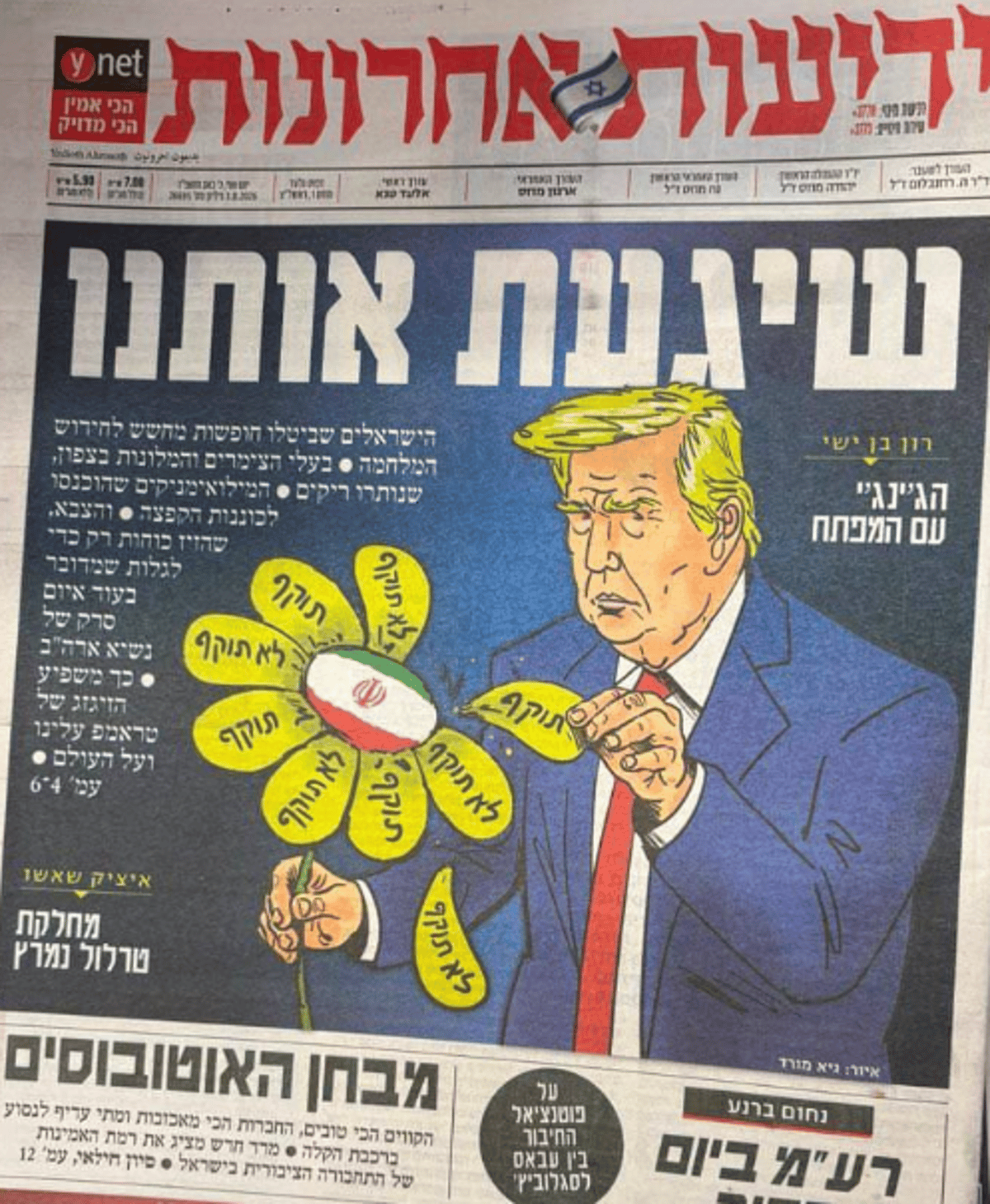
Israel's leading newspaper Yediot Aharonot took aim at President Trump's repeated reversals over Iran strikes on Monday, sarcastically summarizing the president's pattern: "You drove us crazy: 'I will attack. I will not attack. I will attack. I will not attack.'"
The scathing front-page commentary reflects growing Israeli frustration with what appears to be an increasingly erratic US approach to Iran policy after six months of conflict. Trump has repeatedly threatened strikes on Iranian infrastructure, most recently threatening "the biggest attack since World War II," only to cancel those operations at the last moment, citing diplomatic progress or appeals from regional allies like Saudi Arabia.
The repeated policy reversals in Washington have turned uncertainty into a logistical nightmare, with Israelis learning about the "outlines of a deal" from the US president while wondering how stable those understandings are, whether Iran will reopen the Strait of Hormuz, and what Trump's latest reversal will ultimately mean for Israel's security.
On Sunday, Trump announced he had canceled another large-scale strike on Iran after the outlines of a possible agreement were reached, catching Israelis at the height of the summer travel season, when airports, vacations and overseas flights are at their busiest. The announcement also coincided with Iran's denial that negotiations would begin on Monday as Trump claimed, adding to the confusion.
Iranian officials were quick to mock the reversal, with Mohammad Marandi, a senior Iranian figure associated with the regime's negotiating delegation, writing "Trump retreated again" on social media shortly after the announcement.
The central issue driving the latest escalation, freedom of navigation through the Strait of Hormuz, remains unresolved, with Iran continuing to oppose unrestricted passage through the strategic waterway without its approval, and no clear solution appearing imminent.
The Yediot editorial reflects a broader Israeli concern about the predictability and credibility of US commitment in the region. While Israeli officials have expressed reluctant acceptance of the ceasefire and diplomatic opening, the constant threat-and-reversal cycle has created persistent uncertainty about whether negotiations will actually occur or if military operations will resume without warning.
The campaign against Iran has now entered its sixth month, leaving Israel and the wider region in prolonged uncertainty.