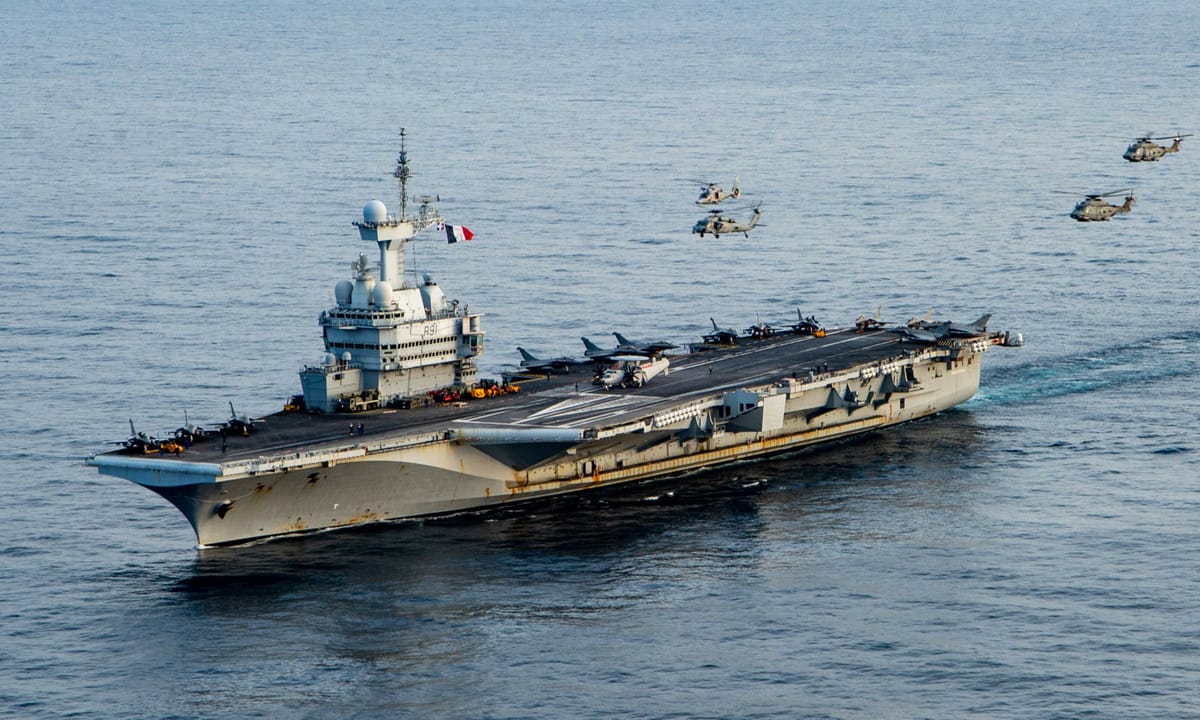
France has deployed its only aircraft carrier, the nuclear-powered Charles de Gaulle, toward the Red Sea as part of a multinational effort to prepare for securing shipping through the Strait of Hormuz once conditions allow the waterway to reopen.
The French Armed Forces Ministry said Wednesday that the carrier and its strike group had crossed the Suez Canal and were heading toward the Red Sea. French military officials said the deployment would place the carrier closer to the Strait of Hormuz without sending it directly into the contested waterway.
Col. Guillaume Vernet, spokesman for the French armed forces chief of staff, said the Red Sea position would allow France to respond more quickly if Iran agrees to reopen the strait under a potential peace arrangement.
“Geographically, it’s closer to the Strait of Hormuz and will therefore enable us to react faster, once the conditions are met,” Vernet said.
The Charles de Gaulle, launched in 1994, carries around 40 aircraft and helicopters and has a crew of nearly 2,000. It is sailing with eight warships and two amphibious assault ships, according to French officials.
Vernet said the French deployment is part of a multinational mission separate from President Donald Trump’s Project Freedom, the US operation that escorted commercial vessels through the strait before being paused this week amid reported progress in US-Iran talks.
France and Britain have been working with other countries on a broader maritime security effort aimed at restoring safe passage through the Strait of Hormuz, which has remained effectively closed since the US-Israeli war with Iran began on February 28. The closure has disrupted global energy markets and left hundreds of ships stuck in or around the key waterway.
French President Emmanuel Macron and British Prime Minister Keir Starmer helped convene a coalition of more than 40 countries last month to discuss the crisis and possible security arrangements. The coalition has so far avoided joining the war against Iran directly, with Starmer saying Britain would not enter another long-term conflict in the Middle East.
Vernet warned that shipping through Hormuz is unlikely to resume without Iran’s cooperation, citing the threat level and the high insurance costs facing commercial vessels.
“Today the Strait of Hormuz is stuck because of the threat and the insurance premiums are so high,” he said. “Not a single ship will jeopardize their trip or go there.”
The French deployment comes as diplomatic efforts continue over a possible agreement that would end the war and reopen the strait under new security arrangements.