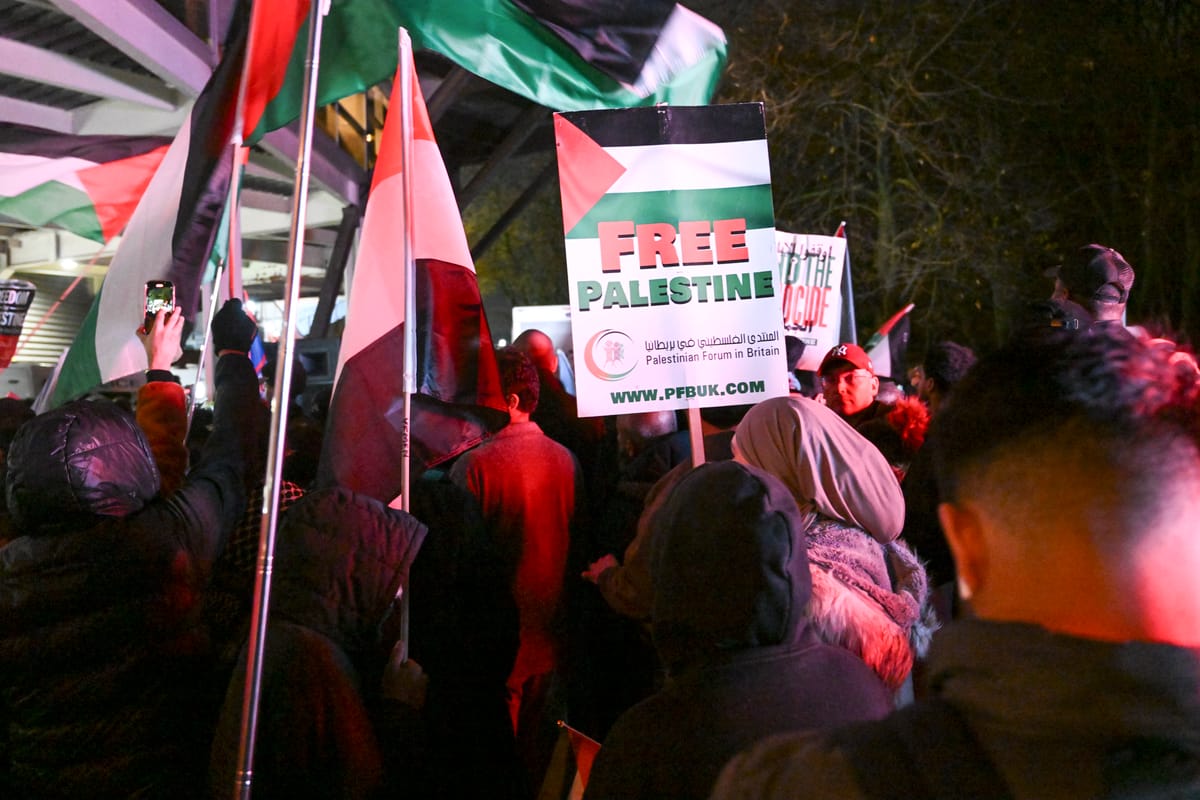
Four people were arrested in London on Wednesday evening after chanting “globalize the intifada” at a pro-Palestinian demonstration, marking the first enforcement action under a newly announced police crackdown on slogans deemed to incite violence or antisemitism.
The arrests took place at a Palestine Coalition protest in central London, just hours after the Metropolitan Police and Greater Manchester Police said they would adopt a more assertive approach toward chants and placards referencing “intifada.” Police said two of the demonstrators were detained for racially aggravated public order offenses related to the chants, with two additional arrests made for public order violations. A fifth individual was arrested for obstructing police during the initial detentions.
The protest was controversial from the outset. Its planned route would have passed near Trafalgar Square during a public Chanuka menorah lighting, prompting police to impose restrictions under the Public Order Act. Officers barred demonstrators from assembling around Trafalgar Square, Whitehall, Parliament Square, and surrounding areas, citing concerns over public safety and community tensions.
The tougher policing stance follows a series of deadly antisemitic terror attacks abroad, including the mass shooting at a Chanuka celebration in Sydney’s Bondi Beach and a recent attack on a synagogue in Manchester. In a joint statement earlier Wednesday, senior police commanders said the security context had changed and that slogans previously assessed as falling below the threshold for prosecution would now be treated differently.
“Words have meaning and consequence,” the statement said, adding that chants such as “globalize the intifada” have caused fear in Jewish communities and would now prompt arrests. Jewish organizations largely welcomed the move. The UK’s Chief Rabbi, Ephraim Mirvis, called it “an important step” in challenging rhetoric that has inspired violence.
Pro-Palestinian groups condemned the arrests. Chris Nineham, vice chair of the Stop the War Coalition, accused authorities of exploiting overseas attacks to restrict protest rights. Ben Jamal, director of the Palestine Solidarity Campaign, said the new approach amounted to political repression, arguing that the Arabic term “intifada” refers to resistance against injustice rather than a call for violence.
Police leaders rejected that framing, stressing that it is possible to protest in support of Palestinians without intimidating Jewish communities or breaking the law. The Crown Prosecution Service said it is working closely with police on antisemitic hate crime cases but noted that charging decisions remain context-specific and subject to evidentiary thresholds.
Security has meanwhile been increased around synagogues, Jewish schools, and community institutions across the UK, as authorities brace for further protests under heightened tensions.