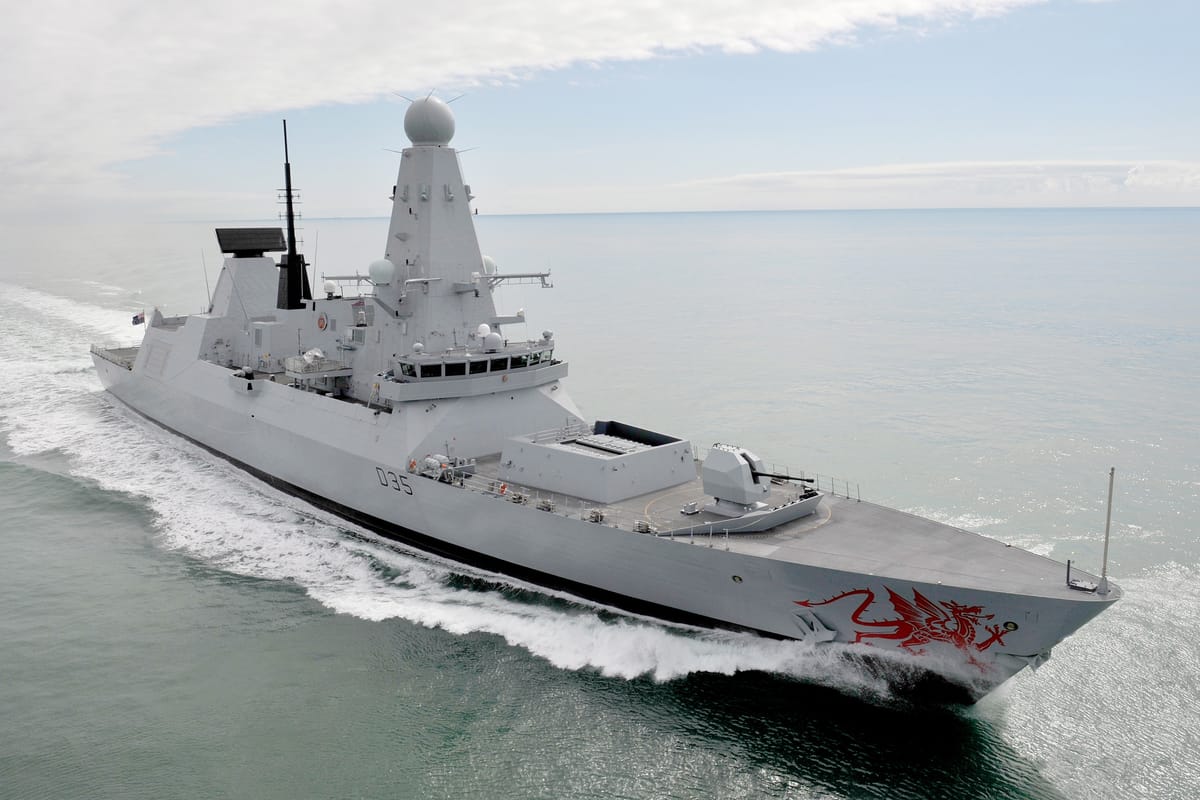
Britain announced Saturday it is repositioning HMS Dragon, a Royal Navy Type 45 air-defence destroyer, to the Middle East in preparation for a potential multinational mission to protect commercial shipping through the Strait of Hormuz. The move, coordinated with France, marks the most concrete European military commitment to restoring freedom of navigation since the waterway was effectively shut in late February.
But the deployment comes with a significant caveat: it is explicitly not support for the American war effort, and the distinction matters enormously in Washington.
What HMS Dragon Will and Won't Do
"We can confirm that HMS Dragon will deploy to the Middle East to pre-position ahead of any future multinational mission to protect international shipping when conditions allow them to transit the Strait of Hormuz," a Ministry of Defence spokesman said. "The pre-positioning of HMS Dragon is part of prudent planning that will ensure that the UK is ready, as part of a multinational coalition jointly led by the UK and France, to secure the strait, when conditions allow."
The key phrase is "when conditions allow." As the U.S. and Iran inch toward a potential diplomatic off-ramp from their ten-week war, France and Britain have been working on a proposal to lay the groundwork for safe transit through the strait once the situation stabilises. The plan would need coordination with Iran, and a dozen countries have indicated a willingness to take part.
At a two-day meeting in London in April involving more than 44 countries, military planners discussed the practicalities of a multinational mission led by the UK and France. Some 40 countries are understood to have agreed in principle to participate. The MoD said deploying HMS Dragon would strengthen the confidence of commercial shipping and support mine clearance efforts once hostilities end.
France recently moved its Charles de Gaulle aircraft carrier to the Red Sea in a move aimed at signalling that the coalition stood ready to secure the strait. Together, the Franco-British posture is a deliberate signal: Europe will help reopen the strait, but on its own terms, and only after the shooting stops.
The Alliance Rift Underneath the Deployment
The announcement of HMS Dragon's repositioning cannot be separated from the much larger story of transatlantic tension it sits within.
When Trump imposed a naval blockade on Iranian ports on April 13, he called on allies to join. NATO allies said they would not get involved in the blockade, proposing instead to intervene only once fighting ends — a refusal likely to anger Trump and increase strains in the alliance. "We're not supporting the blockade," British Prime Minister Keir Starmer told the BBC. "My decision has been very clearly that whatever the pressure, and there's been some considerable pressure, we're not getting dragged into the war," he said.
That pressure has been considerable. Trump warned on Truth Social that the U.S. had been informed by most NATO allies that they did not want to get involved in the military operation. "We will protect them, but they will do nothing for us, in particular, in a time of need," he said. Trump has threatened to withdraw from NATO and has been weighing pulling U.S. troops from Europe, in part because several countries denied American military planes use of their airspace for strikes on Iran.
The friction extends beyond Britain. The United Kingdom, France, and Germany all declined combat roles in protecting the key oil choke point, drawing warnings from Trump and Republican allies about NATO's reliability. Turkey's foreign minister said the strait should be reopened through diplomacy, calling the creation of an international force "complicated."
A Different Vision for the Strait
What Britain and France are proposing is not a wartime operation but a post-ceasefire one: a defensive, multinational maritime mission with Iranian coordination, designed to restore commercial confidence rather than enforce an American blockade. The two frameworks are not just militarily different — they reflect fundamentally divergent views of how the crisis should end.
Britain's ability to participate in any protective mission will be limited by the stretched Royal Navy, which is much smaller now than in the past and which has had to retire some ships before replacements have become available. HMS Dragon's deployment is in part a statement of intent that Britain has to make with the assets it has.
The backdrop against which all of this unfolds remains volatile. On Friday, a U.S. fighter jet fired on and disabled two Iranian-flagged tankers that Washington accused of challenging its naval blockade of Iran's ports. The U.S. action prompted Iranian retaliatory attacks. It came after a flare-up overnight Thursday to Friday in the strait, where Iran has been seeking to extract tolls from foreign vessels and wield economic leverage over the U.S. and its allies.
Iran on Saturday questioned the seriousness of American diplomacy in the wake of those renewed naval clashes. Pakistan's mediation effort continues in Islamabad, but a deal capable of stabilising the strait well enough for the UK-France mission to begin has not yet materialised.
Until the U.S.-Israeli war against Iran, the Strait of Hormuz was open and about 25 percent of the world's seaborne oil trade and 20 percent of the world's liquefied natural gas passed through it. It now operates at a fraction of that capacity. Whether HMS Dragon's arrival in the region marks the beginning of the end of that disruption, or merely the next chapter in a conflict whose trajectory remains deeply uncertain, depends on negotiations that have so far defied resolution.