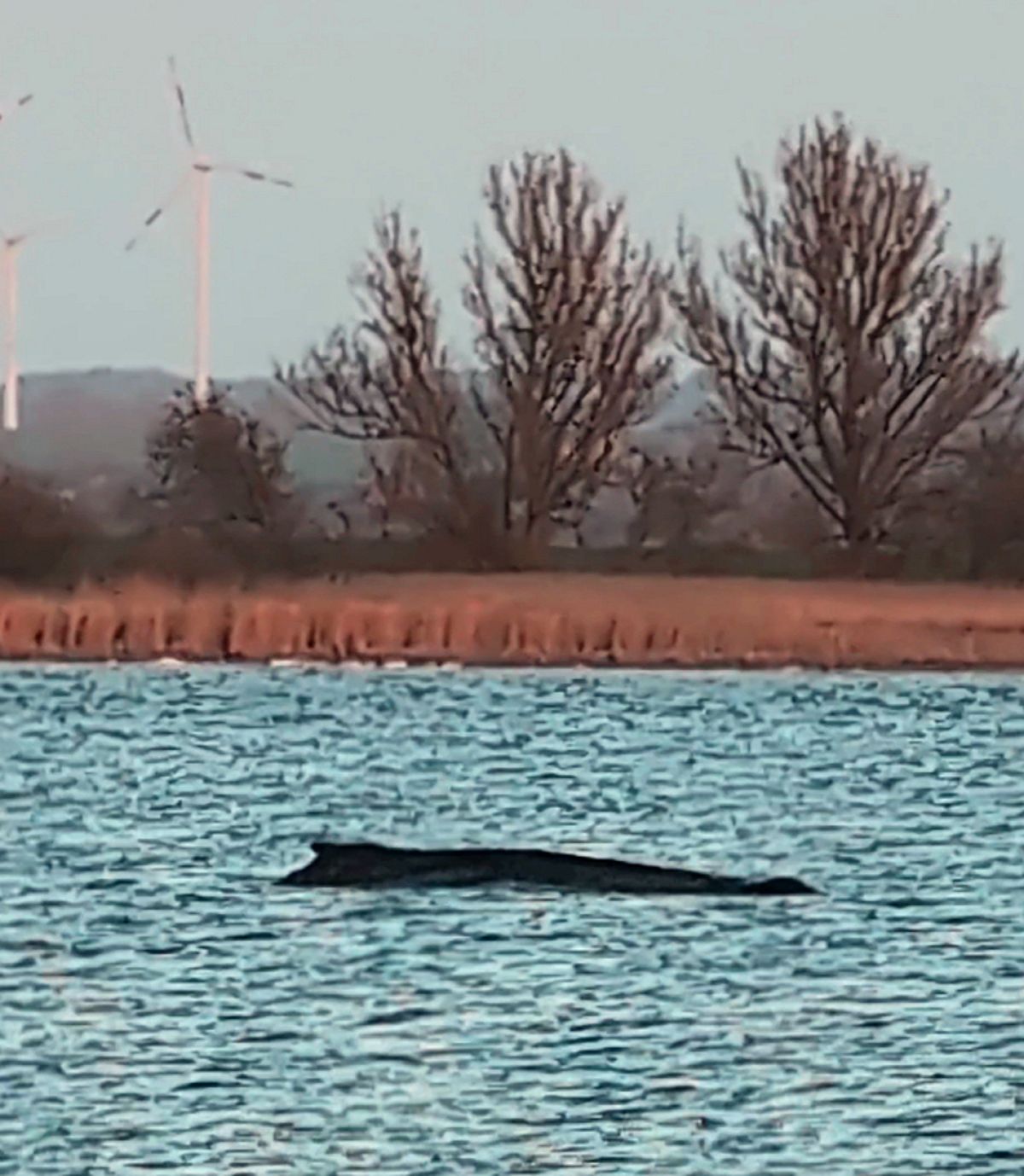
Timmy the humpback whale was only about 32 feet long, roughly the size of a double-decker bus. He had no name until a German seaside town gave him one. And yet, for weeks, millions of people around the world couldn't look away.
The young humpback whale, who was stranded for weeks in shallow waters, has been found dead just off Denmark's coast, the Danish Environmental Protection Agency confirmed on Saturday. His body washed up Thursday near the small island of Anholt in the Kattegat, the broad strait between Denmark and Sweden connecting the Baltic Sea to the North Sea. Authorities confirmed his identity using a GPS transmitter still fastened to the whale's back, recovered by a Danish Nature Agency worker once sea conditions allowed them to reach the carcass.
"It can now be confirmed that the stranded humpback whale near Anholt is the same whale that was previously stranded in Germany and was the subject of rescue attempts," said Jane Hansen, head of division at the Danish Environmental Protection Agency.
Lost in the Wrong Sea
Timmy's ordeal began in early March, when he was first spotted in Wismar harbor, entangled in a fishing net, and had to be freed by emergency services. Then, at the end of March, he became stranded in shallow water near Timmendorfer Strand, a town on Germany's north coast that gave him his nickname.
The Baltic Sea, where Timmy had lost his way, is one of the world's least salty bodies of water, poorly suited for a humpback built for the open ocean. During the weeks he was stranded, he spent days barely moving, breathing irregularly, and suffering from a painful skin condition caused by the Baltic's low salt content.
What followed was an extraordinary public spectacle. Timmy's ordeal was livestreamed around the world, drawing widespread media coverage as rescuers tried desperately to coax him to freedom. German authorities eventually gave up, fearing he was too weak. But the story wasn't over.
A Million-Euro Gamble
Millionaire donors funded an estimated €1.5 million independent rescue attempt to coax the mammal into a water-filled holding pen and tow it back to its natural habitat in the North Sea. The privately funded effort pressed ahead despite warnings from scientists that the whale was too weak to survive.
The rescue divided opinion sharply. Marine biologist Thilo Maack of Greenpeace was among those who cautioned against false hope. "I believe the whale will die very soon now," he told the Associated Press in April. "And I would also like to raise the question: What is actually so bad about that? Yes, animals live, animals die. This animal is really, really very, very, very sick. And it has decided to seek rest."
Others argued passionately for giving Timmy every chance. Mecklenburg-Western Pomerania's environment minister, Till Backhaus, who allowed the private rescue attempt to go ahead, said it was a natural response "to use even the smallest chance when a life is at stake."
Timmy was transported in a flooded barge to the North Sea at the end of April and released on May 2. He had made it, or so it seemed.
The End
He survived barely two weeks in the open water. His body was found roughly 130 kilometers from where he was released.
The Danish Environmental Protection Agency has warned the public to keep their distance, noting that the whale may carry diseases transmissible to humans, and that there is also a risk of explosion from gases building up inside the decomposing carcass. There are no plans to remove the body.
For the many thousands who followed his story, the ending is a painful one. Timmy captured the hearts of whale lovers across the globe who had rooted for a happy ending. His name, borrowed from a cheerful German beach town, became a symbol of hope, and now, of its limits.
The sea he longed for finally had him. It just wasn't enough.