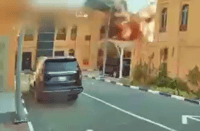
The attack on three commercial vessels in the Strait of Hormuz that collapsed the memorandum of understanding with Washington and restarted the war was ordered by a hardline faction acting without the knowledge of Iran's president, the commander of the Revolutionary Guards or the Supreme National Security Council, according to an extensive New York Times investigation.
The account rests on five Iranian officials and two members of the Islamic Revolutionary Guard Corps. It describes President Masoud Pezeshkian in Iraq in July for a week of mourning ceremonies for Ayatollah Ali Khamenei, killed at the start of the war, having just completed negotiations on the memorandum, when word reached him that Iranian forces had opened fire on three merchant ships, setting a Qatari liquefied natural gas tanker ablaze and damaging the others. Pezeshkian called IRGC commander in chief General Ahmad Vahidi, called the attacks reckless and demanded answers. Vahidi told him he had neither authorised the strike nor known of it in advance. The Supreme National Security Council had also been unaware. Pezeshkian returned to Tehran, and by the next morning the United States had resumed airstrikes.
Investigations by the Iranian government and security services concluded that the decision was made by Hossein Taeb, a cleric and intelligence figure who had opposed the agreement from the outset and who told the new supreme leader that Iran had erred in ending the war. Taeb ran the IRGC's intelligence organisation for years before Ali Khamenei removed him in 2022 following a series of security failures, among them Israeli penetration of Iran's security apparatus and the collapse of an Iranian plot in Turkey. He returned to prominence after Khamenei's killing, played a central role in installing Khamenei's son Mojtaba as successor, and has now been appointed to lead the Basij.
When Pezeshkian demanded to know who had given the order, he was told field commanders had acted on their own under a standing directive permitting attacks on any vessel judged to be violating Iranian control of the strait without clearance from central command. One sign of the internal dispute is that the IRGC's Khatam al-Anbiya headquarters never claimed the July 7 attack, though it routinely claimed others before and after. Iranian officials told Washington and several regional governments within hours that rogue elements were responsible, and Foreign Minister Abbas Araghchi was sent to Oman to contain the damage.
What followed inside the leadership was described as one of the fiercest confrontations since the war began, with shouting matches between senior officials, two generals threatening to resign and accusations of treason exchanged between factions. The Supreme National Security Council was reshuffled and General Mohsen Rezaei, a former IRGC commander seen as capable of mediating, was placed in charge. The divisions have not closed and the hardliners have emerged stronger.
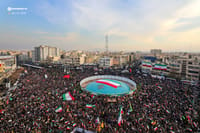
Underpinning all of it is the absence of the one figure with authority to settle such disputes. Mojtaba Khamenei has not been seen in public since taking power, and his whereabouts remain secret. His mother-in-law, Tayebeh Mahrouzadeh, said in a video interview this month that relatives have no information about where he or his three children are. Pezeshkian said in May that he had met him. Two Iranian officials and a former senior official described that meeting as highly unusual, saying the president was driven in an ambulance with tinted windows to a secure video link where a man presenting himself as an intermediary relayed messages, and that Pezeshkian later told a close ally he was not certain he had actually spoken to the supreme leader. Last month Pezeshkian said he had been granted a second meeting lasting seven hours.
The report lands the day before Gulf foreign ministers are due in Muscat to discuss the strait. Two strategies have been under debate in Tehran, a return to negotiations or a sharp escalation aimed at damaging US Navy vessels, killing American troops and driving up oil prices, both intended to end the naval blockade that has cut Iranian oil sales to zero.
Hardline generals including IRGC Aerospace Force commander Seyed Majid Mousavi have pressed the second course, presenting the security council with a war plan in which Iran, the Houthis and Iraqi militias would intensify attacks on regional oil infrastructure. Pezeshkian and parliament speaker Mohammad Bagher Ghalibaf warned it could drag Iran into an abyss. Mahdi Mohammadi, Ghalibaf's senior adviser, told the Times the war has entered its escalation phase.