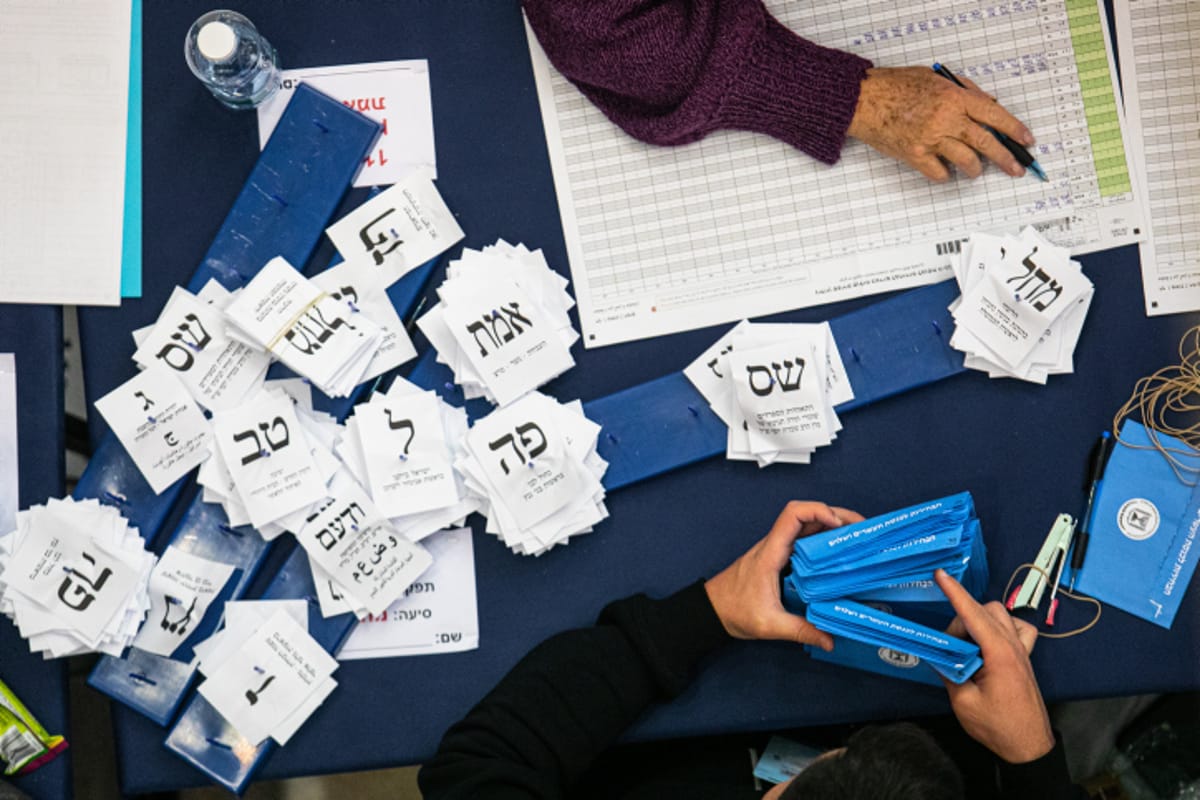
The battle for mandates in the Knesset 26 elections is far from settled: more than half a million votes still await counting in the double-envelope process. The count is expected to begin tonight, but near-final results are not expected before tomorrow evening, with the verification process possibly continuing into the coming days.
As of 1:00 PM, 77.6% of valid votes had been counted. According to current figures, the Netanyahu bloc stands at 54 mandates, the Eisenkot bloc at 49, and the Arab parties at 17. But the numbers do not yet reflect the full picture, and the gaps may shift once counting is complete.
The Central Elections Committee prepared in advance for an unusually high volume of double envelopes, primarily due to the war, reserve duty, and the voting of evacuees far from their registered addresses. In the previous elections in 2022, more than 460,000 people voted this way. This time, estimates stand at 600,000 to 650,000 voters, a number equivalent to roughly 15 mandates in vote terms, though the double envelopes are not allocated mandates separately.
Will the double envelopes shift the balance of power?
Experience from previous election cycles shows that these votes can have a real impact on mandate distribution. Because a large portion of double-envelope voters are soldiers and security personnel, the rate of support for chareidi and Arab parties among them is typically lower than their share in the general population. As a result, counting these votes tends to improve the position of secular parties and weaken chareidi and Arab parties. However, this is not expected to harm the bloc overall, since soldiers also belong to liberal right-wing or religious parties, according to an analysis by Ynet.
A striking example was recorded in the Knesset 25 elections: before the double envelopes were counted, United Torah Judaism stood at eight mandates and Yisrael Beiteinu at five. After the count was completed, UTJ dropped to seven mandates, while Avigdor Liberman's party rose to six.
Changes were also recorded in the March 2021 elections following the double-envelope count. Around 428,000 votes were counted in that framework, and as a result Ra'am dropped to four mandates and Meretz rose to six, with no change in the division of blocs.
Still, it is impossible to determine in advance how many mandates will be added or subtracted from each party. Mandate distribution depends on the total valid votes, the final results, the electoral threshold, and surplus-vote agreements.
Why are the results delayed?
Elad Nave, director of the control center at the Central Elections Committee, said this morning in an interview with Ynet that absorption of regular polling stations is ongoing, and that at this stage about half have already been entered into the system.
Nave emphasized that it is still too early to assess the impact of the double envelopes. He said that although the committee expects more than half a million envelopes, the distribution of votes within them is usually similar to the national distribution and does not necessarily indicate significant deviations. He added that as long as not all polling stations have been absorbed and the double envelopes have not been counted, it is impossible to determine even the number of votes required for a mandate.
The counting process consists of several stages. First, the envelopes are checked and cross-referenced to ensure that no one voted both at their registered polling station and via a double envelope. The envelopes are then distributed to the appropriate committees, and only then are the envelopes opened and vote counting begins under the supervision of representatives of the Elections Committee and the parties.
According to the updated estimate, counting is expected to begin as early as this evening and conclude tomorrow evening. However, the committee does not rule out that the process may continue until Friday.
Even after the count is completed, the process will not end immediately: in the coming days, a re-examination of sample polling stations and stations where discrepancies or unusual incidents were discovered is planned. Only after the checks are completed will it be possible to approach the final results.
Nearly 80% of IDF personnel voted
Alongside the vote count, the IDF spokesperson updated that the voting rate among military personnel stood at 79.9%, an increase of 6.2 percentage points compared to the 2022 elections.
The IDF noted that more than 890 military polling stations were deployed at bases and units across the country, about a quarter of them mobile. The polling stations operated starting last week and throughout election day, in order to enable soldiers to vote even in combat zones and remote bases.
Until the count and verification are completed, the current mandate distribution remains temporary, and the final decision on the composition of the next Knesset is still open.