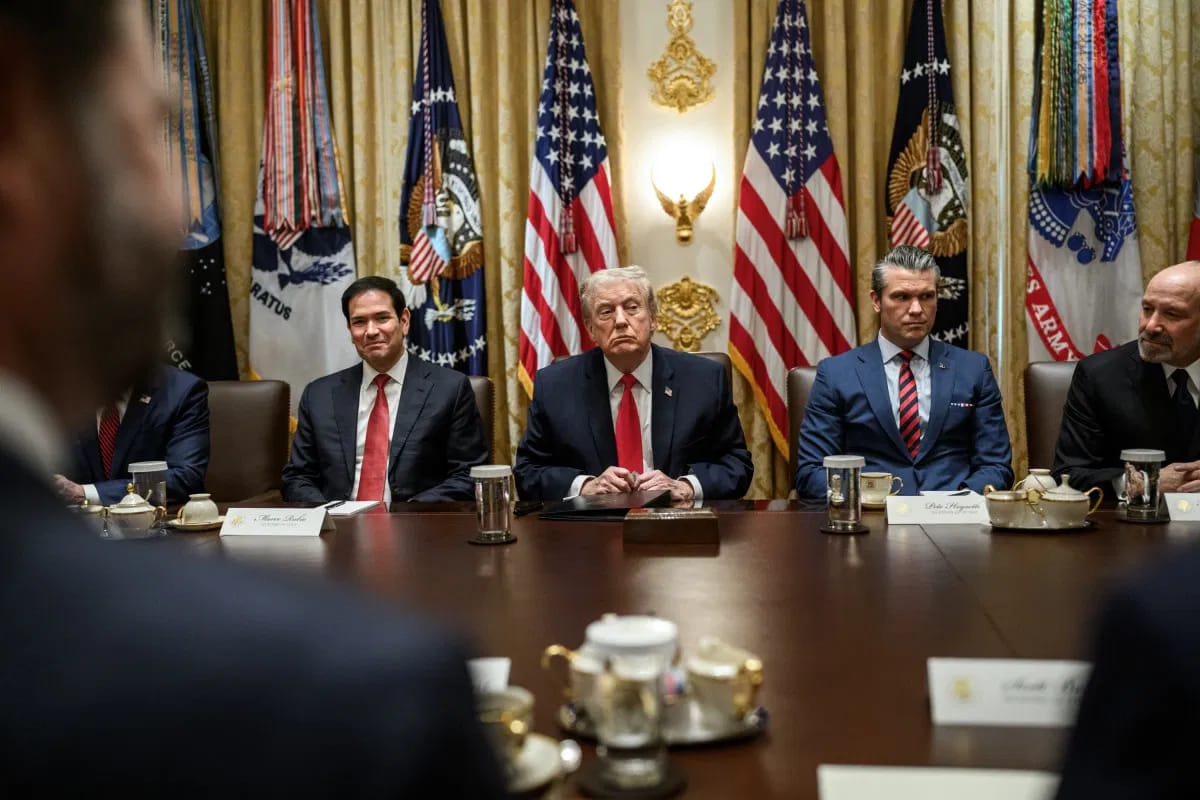
In a series of dramatic statements made aboard Air Force One on Saturday night, President Donald Trump revealed that the Iranian regime is "seriously talking" with the United States to avoid a catastrophic military escalation. While a massive American fleet, described by Trump as larger and more powerful than the one deployed to Venezuela, moves into striking distance in the Persian Gulf, the President expressed a cautious hope for a deal that would see Iran finally giving up its nuclear weapons program. Despite the "warlike atmosphere" portrayed in international media, senior officials in Tehran have also hinted that a new framework for advanced negotiations is taking shape. However, the situation remains extremely volatile, as Trump confirmed he has personally delivered a direct ultimatum to the Iranian leadership, the details of which remain a closely guarded secret even from America's closest Gulf allies.
The Secret Plan and Allied Skepticism
During an exchange with reporters, Trump addressed concerns that regional partners like Saudi Arabia and the United Arab Emirates are being kept in the dark regarding specific U.S. intervention plans. "Well, we can’t tell them the plan. If I told them the plan, it would be almost as bad as telling you the plan, it could be worse, actually," Trump said. He emphasized that while a "tremendously powerful fleet" is heading out, the primary objective remains a negotiated settlement. "The plan is that [Iran is] talking to us, and we’ll see if we can do something, otherwise we’ll see what happens," he added.
This lack of transparency has caused friction within the Gulf Cooperation Council (GCC). High-ranking officials from the region have indicated that they are not being briefed on Washington's objectives, and a senior Gulf official stated that Saudi Arabia would not allow its airspace or bases to be used for a direct attack on Iran. Despite the skepticism from Gulf allies who believe Iran frequently uses the promise of negotiations as a stalling tactic, Trump remained firm. "Well, that’s true, but they are negotiating, so we’ll see what happens," the President remarked. He also alluded to previous efforts to neutralize the nuclear threat, noting, "The last time they negotiated, we had to take out their nuclear, didn’t work, you know. Then we took it out a different way, and we’ll see what happens."
War or Diplomacy: Tehran’s Response
The rhetoric from Tehran reflects a government deeply divided or perhaps playing a sophisticated double game. Foreign Minister Abbas Araghchi confirmed that Iran is prepared to resume nuclear talks but issued a stern warning that negotiations cannot proceed under the shadow of military threats. Araghchi was also explicit that Iran’s ballistic missile program is entirely off the table. "Iran is ready for both scenarios, war or diplomacy," he stated, following Trump’s hints that a deadline for a deal had been communicated directly to the regime.
While the supreme leadership often maintains a belligerent tone, Ali Larijani, the head of Iran’s Supreme National Security Council, offered a more conciliatory perspective. He suggested that contrary to the public image of an imminent explosion, "a framework for advanced negotiations is taking shape." President Trump acknowledged the gravity of the human cost if the situation continues to deteriorate, noting that "a lot of people are being killed" in the ongoing regional instability. As the most powerful ships in the world take their positions in the Gulf, the question remains whether the "rough situation" will end in a historic disarmament treaty or the start of an all-out war that will reshape the Middle East.