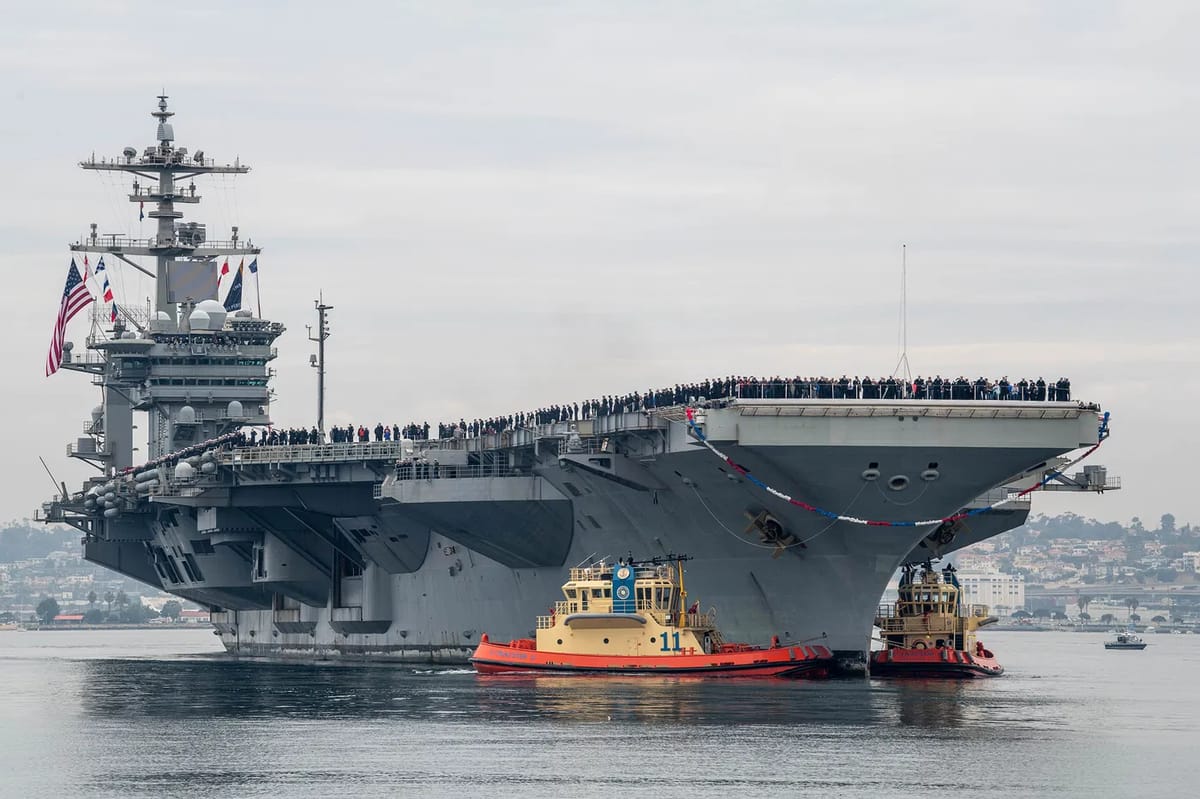
In a direct counter-response to reports suggesting limited military capabilities, the Washington Post reveals that the United States has amassed a historic naval presence in the Middle East, with roughly one-third of the entire active U.S. Navy fleet now concentrated in the region.
This massive deployment grants President Trump the flexibility to choose between a broad, intensive bombing campaign or highly surgical kinetic strikes against Iran. The buildup is being characterized as the most significant concentration of American power in the Middle East since the lead-up to the 2003 Iraq War.
The arrival of the USS Gerald R. Ford near Crete on Monday, carrying dozens of advanced aircraft, marks a strategic pivot. It joins the USS Abraham Lincoln, currently stationed off the coast of Oman. Analysts note that with these assets, the U.S. has successfully "bracketed" Iran from both the Mediterranean and the Arabian Sea.
Dana Stroul, former Deputy Assistant Secretary of Defense for the Middle East, told the Washington Post that this level of force enables any operational decision the President might make, ranging from localized missions to a full-scale kinetic campaign.
Satellite imagery and flight tracking data confirm a surge of over 150 aircraft to bases across the Middle East and Europe since the breakdown of nuclear talks on February 17:
- Muwaffaq Salti Air Base (Jordan): Recent imagery shows over 60 aircraft on the tarmac, including F-35 Lightning II stealth fighters specifically designed to neutralize advanced air defense systems.
- European Positioning: More than half of the newly deployed aircraft have landed at bases in Europe, such as the UK and Portugal. Experts explain this strategy places high-value assets like F-22 Raptors and F-16s outside the range of Iranian ballistic missiles while allowing them to be surged into the theater within hours.
- Early Warning Dominance: The U.S. has deployed one-third of its E-3G Sentry (AWACS) fleet to the region to provide real-time battle management and early warning capabilities.
The report appears to serve as a rebuttal to claims that the U.S. military could only sustain a five-day campaign. Pentagon experts suggest the current deployment is designed for a "high-intensity, high-speed" operation intended to achieve objectives rapidly while minimizing the window for Iranian retaliation.
While the administration continues to state that diplomacy is the "first choice," the military footprint now exceeds the reinforcements seen prior to the U.S. strikes in June 2025, signaling that Washington is fully prepared for a sustained conflict if the upcoming Geneva talks fail to produce a breakthrough.