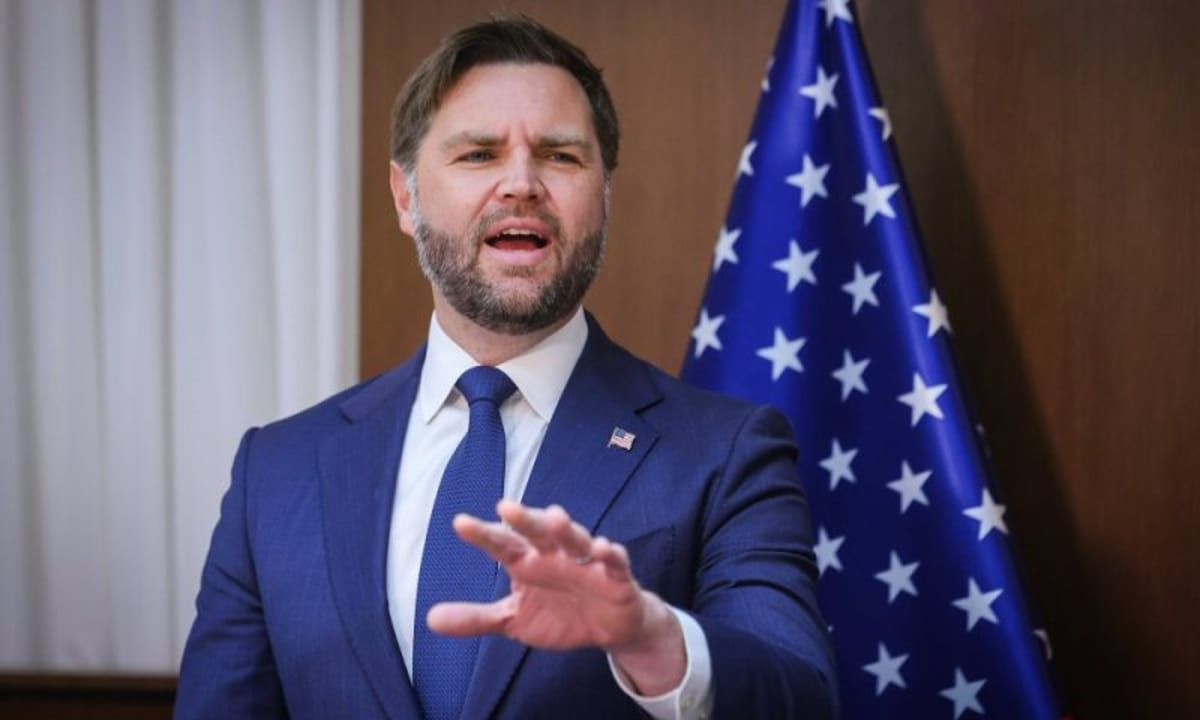
Vice President JD Vance sparked controversy in the Middle East with remarks distancing the U.S. from regime change in Iran, placing responsibility squarely on Iranian citizens despite widespread government crackdowns on protesters.
Asked about American aspirations regarding Iran and whether he would like to see the fall of the ayatollah regime, Vance deflected the question and avoided taking responsibility for the issue.
"If that's what the Iranian people want to do, overthrow the regime, then they should act on it," Vance said coolly, adding that the U.S. position "is focused on ensuring Iran does not have nuclear weapons."
The vice president's comments drew sharp criticism, particularly given President Trump's repeated declarations that "help is on the way" and his calls for protesters to continue demonstrating against the regime despite street violence.
Many are now accusing the administration of cynically exploiting tens of thousands of deaths to advance a narrow policy agenda with little connection to the freedom of Iranian citizens.
Vance, known as one of the most influential isolationist voices in the administration, reportedly opposed previous military action against Iran. He views isolationism and withdrawal from conflict zones as core American objectives, even when it comes at the cost of abandoning allies.
The shift in rhetoric represents a notable departure from earlier administration messaging and has raised questions about U.S. commitment to supporting democratic movements in the region.
But JD isn't completely wrong. Here's why:
Regime changes, including revolutions, are often driven primarily by internal forces, citizens, dissidents, and opposition groups within the country. For example, the 1979 Iranian Revolution that established the current Islamic Republic was led by Iranians themselves, fueled by widespread domestic discontent with the Shah's rule, economic issues, and religious leadership under Ayatollah Khomeini. External influences (like U.S. support for the Shah) played a role but weren't the decisive factor; it was mass protests and strikes by Iranians that toppled the monarchy.
Similarly, current protests in Iran (which have intensified since late 2025 over economic hardships, political repression, and calls for a transition of power) are homegrown, with slogans like "Death to Khamenei" emerging from neighborhoods in Tehran and other cities.
The practical reality is that overthrowing a deeply entrenched regime like Iran's, with its powerful security apparatus (e.g., the IRGC), requires significant internal mobilization. External intervention alone rarely succeeds without broad domestic support, history shows failures like the U.S.-backed attempts in Iraq or Libya leading to chaos rather than stable change. Vance's point aligns with this: Sustainable change must come from the people affected.
The issue is that although change has to come from within Iran, it truly seems that under the iron-clad grip of the ayatollahs, they stand no chance without external help. And that's where things get tricky.
But Israel, the U.S. and Iran all believe the current talks have slim to zero chances of success, so 'Help is on the way' may prove true in the end.