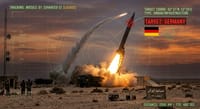

Senior Israeli defense officials assess that a direct military confrontation with Iran is unavoidable, as Tehran accelerates its ballistic missile production at an alarming rate. According to a detailed Ynet report citing IDF sources, Iran is on track to possess at least 5,000 ballistic missiles by the end of 2027, with current production standing at approximately 100 missiles per month, and expected to rise further.
The assessment, shared in closed-door discussions with American counterparts, highlights Iran's strategy of relying on sheer volume to overwhelm defenses. Israeli officials warn that even Israel's advanced multi-layered air defense systems, including Arrow 3, David's Sling, Iron Dome, and potentially allied assets like U.S. THAAD and Patriot batteries, lack a fully hermetic solution against prolonged, large-scale missile barrages numbering in the thousands.
The projection is not theoretical: it serves as a daily operational baseline for Military Intelligence, the Israeli Air Force, and air defense units. Without the aggressive disruption operations conducted during Operation Rising Lion (the June 2025 12-day war with Iran), Israeli sources estimate Iran's arsenal could have approached 8,000 missiles by the end of the decade.
During that conflict, Iran launched over 500 ballistic missiles and around 1,000 drones toward Israel. While approximately 86% of the ballistic missiles were intercepted, the handful that penetrated caused severe damage in cities including Tel Aviv, Ramat Gan, Bat Yam, Haifa, and Beersheba (including strikes near Soroka Medical Center).
Post-war intelligence indicates Iran has rebuilt much of its production infrastructure, including underground facilities and solid-fuel mixing capabilities damaged in prior Israeli strikes, and resumed large-scale output. Tehran is banking on quantity: saturating Israeli skies to the point where even high interception rates leave unacceptable levels of damage to the home front.
Israeli defense planners emphasize that the primary objective now is to slow or halt Iran's missile race before the numbers become irreversible. "There is no airtight answer to a scenario of thousands of missiles," one senior source told Ynet.
Options under discussion include continued preemptive strikes on production sites, launchers, and storage facilities, potentially with or without full U.S. coordination, as well as bolstering active defenses and passive civil protection measures.
Before the 2025 war, estimates placed Iran's ballistic missile inventory at around 2,500–3,000. The conflict saw Israel destroy roughly one-third to one-half of launchers and a significant portion of stocks, reducing Iran's effective arsenal to an estimated 1,000–1,200 missiles and only about 100 serviceable mobile launchers by early 2026. Yet Tehran has demonstrated rapid recovery, resuming production despite renewed sanctions and ongoing Israeli pressure.
Experts warn that Iran's underground "cities" for missile production and storage, combined with improving solid-fuel technology (enabling quicker launches and harder detection), make the threat exponentially more severe with each passing month.
As one defense official put it: "Iran knows that quantity has a quality of its own. If they reach 5,000, or more, the rules of the game in the region change fundamentally."