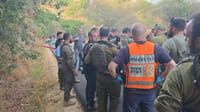
A 14-year-old boy from the ORT Ma'alot yeshiva high school was killed and 24 other people were wounded on Monday afternoon. Unexploded ordnance detonated during a school hike on the Ramim Ridge in the Upper Galilee.
Education Minister Yoav Kisch ordered a 48-hour suspension of school trips in the northern border area and the Golan Heights. Outings already scheduled for those regions will be redirected to alternative routes. All student camps in the north have also been canceled for the next two days.
Ynet reported that the students were on the first day of their school's annual trek along the Israel National Trail. The outlet said the blast struck near Mitzpe Pe'er, close to the Lebanese border, in an area that had previously been used as a staging ground for Israeli forces and had also been hit by Hezbollah fire.
Accounts of what happened before the explosion differ. Yeshiva World News cited preliminary findings that one student found the munition, took a photo of himself holding it and sent the picture to his family. Six other students then handed it around and were photographed with it. Investigators believe he put the device in his backpack and tossed the bag toward a spot where teachers and students were sitting. The impact apparently set off the blast. The boy who was killed had been seated near where the bag came down. Police were also examining whether the device went off inside a student's bag while he stood beside his classmates. Investigators have not established what triggered the detonation.
Arutz Sheva reported a third version. Eitan Masauri is a 14-year-old who was struck by shrapnel in the neck. He told Prime Minister Benjamin Netanyahu, who visited Rambam Hospital in Haifa, that the student who found the munition had been playing with it and unscrewed part of it before it blew up.
"Guys were thrown through the air, some fell into the bushes. There were two seconds of shock," Masauri said. "I realized I was injured. I saw that a friend was hurt, and I tried to help him."
The reports also disagree on the severity of the injuries. Magen David Adom, Israel's national emergency medical service, confirmed that 24 people were hurt. By its count, two teenagers were seriously injured, ten people were moderately injured and twelve were lightly hurt. Ynet put the figure at three seriously injured and one moderately injured. Rabbi Yaakov Weitzman, who accompanied the students, was among the wounded. Some of the injured suffered shrapnel wounds to the head and limbs and required emergency surgery. They were taken to Ziv Medical Center in Safed, the Galilee Medical Center in Nahariya and Rambam. Some students applied tourniquets to their classmates before medics arrived.
MDA logged the first call at 2:53 p.m. Fourteen ambulances were sent to the scene. The IDF dispatched three Air Force helicopters, its Unit 669 search-and-rescue force and bomb disposal experts from the Yahalom combat engineering unit. "This is a complex incident," said Itzik Shoshan, head of MDA's Yarden region.
Kiryat Shmona police station commander Elad Ben Lulu said the device was "probably small, but there's no way to know yet." Police warned anyone who encounters unexploded ordnance to keep their distance and call the 100 emergency hotline.
The IDF is still working to determine whether the device was a cluster munition or another type of explosive. It is also examining whether Israeli forces left it behind or Hezbollah fired it, and whether the trip had authorization to enter the area. Kisch said a preliminary examination found that the trip had been approved and the route had been inspected. He added that the safety briefing had included a warning about unexploded ordnance. "This will probably be with us for a long time to come," he said. Israel Police Commissioner Danny Levy visited the scene. He said the outing appeared to have received the necessary approvals but cautioned that further precautions may be required.
After hearing the students' accounts, Netanyahu instructed the head of the IDF Home Front Command to strengthen public warnings about unexploded ordnance. He asked that the warnings stress the strict ban on touching such devices. He also asked that wide areas be searched for other munitions that could endanger civilians.