A newly developed artificial intelligence system may address one of the most formidable obstacles in producing energy through nuclear fusion: controlling superheated, unstable plasma that changes faster than human operators can respond.
Researchers at Princeton Plasma Physics Laboratory (PPPL) and Princeton University created a system called PACMAN that tracks conditions inside a fusion facility and makes decisions within milliseconds. The technology has undergone testing in five experiments at the DIII-D fusion facility in San Diego.
Nuclear fusion powers the sun and stars by combining light atomic nuclei to release enormous amounts of energy, the opposite of nuclear fission, which splits heavy atoms. If scientists can make this process efficient and continuous on Earth, it could eventually provide vast quantities of electricity.
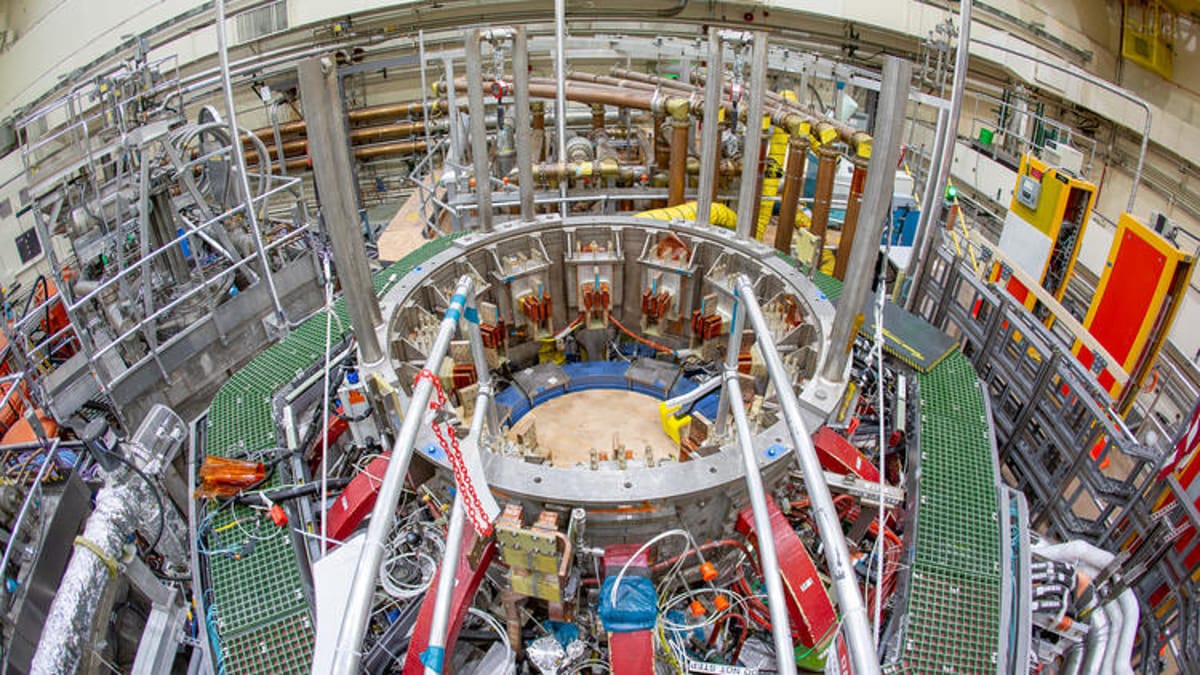
But achieving that goal presents extraordinary technical challenges. Tokamak-type facilities confine plasma at extremely high temperatures using powerful magnetic fields. Maintaining a stable reaction requires constant adjustments to heating systems, magnetic fields, and gas injection.
The problem is that some plasma changes occur within milliseconds.
According to the researchers, even a highly focused human operator can respond to changes within seconds, while PACMAN typically completes its control cycle in approximately 20 milliseconds and repeats it continuously throughout the experiment.
The system collects real-time data on temperature, plasma density, and magnetic signals. Machine learning models then analyze this information, assess what the plasma is doing and what it will likely do in the next moments, and transmit commands to the tokamak's various systems.
One experiment provided particularly significant results. The system successfully predicted a plasma disruption called "tearing mode" approximately 200 milliseconds before it appeared.
Conventional control systems can only detect such disruptions after they begin, then attempt to suppress them. In this case, the artificial intelligence enabled researchers to modify plasma conditions before the disruption developed, preventing it entirely.
In other experiments, PACMAN successfully controlled heating systems, predicted energy bursts at the plasma edge, identified and controlled waves generated by fast particles, and adjusted plasma density and rotation speed to targets set by researchers.
In one demonstration, the system simultaneously controlled all six gyrotrons at the DIII-D facility. These are systems that heat plasma using powerful microwave beams. The artificial intelligence adjusted both the systems' power levels and the direction of their mirrors in real time to achieve predetermined conditions.
Despite the extensive use of artificial intelligence, researchers emphasized that humans remain in control. PACMAN incorporates hardware safety limits, so even if one of the AI models suggests an impermissible action, the system should not transmit it to the facility.
Additionally, researchers set the experiment goals and control parameters, and after each experiment they examine the data and update the models.
PACMAN's significance extends beyond any single experiment. According to the research team, the system was designed modularly, allowing AI models to be replaced, new models added, or multiple models run simultaneously without rebuilding the entire control system.
Researchers hope the framework can eventually be adapted to other tokamaks, and possibly even to fusion facilities not yet constructed.