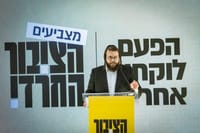
With days to go before Tuesday's election, the established Chareidi parties and their allied institutions are working to keep voters away from the Haredi Public party, the new list headed by Beit Shemesh Deputy Mayor Moti Leitner, through rabbinic directives, hostile media coverage and what supporters describe as social and economic pressure.
The effort comes even though the party polls at less than half a percent, according to an investigation published Thursday by the Shomrim center. Shomrim's report attributes the pressure to two concerns: that a protest vote among Chareidim, who are notoriously difficult to poll, could be larger than surveys show, and that even tens of thousands of votes below the electoral threshold would mark Chareidim who favor integration into Israeli society as a new political force.
Leitner founded the party in August 2026. His platform calls for protecting full-time Torah scholars from conscription while requiring Chareidi men who are not studying to perform military, civilian or national service, and for core curriculum studies in Haredi schools.
Notes Under Doors and Torn-Down Signs
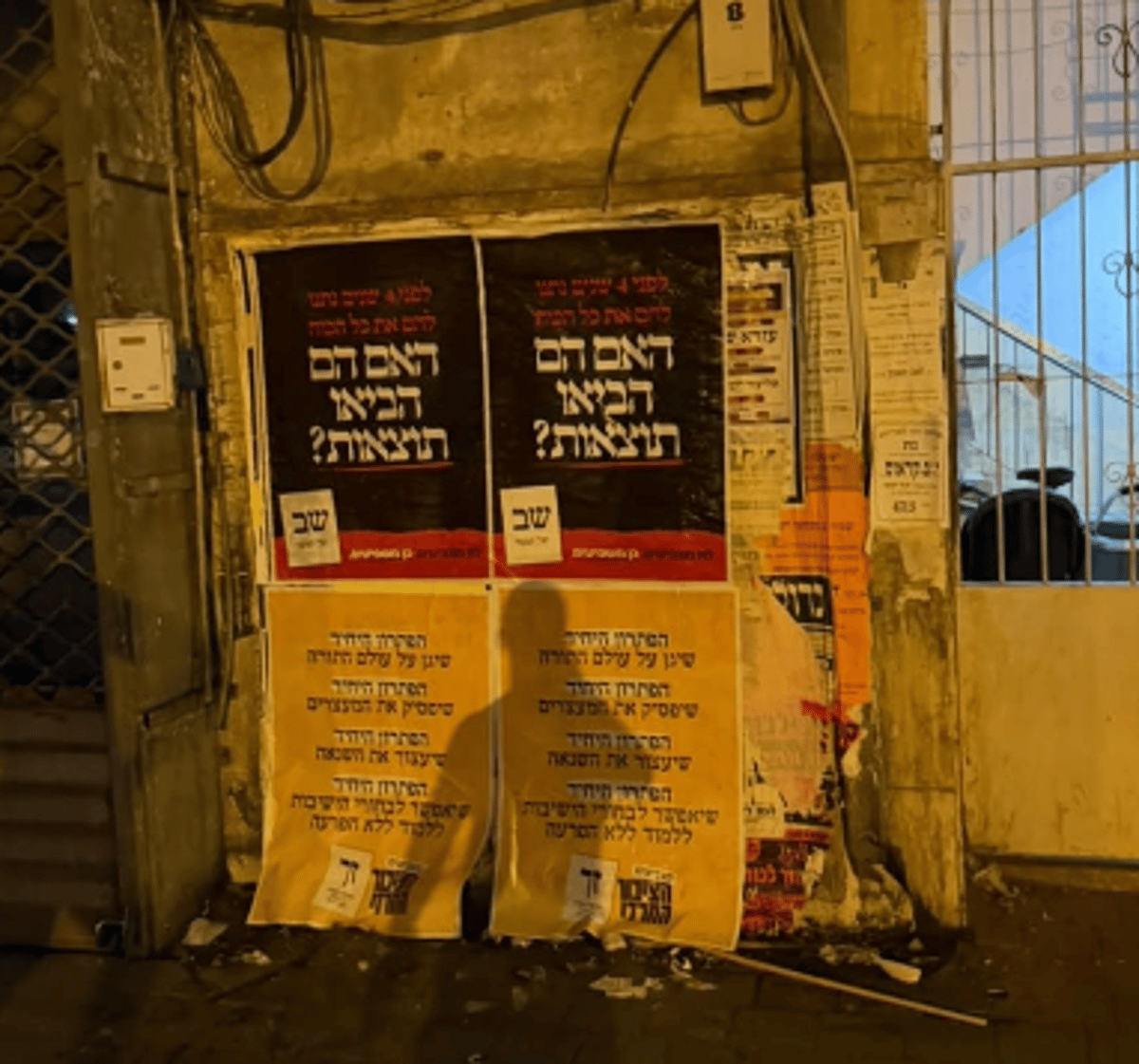
According to Shomrim, a Chareidi family that hung a sign supporting the party later found a note pushed under its door. "Posting a notice openly and declaring 'I do not listen to the Gedolei Hador and the luminaries of the generation' is brazenness and impudence," the note read. It was signed "residents of the city faithful to the Gedolei Hador." Shomrim noted that the message contained no explicit threat, but said its meaning was clear to the family.
Shiri Kroizer, a volunteer at the party's headquarters known in the Chareidi community for her activism against sexual abuse, told Shomrim that the party's signs do not survive the night in Chareidi neighborhoods. "Every sign hung in a Chareidi concentration is torn down by morning," she said, adding that volunteers who put them up in the middle of the night find no trace of them hours later.
Kroizer said fear of community reaction has made it difficult to recruit activists willing to be publicly identified with the party. She described a volunteer who teaches at a prestigious seminary and "trembles with fear" that her involvement will become known, and said some early volunteers dropped out. Teachers and kindergarten instructors who agreed to appear in party videos asked to have their faces blurred, she said. At the party's rally at Jerusalem's Binyanei HaUma last week, attendees "begged not to be photographed," according to Kroizer.
Avraham Yustman, who works in the field of Haredi employment, offered a blunt explanation in a public exchange on X when asked why he had not called on people to vote for Leitner. "And what will I do the day after? Will you hire me?" he replied, as cited by Shomrim.
Canceled Events
Channel 13 Haredi affairs correspondent Yoeli Brim aired a series of testimonies on Monday about pressure on party supporters. One music producer who attended a Leitner rally said his booking agent had been warned by Degel HaTorah figures. "My agent received a message from Degel HaTorah people that if they see my face next to him, they'll cancel my events," he said. "In practice, over Sukkos several events were already canceled."
Leitner himself told Kol Hai radio on Thursday that many voters are afraid to express support publicly because of social pressure and concern about repercussions in their children's schools and their workplaces.
A Confrontation on Haredi Radio
The party has struggled to reach voters through Chareidi media outlets, many of which are aligned with the established parties. Party sources told Shomrim that candidates have difficulty getting airtime and face hostility when they do. "The candidates who go on Haredi radio get hit hard," Kroizer said. "The shouting is real bullying. Humiliating interviews. And they don't get into any Chareidi newspaper."
The sharpest example came on Tuesday, when Leitner was interviewed on Kol Hai's morning program by hosts David Hakham and Betzalel Kahn. According to Kol Hai's sister site Emess, the hosts attacked the very fact of his candidacy, accusing him of undermining the authority of Torah sages and opening a front against the Haredi camp. "By what spiritual, moral or educational authority do you get up and decide that you know better than hundreds of thousands of Chareidim and all the Gedolei Hador?" they asked. Leitner responded that he operates with the backing of a rabbinic committee.
Dudi Maybsky, who wrote about the interview on Facebook, claimed the hosts did not let Leitner answer, shouted at him for five minutes straight and then took him off the air.
The following morning, the hosts devoted part of their program to the criticism. Hakham said he had received personal messages from young men who had considered supporting Leitner but changed their minds after hearing the interview. Kahn argued that modern Chareidim also regard rabbis as a binding authority.
The Seventh Eye media watchdog has reported that the Haredi party newspapers have largely ignored the Leitner story altogether.
Rabbinic Directives
Senior rabbis have issued sweeping calls to vote only for the established parties. None of the statements reported so far mention Leitner by name, and some were delivered primarily in response to the draft law controversy and the separate protest list Tzeva Shachor, but they are aimed at the same pool of disaffected voters.
Rabbi Moshe Hillel Hirsch, a leader of the Lithuanian yeshiva world, said in remarks reported by Ynet that "all those who are bitter, it is forbidden, forbidden, forbidden to go anywhere and vote for someone else." He added that every yeshiva student and every Haredi must vote for Degel HaTorah.
Rabbi Dov Landau, speaking at a rally in Ashdod this week, said voting for UTJ is "an inseparable part of the identity of every Haredi family," including those who work for a living. "Whoever votes for parties the sages are not pleased with, what will he answer his children?" he said.
Shas spiritual leader Rabbi Yitzhak Yosef warned on Kol Hai this week against abstaining and against supporting small lists.
UTJ Prepares a Negative Campaign
UTJ chairman Yaakov Asher told the party newspaper Yated Ne'eman last week that "they are trying to break apart the Haredi public from within, so that people will go waste their vote or stay home." In an earlier interview with Kikar HaShabbat, Asher said Leitner's party "won't hurt us, it will hurt them."
Journalist Michael Shemesh reported this week that the Chareidi parties, which had decided to ignore Leitner entirely, are now preparing a sharp negative campaign against him personally. According to Shemesh, the campaign will accuse Leitner of violating rabbinic guidance and throwing votes away.
Leitner: "They Stop at Nothing"
The campaign within the Chareidi community has run alongside a separate push by Prime Minister Benjamin Netanyahu and his allies to persuade Leitner to quit the race over concerns about wasted right-wing votes, including a late-night meeting with Netanyahu on Tuesday. Leitner said that effort failed because the Haredi parties refused to commit to supporting the reforms Netanyahu offered.
Announcing on Wednesday that he would stay in the race, Leitner accused the established parties of orchestrating the pressure. "The heads of UTJ and Shas and their emissaries are issuing serious threats against us. They stop at nothing," he said. "Powerful, well-oiled systems, a vast monopoly of corrupting power, have marked the heads of tens of thousands of Chareidim who support the Haredi Public movement. Despite their great power, they are afraid."
An influential Chareidi rabbi who sympathizes with the party but is not active in it told Shomrim on condition of anonymity that the gap between public silence and private sentiment could surprise observers. "It may be that they won't pass, as the polls show, but there's also a good chance they'll be the surprise of the election," he said. "A great many people are simply afraid to identify openly."