More than 14 years after landing on Mars, NASA's Curiosity rover continues to operate and explore the Red Planet. The veteran spacecraft has now reached a milestone: 5,000 Martian days, called "sols," since it began working on the surface.
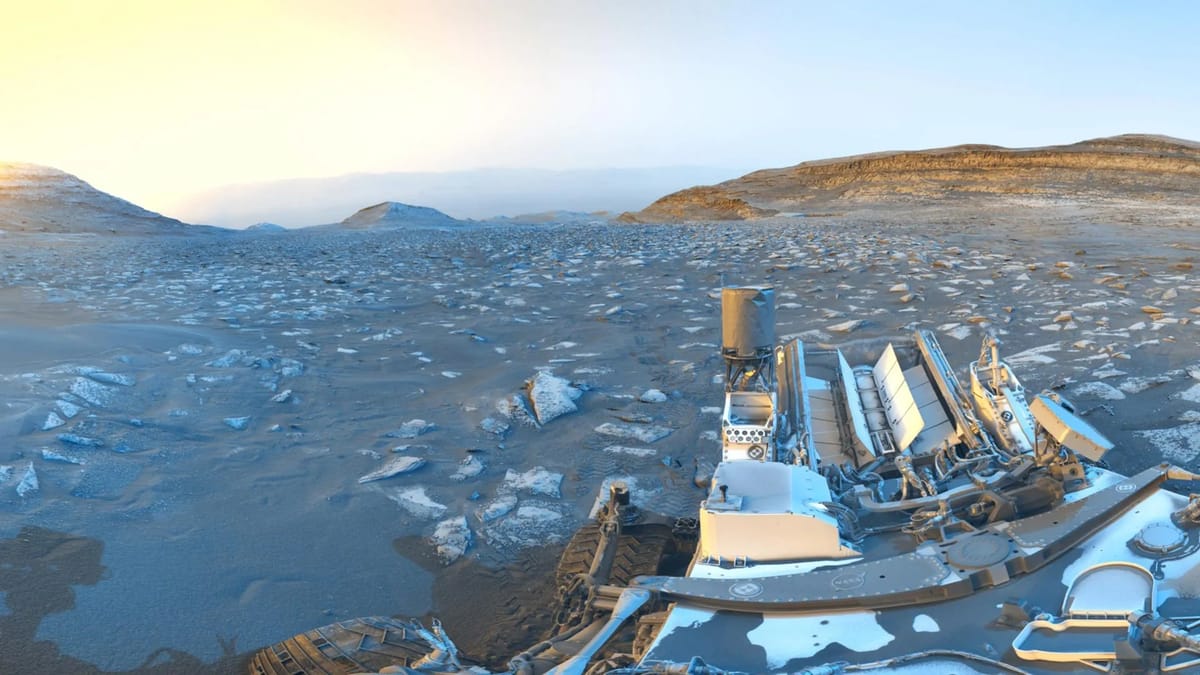
To mark the occasion, NASA released a striking postcard-like image created by combining two panoramas the rover captured in a sandy ridge area known as "Chocolatal." One photograph was taken in the morning hours and the other in the afternoon, and after reaching Earth they were merged into a single image.
Curiosity's cameras typically shoot in black and white, and NASA added color to the image artistically to distinguish between times of day. Portions photographed in the morning received a blue tint, while the afternoon shots were given a yellowish hue.
The image also shows parts of the rover itself, including the antenna used to transmit data to spacecraft orbiting Mars and its nuclear power source. Behind it, the tracks Curiosity left during its journey across the Martian surface are clearly visible.
The rover is currently on the lower slopes of Mount Sharp, which rises about five kilometers within Gale Crater. From the vantage point, one can look down toward the crater floor, while its far rim is barely visible on the horizon.
Curiosity landed on Mars in August 2012 and has since been studying the planet's geology and climate in an attempt to understand whether conditions suitable for microbial life existed there in the past.
NASA noted that the 5,000th Martian day arrived after more than 5,100 days on Earth, because a day on Mars is slightly longer than a day on Earth and lasts about 24 hours and 39 minutes.
Alongside the milestone, Curiosity continues its scientific work. In the area where the image was captured, it is examining sand ridges formed by wind activity, attempting to understand how they were created, whether they are still changing, and what they can teach about environmental conditions on Mars.