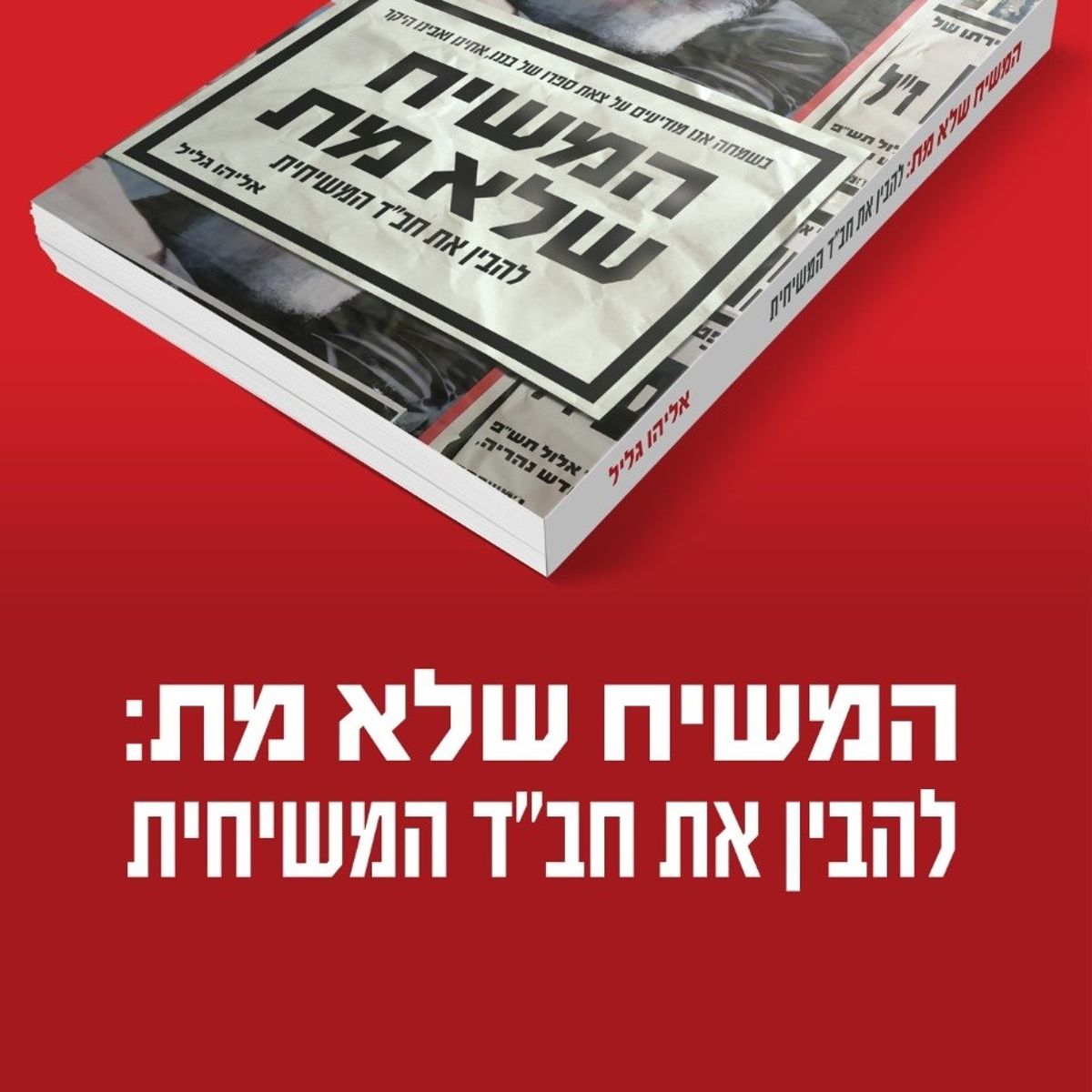
Eliyahu Galil has authored a superb volume. His work successfully makes complex Chabad theology accessible to the educated yet untrained reader while relying on serious research and illuminating footnotes. Galil delivers a decisive strike to the Chabad messianic narrative with great elegance. He utilizes the halakhic tests established by Maimonides to prove that the Rebbe did not meet traditional messianic expectations, all while providing an anthropological glimpse into the world of Chabad Hasidim from a vast array of backgrounds.
Galil deconstructs an extensive modern Jewish narrative into its realistic and classical halakhic components. Throughout the analysis, he raises fascinating hypotheses, such as his disagreement with Professor Israel Knohl, in which Galil argues that the Jewish concept of redemption was born as early as the Homash period. Alongside this, he offers an original analysis identifying the symbol of the State of Israel as a reflection of the Lubavitcher Rebbe complex relationship with Zionism.
And yet, Galil leaves his readers with a melancholy sense of missed opportunity, reminiscent of looking at stadium bleachers that have emptied at the end of a stormy sports season. The lights are out, the drama has subsided, and the spectator remains alone before the empty field, not knowing what the next day will bring.
After leading us safely through the book in clear and flowing prose and expertly dismantling the Chabad messianic structure, Galil leaves the Jewish reader facing a void where the question "What now?" echoes. Although in the final chapters he attempts to offer a glimpse into his personal messianic perception, it seems that at this stage he avoids developing it into an organized and cohesive doctrine laid out before us.
Furthermore, although Galil succeeds in the task of making Chabad theology accessible and proving the halakhic gap between the figure of the Rebbe and the Maimonidean test of messiahship, he refrains from providing the reader with a historical, sociological, or theological explanation for the phenomenon itself. He leaves unanswered the echoing question: why did so many within the Jewish people long, and still long, to believe in the most powerful messianic drama to visit our world since the 17th century?
While the author’s own redemptive messianic thesis still awaits development and deep study, it seems that regarding the historical framework, at least two essential contexts are missing to complete the picture:
- The Circumstantial Traumatic Context: Similar to previous messianic outbreaks in history, such as Bar Kochba after the Destruction or Sabbatai Zvi following the massacres of 1648 and 1649, Chabad messianism was also born from the ruins of the Holocaust. it served as a catastrophic response to an unprecedented historical rupture in the annals of Diaspora Jewry.
- The Hidden Layer (The Third Floor): Beyond the Torah genius of the Rebbe and the circumstances of the era, there seems to exist an additional layer maintaining the messianic system. This is the combination of internal sectarian theology and a well oiled organizational and economic mechanism among the Shluchim enterprise. This mechanism succeeds in keeping the messianic expectation alive and vibrant, even long after the immediate historical motives that gave birth to it have changed.
This is indeed the historical and theological breakthrough the reader expects. Although Galil reveals to us the Chabad secret doctrine and how it justifies the status of the Rebbe as the Prince of the Seventh Generation, and though he skillfully describes how the messianic tension was built alongside the massive outreach project, he avoids linking these moves to the macro questions of contemporary Judaism. The link between the activities of the court and the historical changes in Israel and the Diaspora is what prepared the ground not only for the growth of messianism within Chabad but also for its surprising acceptance among hundreds of thousands of Jews from the outside.
The broad review of the Chabad world, the testimonies of the Hasidim, and the fascinating anecdotes woven into the book lead the reader toward the presentation of two theological positions brought almost as axioms:
- The analysis rejecting the messiahship of the Rebbe based on the Laws of Kings by Maimonides.
- The historical and theological thesis of the author, which is an original and refreshing reading of the concepts of messianism and redemption.
Galil puts forward heavy arguments explaining why the Rebbe did not stand the Maimonidean test, and alongside them, he identifies the roots of messianism and the perception of the redeemer as early as the Five Books of Moses. However, at this point, the reader is required to adopt these determinations without the full rationale behind the exclusionary analysis being laid out, and without the messianic thesis of the author himself undergoing a process of validation against the extensive scholarly tradition on the subject.
It seems that these specific weaknesses are nothing but an invitation to a new creation. A work in which Galil will deeply explore the economic mechanisms, the historical background, and the psycho theological success of Chabad in the last generation; or alternatively, present in a sequel or an expanded edition his organized messianic doctrine and its connection to all branches of Jewish wisdom.
It is fitting that the author harnesses his sharp theological criticism of the non messiahship of the Rebbe in the light of Maimonides, together with his original analysis regarding the roots of the messianic concept in the Israeli religion, and uses them as a foundation for presenting an organized and positive doctrine of his own.
While Galil disagrees with researchers such as Knohl (who dates the idea of redemption to the 8th century BCE) or Kaufmann (who denies the existence of a human redeemer figure in the Bible), he must now deepen and establish the alternative thesis he proposes.
In a sequel or an expanded edition, Galil will have to answer several fundamental questions:
- What is the rationale at the base of his positions regarding Jewish Israeli messianism?
- How does this rationale redefine the understanding of the messianic phenomenon in Judaism as it has been known until now?
- And who are the thinkers within the world of Jewish thought, in the past or present, who stand in the closest ideological proximity to his perception?
The important book by Galil opens a window to a broad discussion worthy of continuation. It would be only right if in a future work the author would confront more directly and in detail the theses of many Chabad researchers mentioned in the book, whose full doctrine remained at this stage only as a background to the discussion without being fully revealed.