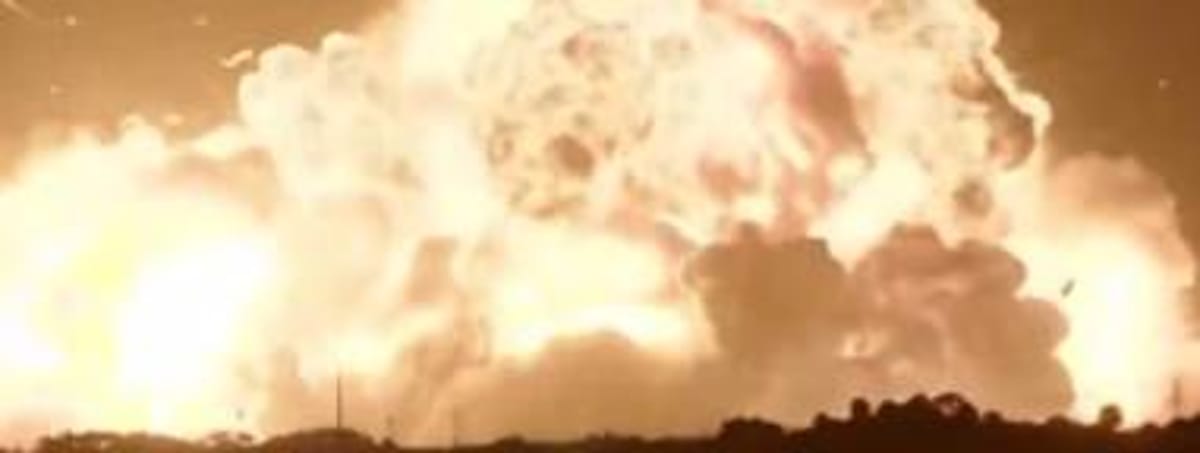
Blue Origin is facing a major setback after a New Glenn rocket booster exploded during an engine test at Cape Canaveral, badly damaging the company’s launch pad and threatening months of delays.
The incident occurred Thursday during a static fire test ahead of a planned New Glenn launch next week. According to company and industry sources cited by Reuters, the booster, named “No, It’s Necessary,” was destroyed in the explosion, while the launch pad was “practically destroyed.”
Engineers now expect the disruption to last at least six months, and possibly longer.
The timing is especially damaging for Jeff Bezos’s space ambitions. Blue Origin is trying to establish itself as a serious heavy-lift launch competitor to Elon Musk’s SpaceX, while Amazon is racing to deploy its LEO satellite internet constellation. That network is meant to compete with Musk’s Starlink, making the failure not only a technical blow, but a strategic one.
Blue Origin and Amazon had been counting on New Glenn to provide rapid launch capacity for Amazon’s more than 3,200 satellite broadband network. Amazon needs to deploy half the constellation by July 2026 to meet regulatory deadlines. A long delay could put that timeline under serious pressure.
The damage also strengthens SpaceX’s position in the commercial launch market. Amazon has already signed with additional launch providers, including SpaceX, to reduce dependence on Blue Origin. But that also gives Elon Musk leverage over Bezos at a sensitive moment in their long-running rivalry.
Musk responded publicly after the explosion, writing on X: “Sorry to see this, I hope you recover quickly.” He later replied to Bezos with the Latin phrase “Ad astra per aspera,” meaning “to the stars through hardship.”