Get our mobile app
Download on the App StoreGet it on Google Play

Shas's electoral challenge

Shas support drops sharply since 1992 peak

Analysis of voting patterns across Israeli cities reveals steep erosion in party strength, particularly in peripheral towns that once formed its electoral base, while haredi-majority areas show smaller but still significant declines

Emergency gathering of Shas council members and hundreds of yeshiva heads in support of the movement

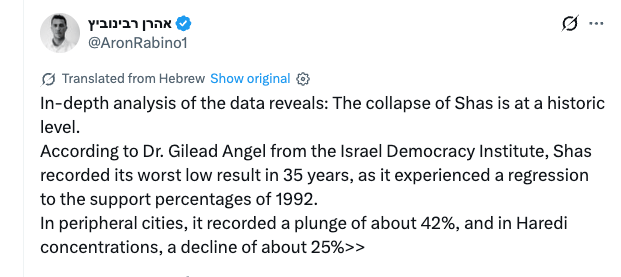
Shas suffered a sharp drop in support across Israel’s cities in Tuesday’s election, according to an analysis by Knesset correspondent Aharon Rabinowitz, who compared the party’s results with its peak more than three decades ago.

In a post on X, Rabinowitz wrote that Shas recorded its highest level of support in 1992 and has seen steady erosion in many cities since.

The losses were steepest in the periphery, where Shas built a lot of its electoral power. According to his figures, the party’s support fell by 48.5% in Dimona, 46.3% in Netivot, 45% in Ofakim, 42.1% in Sderot and 39.9% in Ashkelon. It dropped by 39% in Netanya, 37.2% in Ashdod and 29.6% in Holon.

In cities with large chareidi populations, the declines were smaller but still significant: 21.5% in Tzfat, 15.34% in Jerusalem and 9.1% in Tiberias.

The gap between the two groups of cities points to the scale of the challenge facing Shas. A party built on a broad base of Sephardi and traditional voters held up relatively well in chareidi areas, but lost ground precisely where it was once strongest.

Political observers attributed much of the decline to Netanyahu’s campaign to draw votes away from his coalition partners, as well as to some Shas voters moving to United Torah Judaism.


Ready for more?

Join our newsletter to receive updates on new articles and exclusive content.

We respect your privacy and will never share your information.

Enjoyed this article?

Yes
No
Follow Us:

Unmissable content


Loading comments...

Also of Interest