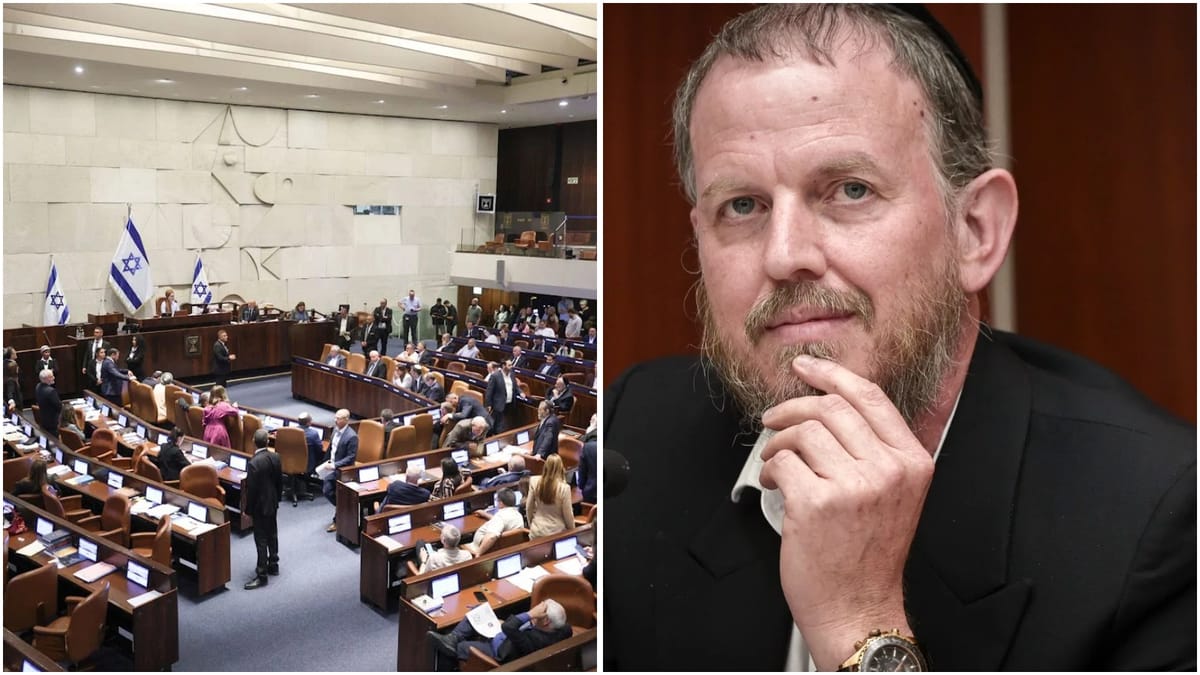
Once the votes are counted, Israel moves to one of the most technical stages of its electoral process: turning ballots into Knesset seats. The calculation is more involved than simply dividing the vote by a fixed number.
Israel uses the Bader-Ofer method, named for the two lawmakers who wrote it into law: Yochanan Bader of Gahal, then on the right of the political map, and Avraham Ofer of the ruling Alignment party. The formula accounts for each party's vote total, its leftover votes and the surplus-vote agreements parties sign with one another.
On Tuesday, attorney Avraham Yustman, who represents Agudas Yisrael on the Central Elections Committee, published a step-by-step breakdown of the calculation using figures from the October 27 election.
Setting the Price of a Seat
According to Yustman, the election produced 5,691,396 valid votes. The 306,584 votes cast for parties that failed to cross the electoral threshold are removed first, leaving 5,384,812 votes eligible for seat allocation.
That total is divided by 120 to produce the initial divisor, roughly 44,873 votes per seat.
Each party's vote total is then divided by that figure, and the party receives the whole number of seats the result allows. At this point, surplus agreements come into play: two parties that signed one are treated as a single unit when competing for the remaining seats.
Likud and Religious Zionism, for example, had a combined 1,458,137 votes, while Yahadus HaTorah and Shas had 612,163. Lists without surplus agreements compete on their own.
Bidding for the Last Seats
After the initial allocation, three seats remained. To assign them, the Bader-Ofer method divides each list's or pair's vote total by the number of seats it already holds plus one. The highest result wins the seat, and the calculation is rerun for the next one.
Yustman compares the process to an auction, with each list bidding the number of votes it can put toward an additional seat.
In the first round, Likud and Religious Zionism bid about 44,186 votes and won the 118th seat, bringing their combined total to 33. In the second, Yesh Atid and the Democrats led with about 44,135 votes and took the 119th seat. In the third, the Joint List and Ra'am bid about 44,124 votes and won the 120th and final seat.
Splitting Seats Between Partners
Once a pair's combined total is set, the seats still have to be divided between the two parties.
Yustman illustrated this with UTJ and Shas, which together won 13 seats. Their combined 612,163 votes divided by 13 gives an internal divisor of about 47,089 votes per seat.
UTJ received 312,630 votes and Shas received 299,533, which entitles each to six seats in the first stage and leaves one seat unassigned. The method then checks which party would present the higher divisor for a seventh seat. Yahadus HaTorah comes out ahead, so it finishes with seven seats and Shas with six.
Through that sequence of divisors, surplus agreements and internal splits, all 120 Knesset seats are allocated.