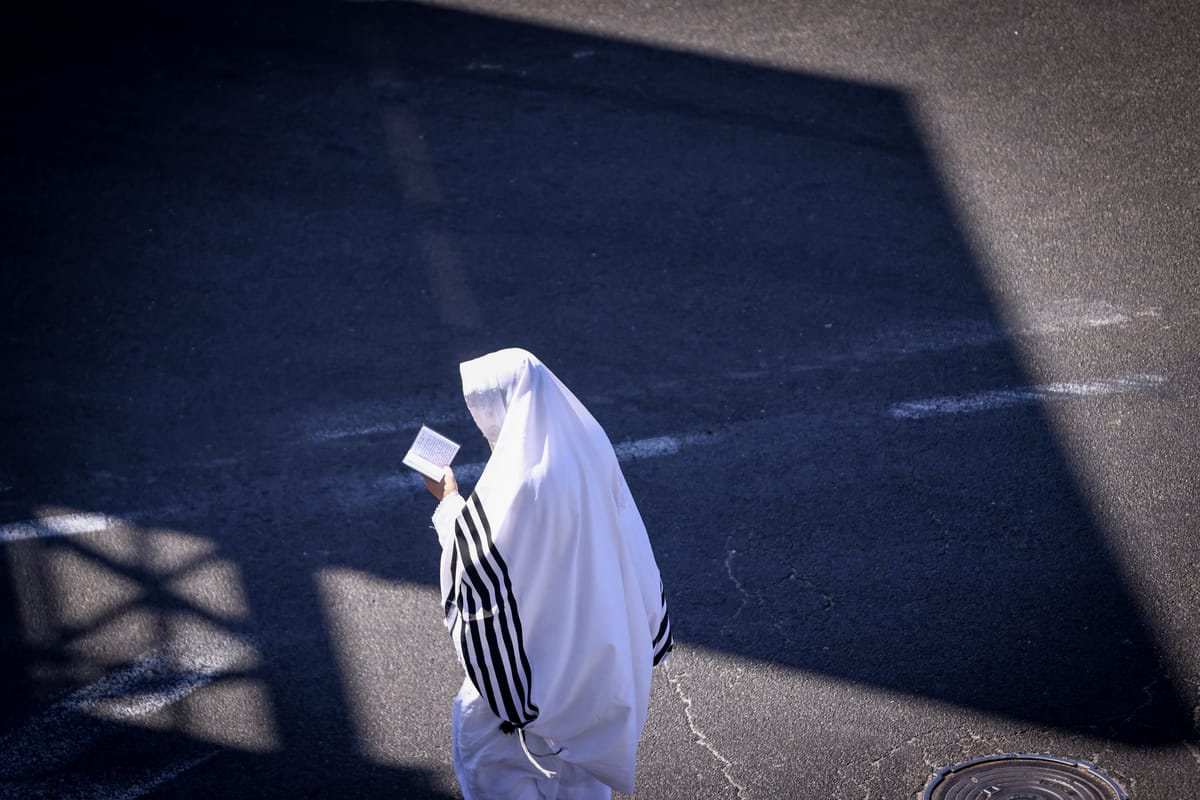
Before Yom Kippur, I met with a precious Jew. His gaze was heavy, saturated with deep sadness and the trail of an exhausting internal struggle. And this is what he told me, heart to heart:
"Rosh Hashanah still passes over me with some relative peace, but Yom Kippur? Yom Kippur is a powerful and destructive emotional trigger for me. The moment I reach the words of the Vidui, the 'Ashamnu Bagadnu' and the 'Al Chet Shechatanu,' something inside me collapses. I learned theoretically that Yom Kippur is like a pure shower, that confession is meant to cleanse us of all the dirt so we emerge pure and new like a bride and groom. But in practice? I simply can't implement it. I have terrible feelings of guilt that I'm not okay, that I'm simply not a good person."
In that moment, seeing him before me, I thought to myself about this incomprehensible gap: outwardly, on Yom Kippur, this Jew stands in the synagogue dressed in a white and pure kittel, appearing from the outside like a pure angel standing before the King. But beneath the white kittel, in the innermost chambers of his heart, he feels like a prisoner in a dungeon, beaten and absorbing endless guilt. This heartbreaking gap between the external garb of repentance and the internal devastation unfolding in the soul at those very moments is precisely what cries out for repair.
I looked into his deep, sad eyes and began to listen to what was hidden beneath the surface. Very quickly it became clear that in this Jew's heart operates an automatic and cruel system of constant self-accusation. A rigid internal voice whispering to him without pause that he is unworthy, that he is wrong, that nothing he does is enough, and that forgiveness will never come.
Over every small thing at work, over every passing friction with his wife, over every minor misunderstanding with his children, and even in his relationship with his Creator, the thick rod struck him mercilessly: you're not okay, you're not good, there's no forgiveness for this, what will become of you?
Living such a life is an unbearable struggle. Because when the critical voice rules the dome, even beautiful moments of good deeds are immediately distorted; that malicious voice will always arrive and find the flaw, the stain, and the hidden "not okay."
I told him one sentence that changed his perspective: "Know this, the problem isn't in the Yom Kippur prayer itself. The problem lies in the way you think and conduct yourself all six thousand moments of the year. And when Yom Kippur arrives, a day when we ask for forgiveness, a deep conditioning has formed in you: the words of prayer function for you like a threatening shofar shouting at you that you're guilty. This is the destructive power of psychological conditioning."
The roots were planted deep years earlier, in his yeshiva days. That educational supervisor who educated him in his way chose a critical, accusatory, and punishing method, one that doesn't know how to forgive. The young bachur internalized that voice and turned it into the sole manager of his soul.
Here I understood that we must give that voice a name and identity: that rigid supervisor from the past became in our adulthood a "false shofar" that completely distorts and falsifies the will of the Creator, blessed be He. This is a foreign voice disguised as fear of Heaven, but its entire purpose is to extinguish the Divine light pulsing in a person's heart.
I told him that the first step he must take even before going down to the synagogue: "He must learn to ask deep and genuine forgiveness from himself, from the inner child within him who absorbed all the criticism and guilt year after year."
I laid out before him the ten circles of self-forgiveness that his soul so desperately cries out for:
Forgiveness for accusing you of every small thing: for the fact that every time something didn't work out, I immediately pointed the accusing finger at you and made you the sole guilty party.
Forgiveness for seeking only the bad: for the fact that for years I looked at you with a cruel magnifying glass, searching only for flaws and weaknesses, and ignoring all the good and light within you.
Forgiveness for turning Yom Kippur into a trigger of fear: for the fact that I allowed the words of prayer to become a whip striking you, instead of seeing them as a pure shower of cleansing and genuine spiritual renewal.
Forgiveness for judging every quarrel with severity: for the fact that at every small friction, I rushed to strike myself and feel that I always ruin everything.
Forgiveness for being harsh only toward the children: for the fact that over every small challenge in raising the children I felt I was failing, and judged your parenting from a place of pressure and infinite criticism.
Forgiveness for adopting a foreign and harsh educational voice: for the fact that you allowed the supervisor from the past to continue striking you from within, without a drop of mercy or compassion.
Forgiveness for denying you forgiveness: for the fact that I convinced you that there is no forgiveness for your deeds and that you always remain "not good" and hopeless.
Forgiveness for afflicting you without cease: for the fact that I allowed the thick rod of self-criticism to strike your tender soul again and again, without giving you a moment of rest.
Forgiveness for not believing in you: for the fact that I robbed you of self-confidence and the knowledge that you want to do good, that you try and struggle honestly day by day.
Forgiveness for not embracing the inner child within me: for the fact that in the most painful moments, instead of extending a warm and caressing hand, I stood before you as a strict and closed judge.
True Religion Is Mercy, Not Guilt: The New Perspective on "Al Chet"
"Understand," I told him, "if you arrive at Yom Kippur this way, you'll arrive at it completely differently. The words of prayer will stop being a threatening tool. Think how tired your soul already is from these infinite sentences of criticism and accusation. This isn't Torah, this isn't religion, and this certainly isn't spirituality, G-d doesn't want this sadness and brokenness of yours!"
Many of us became confused and mistakenly thought that the more a person feels like nothing, more broken and more humiliated in his own eyes, it's a sign that he's a "true G-d-fearing person" or a "deep ba'al teshuvah." This must be said with the greatest courage: this is not fear of Heaven and not holiness, this is psychological abuse disguised as spirituality, and the Holy One, blessed be He, is repulsed by it and wants only the vitality of your heart and your joy.
Here we uncovered together the new and stirring meaning of the "Al Chet" moment. From now on, this list is not a legal indictment in which a person proves how bad he is; this is a moving declaration that your heart struggled, tried, was wounded and fell from an enormous desire to live correctly. Every confession is actually a fatherly embrace in which Hashem tells you: "I know how hard it is for you, I see all your small battles."
And another thing: a person must find within himself the points of light and good qualities. As is brought in the name of Rabbi Yerucham Leibovitz of Mir, "Woe to the person who doesn't recognize his soul's deficiencies, for he doesn't know what he must repair; but woe and alas to the person who doesn't recognize his virtues, for then he doesn't even recognize his tools of service." A person needs to get into his head and internalize how much light there is within him. The old story you tell yourself about being "not a good person and guilty" must change. True, it's difficult, because you've become accustomed for years to telling that same painful story, but you can choose differently.
Provisions for the road: the next time you feel the trigger coming and your heart begins to contract from guilt, don't panic. Stop for one moment, take a deep breath, and whisper to yourself: "Father, I am now releasing the grip on the threatening shofar. I choose to look at myself with good eyes, to give up the cruel criticism, and to grant my soul the embrace and forgiveness it has waited for so long."
The days passed, and Yom Kippur went by.