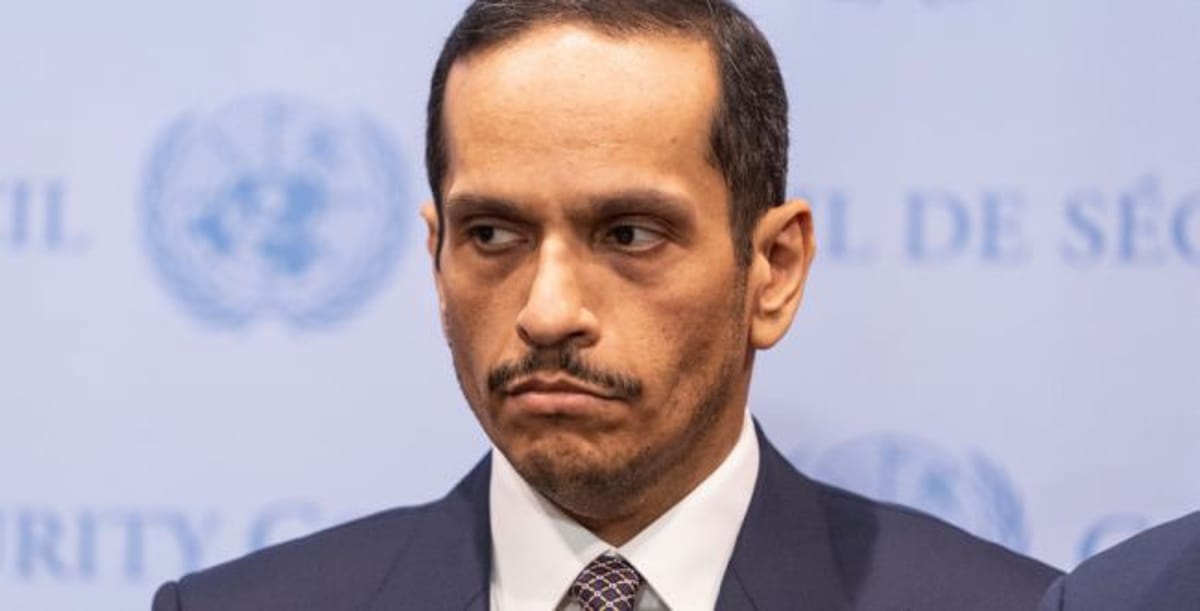
Qatar’s Prime Minister and Minister of Foreign Affairs, Mohammed bin Abdulrahman Al Thani, gave an interview to Al Jazeera today (Tuesday) regarding the peace framework proposed by U.S. President Donald Trump, clarifying that Qatar does not support the document as it currently stands. Al Thani stressed that the proposal is an "initial document" that requires "clarification" and further development, particularly concerning the issue of Israeli withdrawal from the Gaza Strip.
This statement effectively distances Qatar from the unconditional acceptance of the plan, opening the door for changes and renewed negotiations, a position that stands in direct opposition to President Trump's strong warnings.
Prime Minister Al Thani stated that Qatar and Egypt informed the Hamas terror organization during their meeting that "Our primary goal is to end the war. Hamas acted responsibly and promised us to examine the plan." He added, "Qatar is mainly focused on how to end the suffering of the Palestinians in Gaza, ending the war, the starvation, the killing, and the displacement."
He explained that "What was presented yesterday are the principles of the plan, which require discussion regarding its details and method of operation." Al Thani added that "the issue of withdrawal requires clarification and must be discussed," and that "the Palestinian administration of Gaza is mentioned in the plan, and the discussion about it will be conducted with Washington, and that does not concern Israel." He reiterated that the plan is still in its early stages and requires development, stressing that they are working to create a process that "preserves the rights of the Palestinians."
This stance creates a major hurdle, as President Trump has explicitly maintained that the framework is not open to significant changes. Speaking to reporters and later addressing soldiers, Trump issued a clear and repeated message: "Hamas has 3-4 days to respond to our proposal for an agreement." He clarified that if the terror organization rejects or fails to respond to the offer, "there is no more room for negotiation, Israel is authorized to do what is necessary." When asked by journalists if he would allow changes, Trump simply answered: "Not much." Trump’s position implies that the Hamas terror organization cannot resort to past tactics of conditional acceptance, but must accept the text as is.
Simultaneously, the Commander-in-Chief, Lieutenant General Eyal Zamir, conducted a tour in the southern Gaza Strip today. During his visit, Zamir issued a determined operational directive: "We will continue to maintain readiness and alertness, be prepared on the defense lines, and act offensively to achieve security and victory." He emphasized that the military would continue to excel and lead professionally to provide the political leadership with flexibility in managing the campaign. He reiterated the military's goals: "the return of the hostages, the defeat of Hamas, and increasing the damage to its capabilities."
The Commander-in-Chief's push for heightened military pressure is taking place precisely as the chief mediator attempts to renegotiate core elements of the proposed agreement, adding layers of complication to the high-stakes ultimatum period.