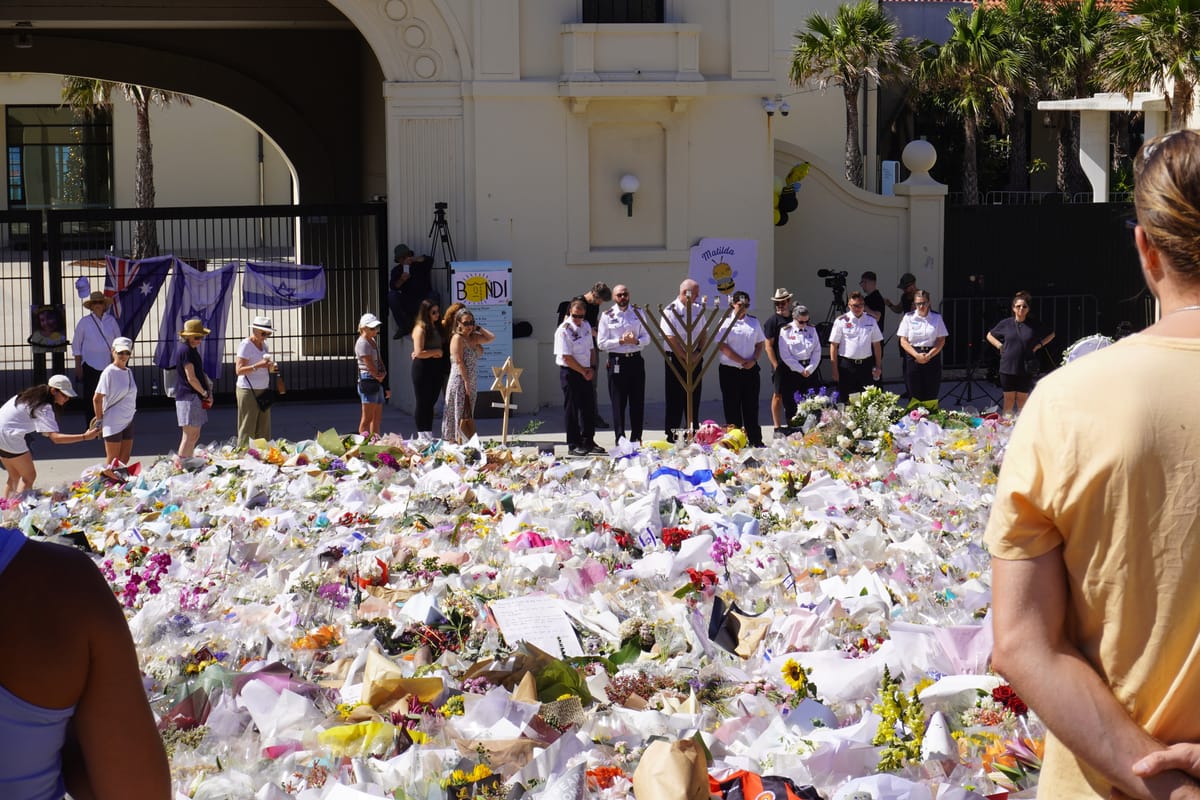
Australian Federal Police (AFP) Commissioner Krissy Barrett has defended her assertion that the deadly December 14 mass shooting at Bondi Beach, which claimed 15 lives during a Hanukkah celebration, was not driven by religious motives but rather by alignment with a terrorist organization.
The statement has drawn sharp criticism from commentators and security experts who argue it downplays the role of radical Islamist ideology in the attack, even as investigations reveal the perpetrators' ties to the Islamic State (ISIS).
The attack unfolded around 6:47 p.m. local time at Archer Park in Bondi Beach, targeting a "Chanukah by the Sea" event organized by Chabad for the Jewish community and attended by about 1,000 people. Father-son duo Sajid Akram, 50, and Naveed Akram, 24, allegedly threw four homemade bombs, none of which detonated, before opening fire with rifles and shotguns, firing approximately 83 rounds into the crowd.
Sajid was killed by police at the scene, while Naveed was critically injured and arrested. He faces 59 charges, including 15 counts of murder and committing a terrorist act, with a court date set for April 8, 2026.
The victims included a 10-year-old girl, Matilda, a Holocaust survivor, a rabbi, and several elderly attendees, highlighting the attack's targeting of the Jewish community on the first night of Hanukkah. Forty others were injured, with 11 still hospitalized as of December 26.
ISIS flags were found in the suspects' vehicle, and both had pledged allegiance to the group, with evidence of months-long planning, including firearms training and a trip to the Philippines.
In a December 16 press conference, Commissioner Barrett described the incident as "a terrorist attack inspired by Islamic State." However, she emphasized that the motivations stemmed from "the alleged actions of those who have aligned themselves to a terrorist organisation, not a religion."
Barrett later clarified that the perpetrators were "inspired by ISIS," an organization she said "distorts and corrupts Islam."
This framing aligns with broader Australian government efforts to separate terrorist acts from mainstream religious practices, but critics contend it obscures the ideological roots of the violence. Court documents released in the case reveal that Naveed Akram adhered to a "religiously motivated violent extremism ideology," including reciting Quranic passages and expressing religious views during the attack.
ISIS, which praised the shooting as a "source of pride" without claiming direct involvement, draws on a radical interpretation of Islam to justify its actions.
Analysts have linked the suspects to known radicals, including preacher Wissam Haddad and individuals previously convicted of ISIS-related offenses.
The commissioner's comments have sparked backlash, with some accusing authorities of "airbrushing" the religious dimensions of radical Islam to avoid offending communities.
In an op-ed for The Australian, columnist Gerard Henderson argued that such language represents "a growing effort to airbrush that as a religion, radical Islam threatens our way of life," potentially hindering effective counter-terrorism measures.
Jewish community leaders, including those from the Community Security Group NSW (CSG NSW), who had warned police of a high terror risk prior to the event, expressed frustration over what they see as minimized acknowledgment of antisemitism.
Prime Minister Anthony Albanese condemned the attack as "an act of pure evil, an act of antisemitism and terrorism," echoing international outrage from leaders like King Charles III and U.S. President Joe Biden.
The incident, Australia's deadliest terror attack and second-worst mass shooting after the 1996 Port Arthur massacre, has prompted calls for stricter gun laws, a national firearms register, and reforms to hate speech legislation.
Investigations, dubbed Operation Arques, continue to probe possible international links, including to Iran, amid revelations of bureaucratic delays in Sajid Akram's gun license processing.
Community heroes, such as Syrian-Australian Muslim Ahmed al-Ahmed, who disarmed one gunman despite being wounded, have been hailed for their bravery.
Barrett's office declined further comment, stating the investigation remains ongoing.