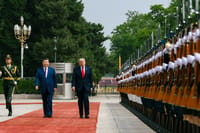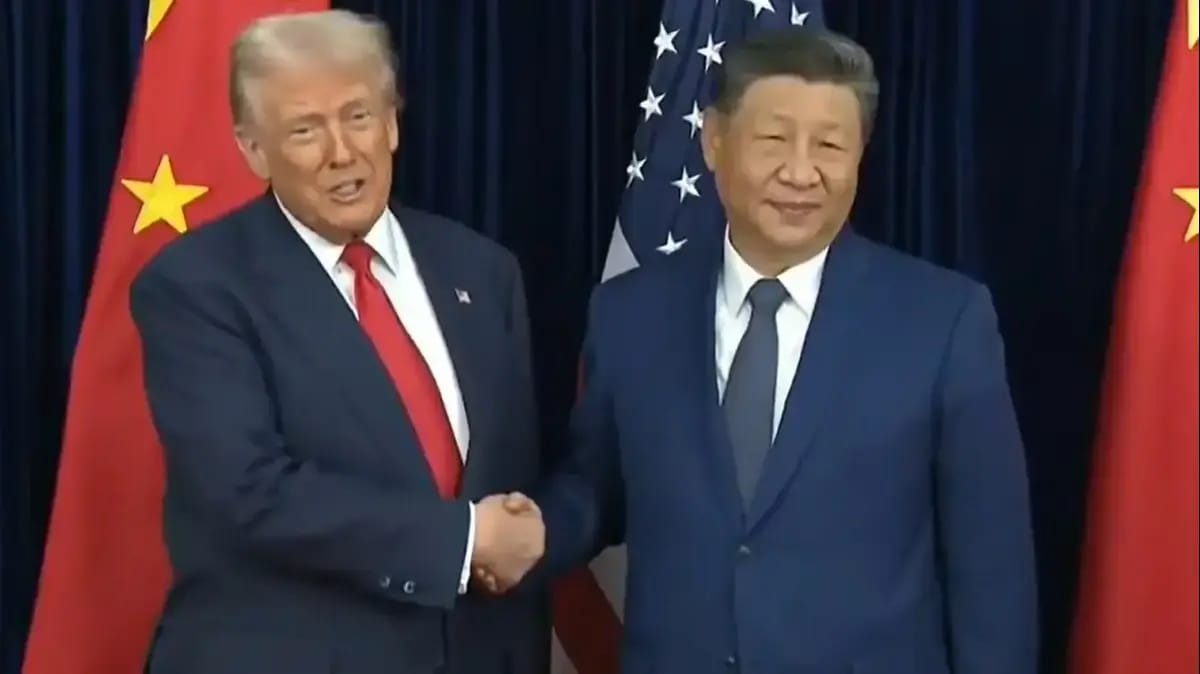
The atmosphere in Beijing is thick with tension as China issues a final warning to the United States regarding the military defense of Taiwan. Just hours before President Donald Trump is scheduled to land for a high-stakes summit with President Xi Jinping, the Chinese Foreign Ministry has reasserted its "rock-solid" determination to block any path toward Taiwanese independence. Beijing is demanding that Washington honor previous commitments and immediately cease all forms of military contact with the island, which China considers its own territory.
The primary point of contention is the massive flow of American weaponry to the island. In December, the Trump administration announced an $11 billion arms package, the largest in history, and rumors of a second $14 billion deal are already circulating. Zhang Han, a spokesperson for China's Taiwan Affairs Office, described the arms sales as "highly irresponsible" and a violation of international obligations. She emphasized that Taiwan is a "core interest" for Beijing and that any attempt to support its sovereignty would be met with an unyielding response.
Adding to the complexity of the situation is a recent political crisis within Taiwan itself. The island's parliament, currently controlled by the opposition, recently approved only two-thirds of a requested $40 billion special defense budget. Programs for the development of local drones were cut, a move that has reportedly disappointed senior U.S. officials. Beijing is expected to use this budget cut as a diplomatic lever, arguing to Trump that the Taiwanese people themselves are tired of spending billions on American weapons.
Taiwanese President Lai Ching-te has remained defiant, recently declaring that the island is a "sovereign and independent state" and a "beacon of democracy" that will not yield to pressure. In response, Chinese officials stated that Taiwan has never been and will never be a country, and they reiterated that while a "peaceful reunification" is the preferred outcome, China has never ruled out the use of force to bring the island under its control. The war of words highlights the narrow path that President Trump must walk during his visit.
A senior security official in Taipei warned that the biggest risk is that Beijing will convince Trump that supporting Taiwan is no longer a "good deal" for the U.S. economy. There are fears that Xi Jinping will present a narrative that the island's own parliament is against the arms sales, providing Trump with a face-saving reason to scale back security support in exchange for trade concessions. For Taiwan, the "One China" policy remains a constant threat that could be triggered by a single transaction in Beijing.
As the two world leaders prepare to meet, the fate of the Pacific hangs in the balance. The summit is expected to cover everything from trade to artificial intelligence, but the "red line" of Taiwan will be the most dangerous topic on the agenda. For the people of Taiwan, the next 48 hours will determine whether their primary ally will stand firm or if the island will become a bargaining chip in a much larger global game of power.