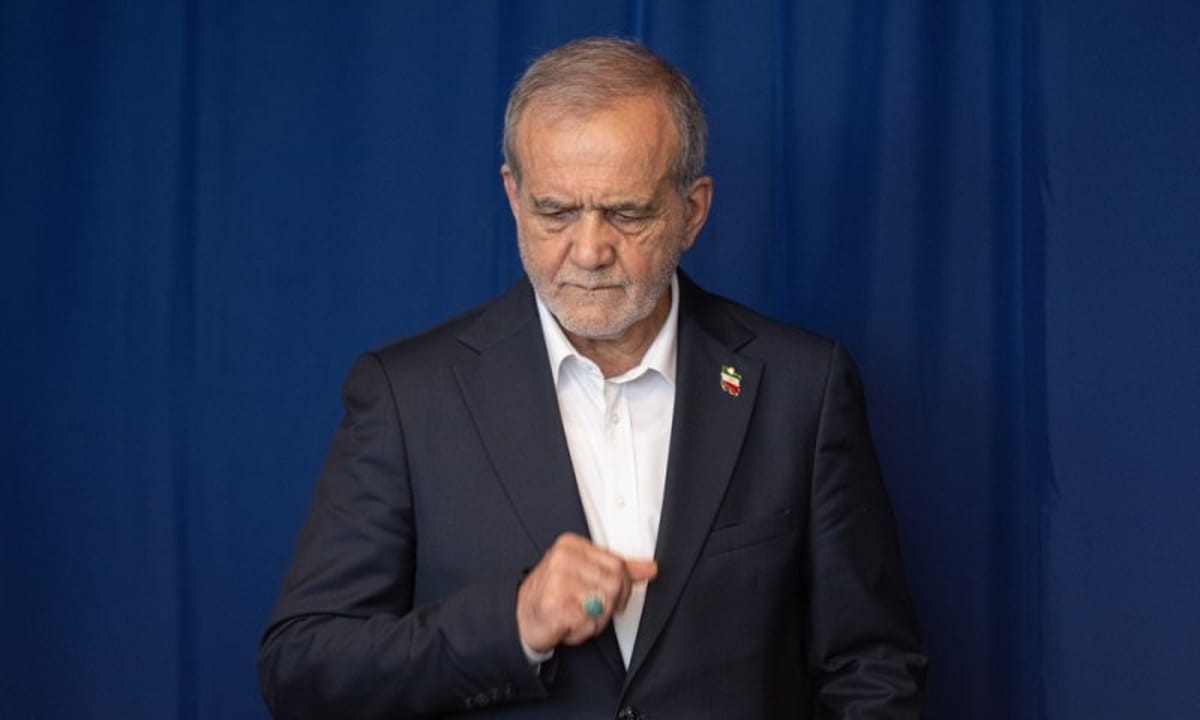
Iranian President Masoud Pezeshkian issued his first public response Sunday to a fresh round of American demands that have thrown a near-finalized US-Iran deal into uncertainty, acknowledging that the path forward is far from simple. "The pressures and challenges facing our society are not simple, and their solutions are not easy," Pezeshkian said, according to Iran's official Fars news agency — a muted but telling acknowledgment from a leader whose country has been at war with the United States and Israel for three months.
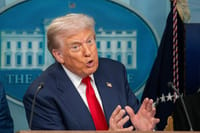
The remarks came after a dramatic 24 hours in Washington. On Friday, President Donald Trump convened a two-hour meeting in the White House Situation Room to review the draft memorandum of understanding that had been taking shape between the two sides through intermediaries — and emerged without announcing any decision. Earlier that morning, Trump had posted a list of non-negotiable conditions on Truth Social, declaring that Iran "must agree that they will never have a Nuclear Weapon or Bomb" and that the Strait of Hormuz must be "immediately open, no tolls, for unrestricted shipping traffic, in both directions."
"President Trump will only make a deal that is good for America and satisfies his red lines. He's not going to take a bad deal."
— White House official, Friday
What the deal looks like — and where it broke down
According to reporting by Axios and CNN, the draft MOU would open the Strait of Hormuz — closed by Iran since February, causing a global oil shock — in exchange for the US lifting its naval blockade. It would then trigger a 60-day negotiating window to address the fate of Iran's nuclear program, including its stockpile of approximately 2,000 kilograms of enriched uranium. A framework agreement was described by American officials as "95 percent complete" as recently as this week.
The sticking points are significant. Trump has demanded that Iran's highly enriched uranium — the roughly 450 kilograms enriched to near-weapons-grade, enough for an estimated 10 to 12 nuclear bombs if further processed — be destroyed, not merely stored or frozen. He stated Friday that the buried nuclear material would be "unearthed by the US, in close coordination and conjunction with the Islamic Republic of Iran, plus the IAEA, and DESTROYED." Iranian state media flatly denied that such a clause exists in the text of the agreement, with the Fars agency saying Trump's post "raised issues that contradict the provisions of the agreement's text" and describing his statement as "a mixture of truth and lies."
The Hormuz question is equally fraught. Treasury Secretary Scott Bessent said Thursday that "nothing is going to be on the table until we see the Strait of Hormuz open," while Iran has insisted it will reopen the waterway on its own terms and timetable — not Washington's — and has rejected any language barring it from collecting transit fees.
The nuclear puzzle
At the heart of the impasse is a fundamental contradiction: Iran's enriched uranium stockpile is now buried under the rubble of nuclear facilities struck by American and Israeli forces earlier in the war. US intelligence has assessed that the bombardment campaign failed to destroy Iran's nuclear capabilities. Extracting the material would require a joint engineering operation of enormous complexity — an undertaking Trump has compared to simply "digging it up," but which nuclear and logistics experts say would require months of work, specialist equipment, and international supervision.
Kazakhstan has signaled it is prepared to receive the uranium stockpile as part of any settlement, IAEA chief Rafael Grossi told the Financial Times — a potential off-ramp that could allow Iran to relinquish the material without appearing to surrender it directly to the United States. That option remains on the table but unconfirmed by Tehran.
Trump has shifted his public position on enrichment repeatedly. He once declared "WE WILL NOT ALLOW ANY ENRICHMENT OF URANIUM" in capital letters. Last month he said he would accept a 20-year moratorium if Iran gave a "real" guarantee — a notable softening. The draft agreement, per Axios, commits Iran to discussing a moratorium on enrichment but leaves the duration and terms to the 60-day negotiating period. How Iran is expected to "sell" that domestically, one US official told Axios, remains the central difficulty — a matter of "national pride considerations."
Where things stand today
American officials told reporters that Tehran would need "several days" to formally respond to the updated US demands. The talks continue, but no signing date has been set. Secretary of Defense Pete Hegseth, speaking after the Situation Room meeting broke without a decision, said the US military is "more than capable" of resuming strikes against Iran if negotiations collapse — a reminder that the ceasefire declared in April remains fragile and, in Lebanon at least, has already effectively broken down.
Secretary of State Marco Rubio reiterated Saturday that the administration's core objective is preventing Iran from ever obtaining a nuclear weapon — a goal Netanyahu publicly aligned himself with in a Saturday phone call with Trump, posting on X that "any final agreement must eliminate the nuclear danger" through the full dismantlement of enrichment sites and the removal of all enriched material from Iranian soil. Iran has consistently called its program peaceful and refused to agree to any deal that permanently ends enrichment as a matter of national sovereignty.
Context
The US-Israel war against Iran began on February 28, 2026. Iran responded by closing the Strait of Hormuz — through which roughly 20% of global oil passes — triggering an energy shock that has kept oil prices elevated for three months. The April 17 ceasefire was nominal from the start; the Lebanon front has escalated sharply this week as Israel captured Beaufort Castle and crossed the Litani River. Hundreds of British sailors are now preparing to deploy to the Strait to help clear mines once a deal is reached — though that moment remains elusive.