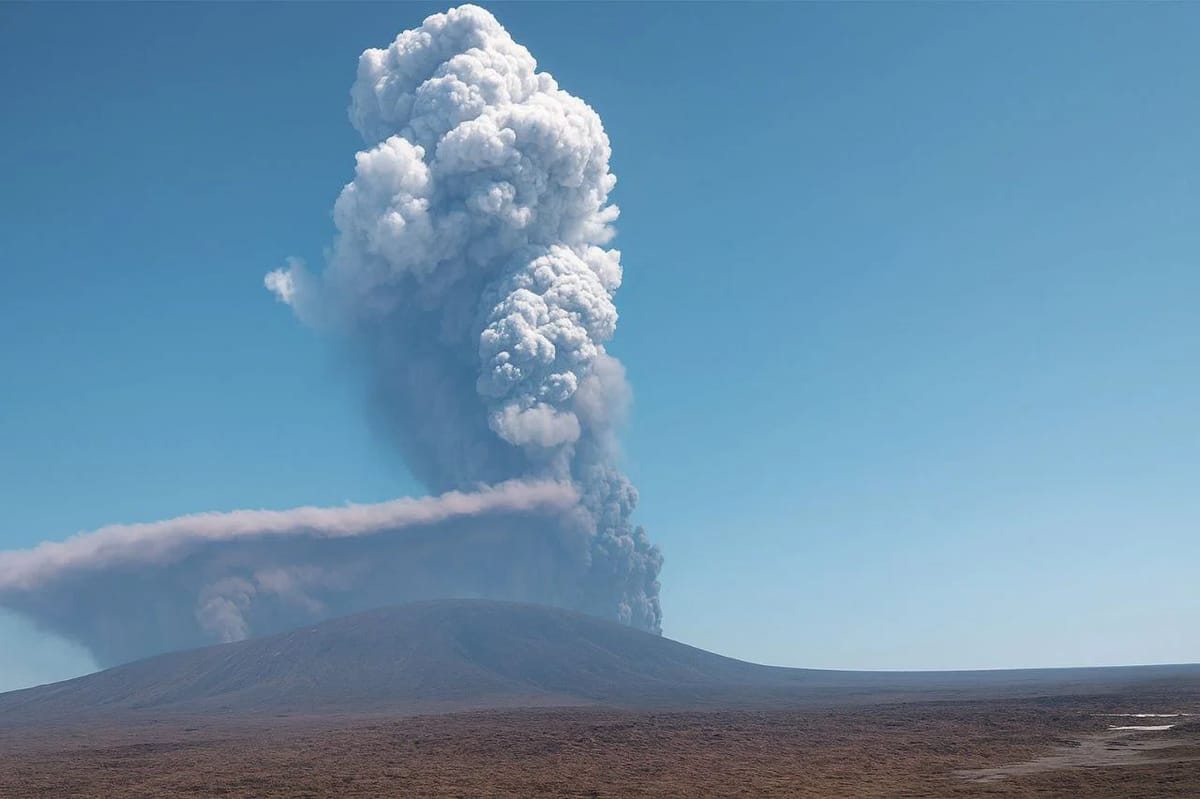
Mount Etna, one of Europe's most active volcanoes, erupted early Sunday morning in an unusually intense episode that shut down airspace over eastern Sicily and forced Catania's Fontanarossa Airport to sharply restrict incoming and outgoing traffic. Dozens of Israeli tourists were reported stranded as a result, after an Israir flight scheduled to land in Catania at 8 a.m. was cancelled due to the eruption.
According to Italy's National Institute of Geophysics and Volcanology, ash emissions began at around 5:45 a.m. UTC from the Voragine crater, sending a column of gas, volcanic ash, and rock several kilometers into the sky. Video circulating on social media showed tourists who had been hiking on the volcano's slopes rushing downhill to get away from the eruption zone. Italian authorities confirmed that everyone who had been on the mountain at the time was evacuated safely.
The ash cloud, roughly a kilometer and a half high, was carried by prevailing winds toward the south and south southeast, directly over Catania, forcing SAC, the company that manages Fontanarossa Airport, to close the affected airspace sector and limit landings to just five flights per hour into the evening. Authorities said ash is not expected to reach the city itself, and both Catania and Palermo airports remained operational, though a number of flights bound for Catania were diverted to Palermo, while others were delayed or cancelled outright. Roads leading up to the volcano were closed to keep visitors away from the eruption zone and allow emergency crews to work unimpeded.
The eruption also collided with a separate wave of aviation strikes already planned across Italy on the same day, involving ground handling staff, air traffic controllers in Milan, security personnel at Rome's Fiumicino and Ciampino airports, and easyJet cabin crew, compounding delays for travelers across the country.
Israir said in a statement that due to the extraordinary volcanic event near Mount Etna in Catania, Sicily, the airspace and airport were temporarily closed to incoming and outgoing flights. The airline said it was in constant contact with airport authorities and awaiting updated guidance as the situation develops. Israir added that it was prepared to resume flights to and from the destination and hoped to do so as early as overnight, conditions permitting, stressing that passenger and crew safety remains its top priority. The company said ongoing updates were being sent directly to passengers on the affected flights.
Etna has been in an active eruptive phase since late December, and volcanic ash disruptions at Catania are typically brief, lasting hours rather than days, given how accustomed the airport is to the volcano's frequent activity. The ground alert level remains at yellow, with no threat to nearby residential communities and no evacuation orders issued.