

Get our mobile app
Download on the App StoreGet it on Google Play

Welcome to First Grade

Syria textbooks teach jihad, IDF attacks

Under Ahmad al-Sharaa, Syrian schools drop Assad's pan-Arabism for Islamist curriculum: fourth-graders learn throwing stones at Israeli tanks earns salvation, eighth-graders study jihad against 'occupiers'

Syria's New Textbooks: Jihad, Throwing Stones at IDF tanks, and Prayers for Martyrs

A new report by the research institute IMPACT-se, published this week, reveals a sweeping ideological shift in Syria's textbooks under President Ahmad al-Sharaa.

The report, which examined 130 textbooks for grades one through twelve, found that the Arab nationalism that characterized Bashar al-Assad's regime is giving way to an Islamist worldview emphasizing jihad, martyrdom, and armed struggle.

Researchers analyzed textbooks for the 2025–2026 school year and compared them to editions from the Assad era. The findings show that alongside the removal of Assad's photographs, symbols of his rule, and slogans associated with him, content related to jihad and self-sacrifice not only remained in the books but in some cases received markedly stronger religious emphasis.
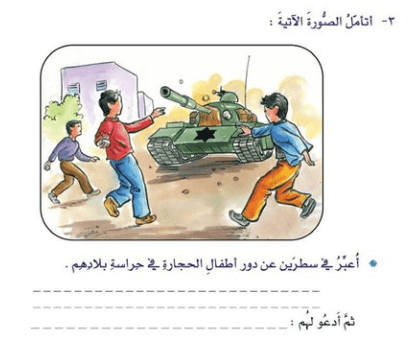
Facing a Jewish tank: Express in two lines the role of the "children of the stones" in defending their land/homeland. Follow-up section: Then I will pray/compose a prayer for them
Facing a Jewish tank: Express in two lines the role of the "children of the stones" in defending their land/homeland. Follow-up section: Then I will pray/compose a prayer for them (Photo: Social media)

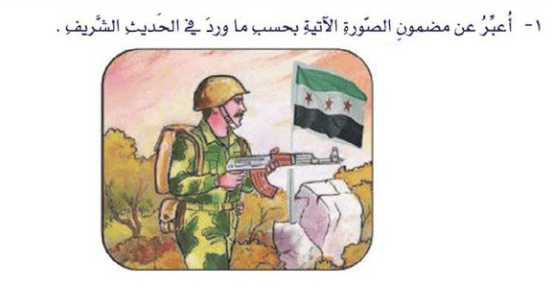
One of the most striking findings concerns fourth-grade students. In a lesson titled "Guarding for the Sake of Allah," children are taught that defending the homeland and holy sites is a way to be saved from the fires of hell. The text is accompanied by an illustration of a soldier carrying a rifle, standing beside the new Syrian flag.

Another illustration shows Palestinian children throwing stones at a tank bearing a Star of David. Students are asked to write how the "children of the stones" defend their land, and then to compose a prayer on their behalf.

Researchers also identified changes in language and messaging in higher grades. According to the report, an eighth-grade textbook replaced phrasing about contributing to "Palestinian resistance" with references to jihad fighters struggling in occupied Islamic countries against enemies of the Islamic nation.

The shift extends beyond military terminology. According to the research findings, the textbooks place far greater weight on belonging to the broader Muslim community, known as the "ummah," at the expense of Syrian national identity and pan-Arab nationalism. Even in lower grades, content emphasizing the Quran and the importance of martyrs now appears.

Exercise from a Syrian textbook for lower grades, in which an image of an armed soldier alongside the Syrian flag is used to teach religious traditions (hadith) dealing with guarding, sacrifice and jihad
Exercise from a Syrian textbook for lower grades, in which an image of an armed soldier alongside the Syrian flag is used to teach religious traditions (hadith) dealing with guarding, sacrifice and jihad (Photo: Social media)

The report also points to additional changes in the curriculum, including reduced content relating to religious and ethnic minorities, altered treatment of women, and removal of some scientific content.

Regarding relations with Israel, the research found that the books continue to justify violent struggle against it.

The research is published against the backdrop of Syria's change in government, after Bashar al-Assad's regime was toppled in December 2024 following a rebel offensive led by the formerly designated terrorist organization Hayat Tahrir al-Sham, which al-Sharaa headed. Now, according to the report, the changes in textbooks indicate that the replacement of the regime is accompanied by a reshaping of the ideological messages being transmitted to the younger generation.

IMPACT-se researchers warn that instead of a clear transition to a curriculum emphasizing tolerance, equality, and coexistence, the findings point to the replacement of some messages that characterized the Assad regime with a more extreme religious and nationalist worldview.

Ready for more?

Join our newsletter to receive updates on new articles and exclusive content.

We respect your privacy and will never share your information.

Enjoyed this article?

Yes
No
Follow Us:

Unmissable content


Loading comments...

Also of Interest