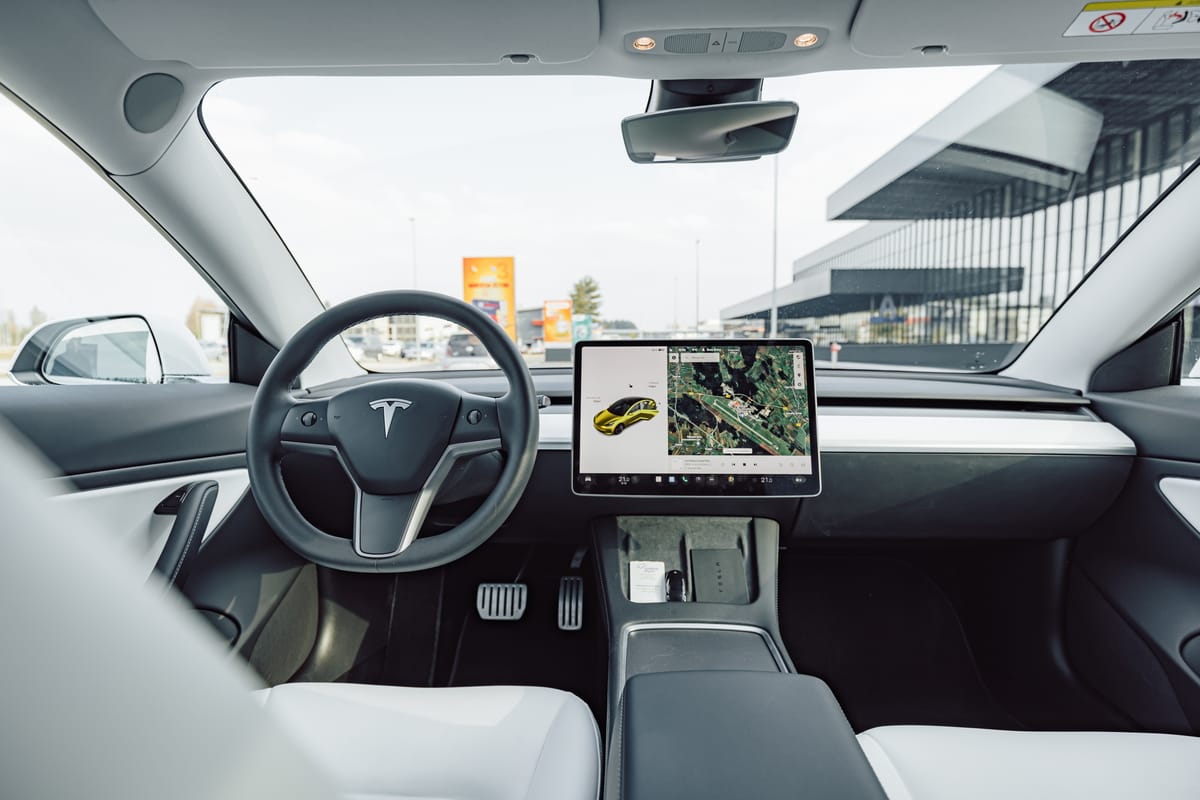
Tesla has begun distributing its summer software update, version 2026.26.6.5, featuring FSD (Supervised) v14.3.8, the latest iteration of the company's advanced driver assistance system. The rollout includes improvements to the artificial intelligence networks that operate the vehicle, expanded capabilities for the Grok voice assistant, and new features for cars equipped with the older Hardware 3 platform.
According to Tesla, one of the central developments in FSD v14.3.8 is a software enhancement that reduces the system's response times by approximately 20 percent. This improvement aims to enable vehicles to react more quickly to changing road conditions. FSD, or Full Self-Driving, is Tesla's brand name for its supervised autonomous driving technology, which requires constant driver attention despite its advanced capabilities.
Enhanced Performance in Edge Cases and Complex Visibility
The update also improves the training phase through reinforcement learning and upgrades the neural network's vision encoder, the component responsible for interpreting information received from the vehicle's cameras. Tesla notes that the enhancement is designed to improve system behavior in rare scenarios, limited visibility conditions, and recognition of a broader range of traffic signs.
Among other improvements, FSD v14.3.8 is expected to handle emergency vehicles, school buses, small animals, and objects protruding into the travel lane more effectively. These enhancements are based on complex examples collected from data across Tesla's vehicle fleet.
Another key element of the update is the unification of the driving model: a single artificial intelligence model now powers FSD, Actually Smart Summon, the vehicle's smart summoning capability, and robotaxi services. (None of these features are currently available in Israel.) Tesla estimates that using a unified model will help produce more consistent, reliable, and mature behavior across different use modes.
It's important to emphasize that FSD is still defined as a supervised driving system. The driver is required to remain alert, maintain full responsibility for the journey, and be prepared to intervene at any moment.
Grok Moves from Conversation to Vehicle Control
The summer update expands the role of Grok, the voice assistant from xAI. In Tesla vehicles equipped with AMD computers, users can now employ Grok not only for conversation or general queries but also to activate vehicle functions through voice commands.
Users can ask the assistant to make phone calls, play music, adjust climate control settings, or search options in the Controls screen. Grok can be activated using the command "Hey Grok" or by pressing and holding the voice command button on the steering wheel.
Tesla states that conversations with Grok are saved anonymously and are not linked to specific vehicles. The expanded capabilities position the voice assistant as a more significant part of the driving interface, bringing the in-car experience closer to more natural voice-based operation.
Hardware 3 Vehicles Also Included
Simultaneously, Tesla has begun distributing FSD v14.1 Lite to vehicles with Hardware 3, primarily Model 3 vehicles from model years 2019–2023 and Model Y vehicles from model years 2020–2023, as part of firmware 2026.21.6. This is a version that attempts to bring some of the improvements developed for HW4 to the older hardware generation, including capabilities derived from the company's reinforcement learning processes.
Among the additions for HW3: the ability to activate FSD from park mode, parking and unparking capabilities, destination arrival mode selection, and a new speed profile called SLOTH. At this stage, distribution is limited to early access vehicles, allowing the company to monitor system performance under real-world conditions before broader rollout.
Europe Crosses 100 Million Kilometers
In the European arena, Tesla reports that vehicles equipped with FSD have traveled more than 100 million kilometers in the five countries where the system has been approved for use. According to the data, this represents a doubling of travel volume since mid-July, when the company stood at approximately 50 million kilometers.
The figure highlights the pace of FSD activity expansion in Europe since Tesla received its first type approval in the Netherlands in April 2026. For the company, the summer update is not just a routine software upgrade: it connects improved driving performance, expanded artificial intelligence interface, and continued support for older hardware models, moving toward a vehicle experience increasingly based on software.
Some of the upgrades are not currently available in Israel, such as autonomous driving and Grok, and may arrive later after bureaucratic procedures concerning them are resolved.