
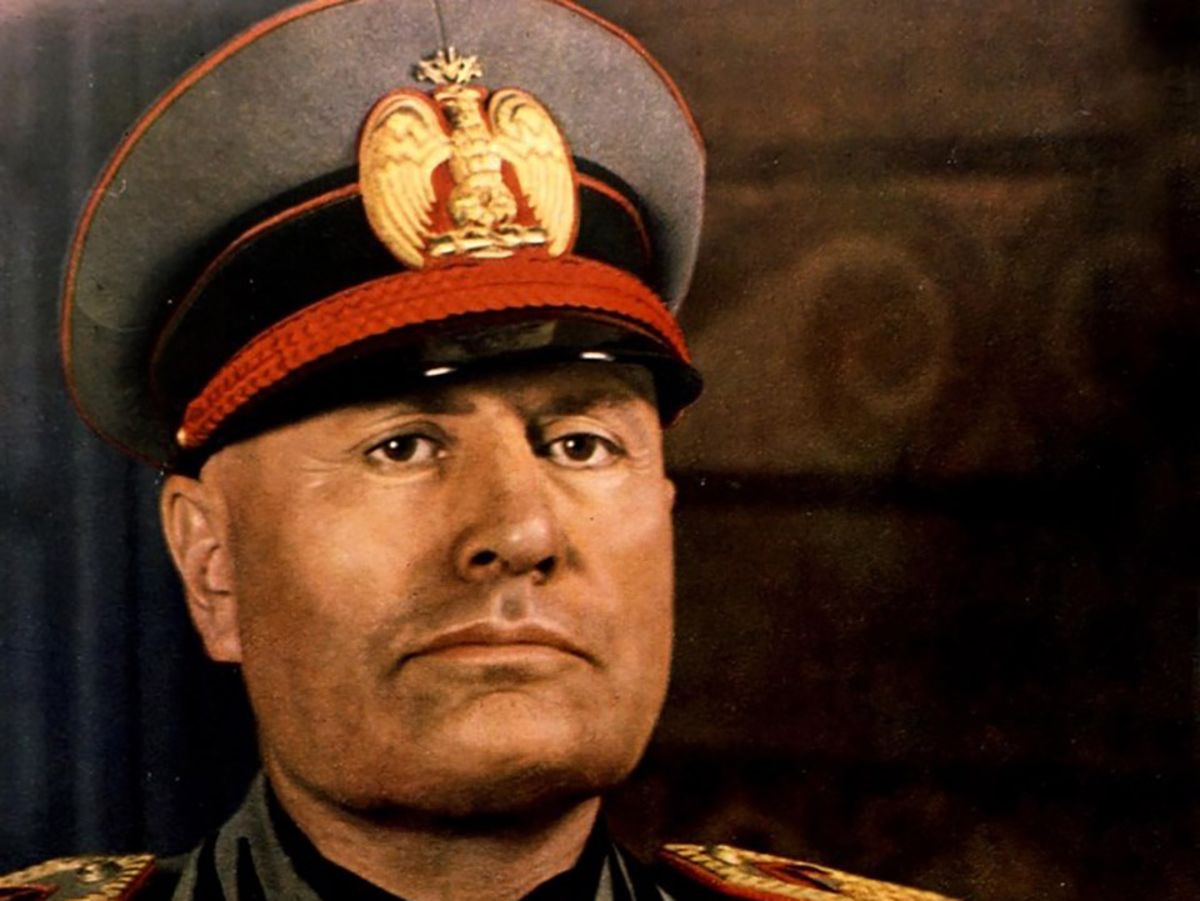
History often remembers Benito Mussolini as Hitler’s sidekick, the bumbling dictator who dragged Italy into ruin. But the true story of the man who invented Fascism is far stranger, more complex, and deeply rooted in an ideology you might not expect.
If you could travel back to Italy just before World War I, you wouldn't find a polished dictator in a military uniform. You’d find a depressed, long-haired drifter known to locals as the "Man in Black." He was often unemployed, hungry, and, perhaps unsurprisingly, a radical Marxist.
Here is the fascinating, often overlooked history of how a hardline socialist invented a new political spectrum and changed the world forever.
1. The "Man in Black" Was a Marxist
Before he was Il Duce, Mussolini was a card-carrying member of the Italian Socialist Party. He wasn't just a member; he was a leading voice, editing the major socialist newspaper Avanti!. His worldview was shaped by the idea of violent revolution to overthrow the bourgeoisie.
So, what changed? World War I.
While most Marxists believed that "class" was the ultimate unifier (workers of the world vs. the rich), Mussolini noticed something interesting when the war broke out: Class solidarity crumbled instantly. German socialists fought for Germany; French socialists fought for France.
Mussolini realized a powerful truth: Nationality was a stronger bond than Class.
2. Fascism Was Originally "National Trade Unionism"
Mussolini didn’t abandon his revolutionary ideas; he just rebranded them. He was heavily influenced by "Revolutionary Syndicalism" (anarcho-communism).
When he founded the Fascist movement, the goal wasn’t to protect the rich, it was to unite the entire nation into one giant "syndicate" or corporation.
This is where the term "Corporate State" comes from.
It didn't mean rule by big business (like McDonald's or Amazon); it meant organizing the whole country into state-controlled trade unions. In his mind, he solved the "Class Conflict" not by one side winning, but by merging the workers and the owners under the supreme authority of the State.
3. Surprisingly Popular (Even with Churchill)
It is easy to look back with 20/20 vision, but in the 1920s and early 30s, Mussolini was a global superstar.
- He stabilized Italy: After WWI, Italy was a chaotic mess of strikes and violence. Mussolini’s heavy hand brought order.
- The "Third Way": He sold Fascism as a middle ground between the "flawed" democracy of the West and the "bloody" communism of the Soviet Union.
- International Fanbase: Figures like Winston Churchill were initially impressed by him, viewing him as a bulwark against Bolshevism.
4. Fascism - Not Nazism
One of the most interesting historical distinctions is that Italian Fascism and German National Socialism (Nazism) were not identical twins.
- Race vs. State: Hitler’s ideology was biological and racial (the Aryan race vs. the Jews). Mussolini’s ideology was about the State and Culture.
- The Jewish Question: For a long time, Mussolini had no interest in Hitler's racial theories. In fact, the Italian Fascist party had thousands of Jewish members. It wasn't until 1938, 16 years after taking power, that Mussolini introduced anti-Semitic laws, largely to appease his new, powerful ally, Adolf Hitler.
5. The Final Twist: Returning to His Roots
The end of Mussolini’s life contains a supreme irony. After being deposed by the King and rescued by the Nazis in 1943, he set up a puppet state in Northern Italy (the Republic of Salò).
With nothing left to lose, Mussolini went back to his origins. He began nationalizing companies and pushing for a "pure" socialization of the economy, blaming the bourgeoisie for his failures. He died claiming he was still a socialist.