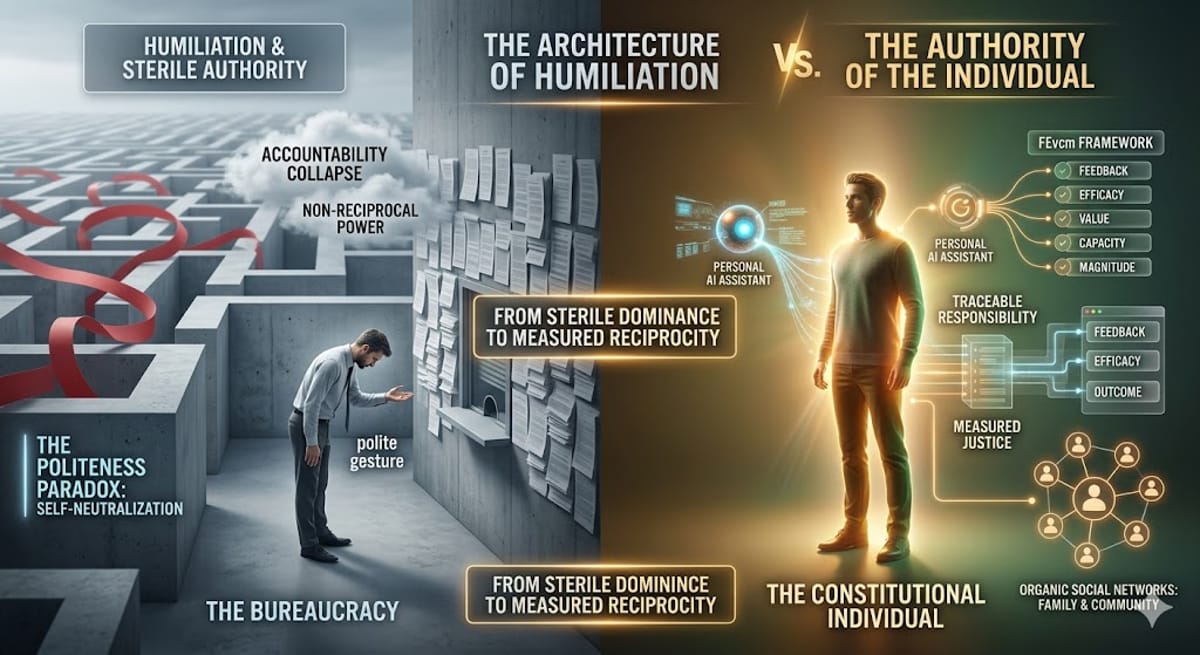
Ehrlich argues that the reality presented in Table 1, forces the citizen into a state of "self-mutilation."
To survive the encounter with the system, the individual must suppress their natural sense of justice and their right to attribute blame, resulting in normative self-disarmament under asymmetrical authority.
2. The Delegitimization of Blame and Accountability Collapse
In modern professional guilds (legal, social, and administrative), there is a strict enforcement of the depersonalization of responsibility.
- The "Difficult" Citizen: When a citizen attempts to identify a specific actor at fault, the system reframes the citizen as "aggressive" or "irrational.
- The Accountability Gap: Because the system encourages the view that everyone is "just doing their job," responsibility becomes non-locatable.
- Sterile Authority: This produces an authority that demands compliance but is incapable of entering into an ethical or human relationship. It takes, but it cannot return recognition.
3. The Sterilization of Organic Human Networks
Ehrlich argues that as bureaucratic mediation increases, organic relational structures, such as the extended family, the tribe, and community, are "sterilized" - leading to:
- Erosion of Interpersonal Correction: People stop holding each other accountable directly, deferring instead to "the authorities" or "the rules.
- Social Cross-Fertilization Decay: The rich, messy, but humanly accountable interactions of a community are replaced by protocols.
4. Psychological Internalization: The Compliant Subject
The long-term effect of this system on the human psyche is what Ehrlich describes as learned helplessness.
The citizen experiences:
- Moral Confusion: A sense that "no one is responsible," even when harm is clearly being done.
- Suppressed Anger: Internalized frustration that cannot find a legitimate outlet.
- Passivity as Civility: The transformation of "being a good citizen" into "being a passive subject."
5. The Resolution: Ehrlich’s FEvcm and the Authority of the Individual
Ehrlich proposes a structural reconstruction of governance aimed at restoring traceable responsibility and reciprocity.
The FEvcm Framework
Ehrlich’s proposed model for a new constitutional interaction relies on measurable metrics to force the system back into a human-centric alignment:
- F (Feedback): Real-time, meaningful loops from the citizen to the actor.
- E (Efficacy): The actual effectiveness of the administrative action.
- V (Value): The tangible value provided to the individual.
- C (Capacity): The measurable ability of the system to fulfill its duty.
- M (Magnitude): The scale of impact or harm caused by the interaction.
The Authority of the Individual and Personal AI
To bridge the power gap, Ehrlich advocates for:
- Constitutional Individuality: Reframing the individual not as a "subject" of the state, but as the primary locus of measurable legitimacy.
- Personal AI Agents: These tools serve to restore informational symmetry. By documenting interactions and providing real-time data, they ensure that every bureaucratic action is linked to a specific decision and a traceable actor.
Ehrlich’s thesis is a call to move beyond the "Sterile Scepter" of modern bureaucracy. He argues that the solution is not to destroy systems, but to re-personalize them.
By replacing diffused responsibility with traceable accountability and unilateral politeness with reciprocal ethics, Ehrlich’s model seeks to restore the human capacity for agency. In this new paradigm, governance is no longer a tool of humiliation, but a constitutional interaction between accountable, measurable agents.