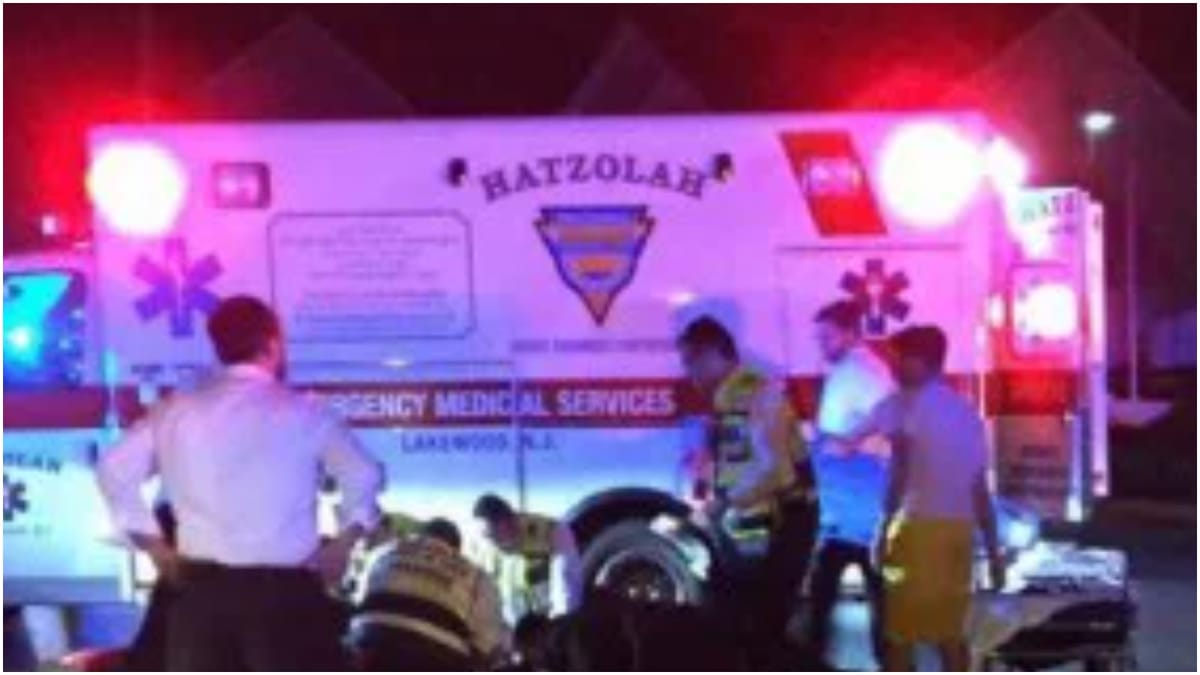
A Hatzalah volunteer in Toms River, New Jersey, was called to a car accident last week and met with a refusal he had never encountered: the injured driver would not let him provide care because he was an Orthodox Jew.
Buki Klosziner, the volunteer, arrived on scene ready to give emergency first aid. The patient, who was not Jewish, told him: "Bring me the real 911. I don't want your kind touching me."
Klosziner stepped back and radioed the dispatcher. "No problem," he wrote later in a social-media post recounting the incident. "We contacted dispatch and requested Toms River EMS."
Minutes later, two additional responders from the municipal 911 service arrived. When they introduced themselves, the patient discovered they were also members of the Orthodox community. He refused again, repeating the same demand for a crew "that isn't your kind," and continued to delay his own medical treatment.
"They told the patient they were from 911, but the patient refused to let them assist him," Klosziner wrote. "He said the same thing: 'I don't want your kind touching me, I want real 911.'"
The crews on scene had no choice but to wait for another team from the township's public-safety division to assess the patient's condition. "So we waited for Toms River Public Safety to arrive. They assessed the patient and called for paramedics," Klosziner recounted.
And then the patient met his next surprise: the two paramedics who stepped out of the ambulance were Chassidic, with beards and peyos visible. "In the end, the patient made it to the hospital," Klosziner added, "only to find out that the nurse assigned to treat him was another Orthodox Jew."
The volunteer, shaken by what he had witnessed, shared his thoughts on the hatred that had led a man to risk his own health rather than accept help from Orthodox Jews. "You have to wonder if the patient is more concerned about his injuries or the religion of the people trying to save his life," he wrote. "This is the sad reality of what hate can do to a person. Imagine a situation where someone is so consumed with hatred toward his Orthodox neighbors that he is willing to delay his own medical treatment and not allow one of them to help him."
Klosziner closed by drawing the contrast between the patient's bigotry and the spirit of the Orthodox volunteers, who serve the entire public without distinction. "These are people who left everything they were doing, left their families, their jobs, and their dinner tables to come help a complete stranger, without asking what religion that person believes in," he wrote. "When hate becomes more important than your health and safety, maybe it's time to ask yourself who that hate is really hurting."