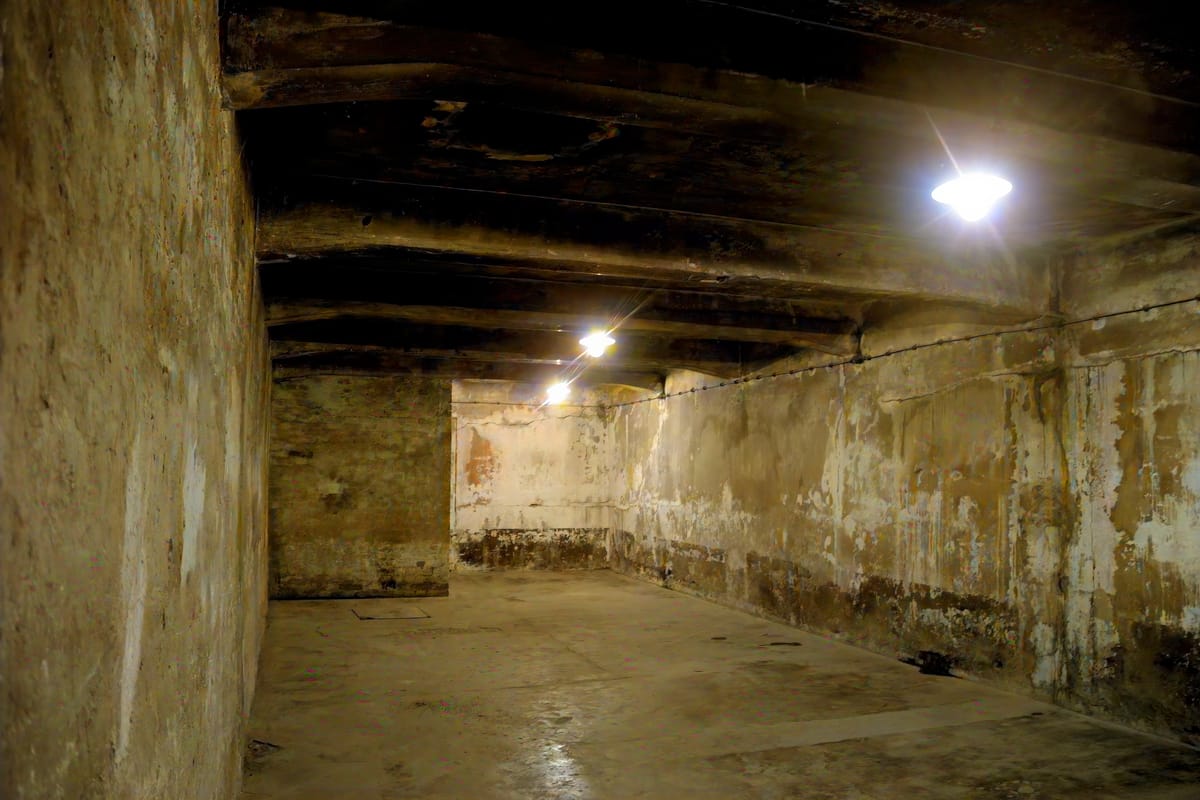
It was October 10, 1944, Simchat Torah, and roughly eight hundred Jewish boys, some as young as thirteen, were pulled from Block 11 at Auschwitz. The night before, Josef Mengele had come through on one of his visits, and by morning their ID cards were already stamped with a single German word: gestorben. Died. SS guards marched them to Crematorium 5, stripped them, and pushed them into the gas chamber. Almost eighty years later, that same date on the Jewish calendar would fall on October 7, 2023.
Then, at what should have been the very last moment, something shifted. Three German officers showed up and stopped the process, pulling fifty one of the boys out to go unload a shipment of potatoes instead. Historians think the order actually came from Johann Schwarzhuber, the SS officer running that section of Birkenau, not from Mengele himself. Nobody's entirely sure why. But those fifty one boys walked out of a gas chamber alive, and as far as anyone knows, that's never happened anywhere else in the Holocaust.
The book zeroes in on six of those boys, all from ultra-Orthodox homes in Hungary, and follows them from childhood through the mass deportations of summer 1944, into that chamber, and out the other side into lives nobody could have predicted for them. For context, around 440,000 Hungarian Jews were sent to Auschwitz in that same window, close to half the country's entire Jewish population, and most of them were killed the moment they arrived.
Rabbi Naftali Schiff is the one who put this together. He founded Jewish Futures and its travel arm JRoots, which has taken something like 30,000 people to Poland over the past twenty years, and it was through that work that he got to know a long list of Holocaust survivors, including the six men at the heart of this book. He first picked up pieces of the story from Esther Farbstein, a Holocaust scholar in Jerusalem who knew the events had happened but had never actually met any of the survivors herself. It took Schiff close to twenty five years to track them down and get their stories.
His co-writer is Michael Calvin, a British journalist who's written several Sunday Times bestsellers, mostly sports biographies, people like Alastair Cook and Gareth Thomas. He also co-wrote the memoir of Josef Lewkowicz, a Holocaust survivor who went on to hunt Nazis. Calvin's Catholic, and both men have talked about the pairing itself, a rabbi and a Catholic journalist working on a Holocaust testimony project together, as part of the point they're making about shared moral responsibility. This is their second book together.
The reception's been strong. Kirkus called it a harrowing collection of survivor testimony that speaks to individual bravery, and it's already been translated into ten languages, hitting bestseller lists in the UK and Canada before it even came out in the US this June. There's also a companion documentary called Undeniable coming out alongside it, which includes testimony from Robert Jan van Pelt, the scholar who served as a key expert witness in Deborah Lipstadt's libel case against Holocaust denier David Irving.
As for why now, Schiff hasn't been shy about it. He'd been collecting these testimonies for a quarter century, but he pushed to actually finish the book because of October 7, landing as it did on the same date in the Jewish calendar as that original selection at Auschwitz. He's argued that the massacre exposed real limits in how we do Holocaust memory, that we've built it mostly around museums, and that Jewish communities need to be putting just as much into living education, schools, and heritage trips as into monuments. He's also mentioned he initially pushed back on calling a book about Auschwitz Miracle, and got outvoted by his co-author and the publisher, before coming around to it himself, seeing it as fitting given what he calls the ongoing, improbable survival of the Jewish people.
Put simply, this book sits right at the intersection of testimony and the current moment. It's being marketed explicitly around that Simchat Torah and October 7 parallel, at a time when antisemitism and Holocaust denial are both on the rise, which gives it an obvious hook for anyone covering Jewish memory or the post-October 7 landscape. And because it leans on six first-person, never-before-published testimonies, plus Calvin's journalistic storytelling chops, it's more chilling than ever.