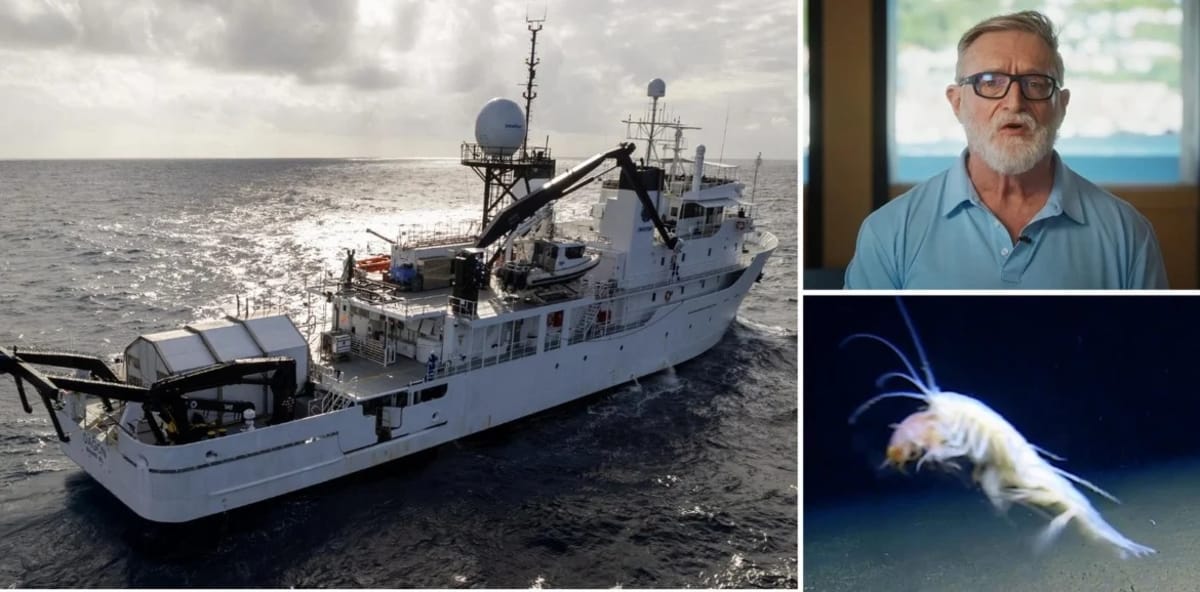
More than five miles beneath the Pacific Ocean's surface, in total darkness and crushing pressure, researchers have identified a small predator previously unknown to science. The newly discovered species is an amphipod, a tiny crustacean, that has been named Princaxelia malohi.
The species was found during a 2024 expedition to the Tonga Trench aboard the RV Dagon, a research vessel owned by Inkfish, the marine research organization founded by Valve creator Gabe Newell. Scientists deployed unmanned research platforms equipped with cameras, traps, and fish bait to the ocean floor. These platforms attracted scavengers, and in their wake came the predator.
Five specimens of the new species were collected at depths ranging from approximately 8,200 to 8,350 meters. They measured between less than two centimeters and nearly four centimeters in length. Despite its diminutive size, the creature is equipped with powerful limbs for capturing prey and mouthparts adapted for hunting. Researchers also identified a unique anatomical structure in its appendages that has not been described in other species of the same genus.
Footage from the ocean floor provided researchers with a rare glimpse into its behavior. In one recording, Princaxelia malohi can be seen holding another amphipod of the species Hirondellea dubia, readjusting its grip on the prey, and moving with it along the seafloor. Additional footage showed the crustaceans waiting on the bottom and launching short swimming attacks toward other animals.
The depth at which this species was found makes the discovery particularly intriguing. The deepest specimen was collected at approximately 8,350 meters, an area at or slightly below the known depth limit where bony fish can survive. Researchers estimate that at these depths, where predatory fish are virtually absent, amphipods of the Princaxelia genus may play a more central role as predators in the ecosystem.
The expedition itself was extensive in scope. Six research platforms conducted 104 deployments at 37 sites, collecting more than 1,250 hours of high-quality video footage from the seafloor. Simultaneously, the expedition mapped tens of thousands of square kilometers of ocean floor.
The scientific study, published in the journal ZooKeys, actually described two new species from the Princaxelia genus, one from the Tonga Trench and another from the Mariana Trench. This brings the total number of known species in the genus to seven. Researchers used both anatomical characteristics and genetic testing to distinguish between the species.
The creature itself may have been observed more than a decade ago. Video footage shot in the Tonga Trench in 2012 showed similar animals, but at the time researchers lacked physical specimens that would allow them to definitively determine which species they were observing. Only the new expedition made it possible to connect the footage from the depths with specimens, anatomical structure, and genetic data, and finally give a name to the tiny predator living in one of the most extreme environments on Earth.