
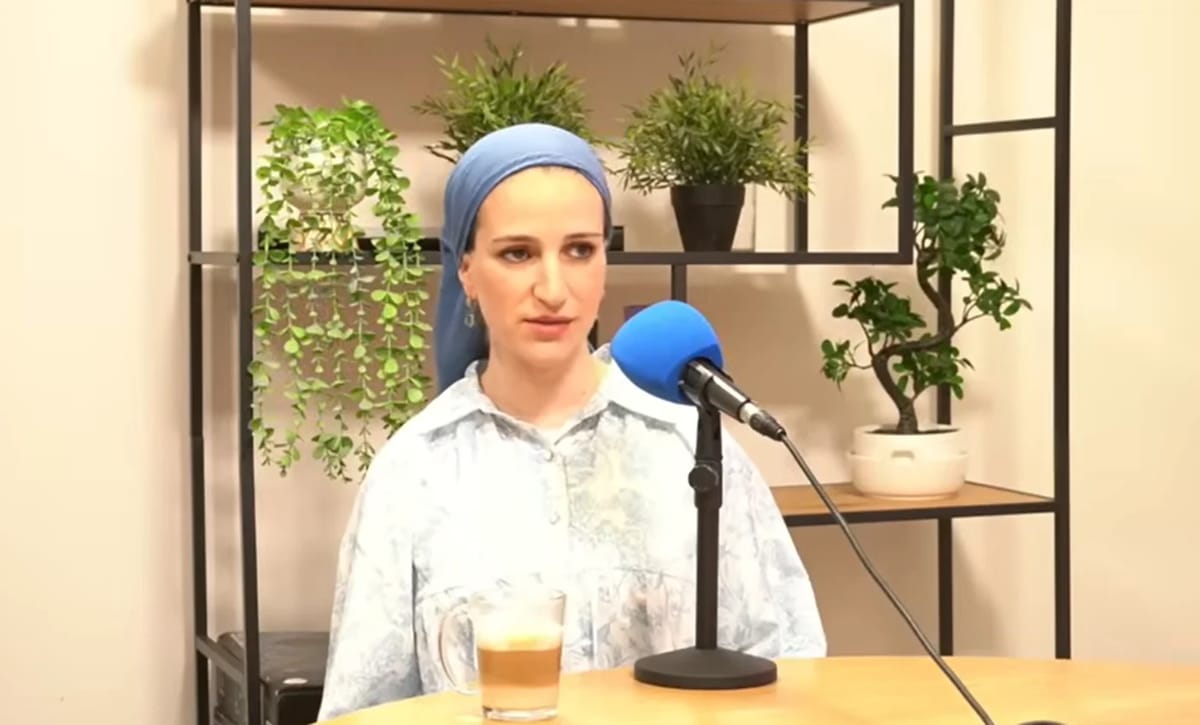
When Cheli Elchamister's first marriage came to an end, she was caught off guard by what followed: "I got hundreds of calls from people urging me not to go through with it. Strangers who didn't even know me assumed they knew what was best and tried to talk me out of it," she shares in her discussion with Rabbi Guy Elalouf. "It felt like they were saying, 'You don't know what's good for you.'"
Remarrying in her second chapter prompted Cheli daughter of the Rishon LeZion Rabbi David Yosef and granddaughter of the late Maran Rabbi Ovadia Yosef to reflect deeply. Today, she leads courses for women on navigating second marriages and overcoming challenges, drawing openly from her own experiences.
"I draw a clear line between what's rooted in the Torah and what's born from chauvinistic social norms," Cheli explains. "There's a real distinction between core Torah principles and cultural traditions. In my talks, I tackle phrases like 'A righteous woman fulfills her husband's wishes' and the blessing 'Who has not made me a woman.'"
Rabbi Elalouf shares his view that Haredi society and Judaism aren't one and the same: "We must never equate Haredi life with Judaism itself. Not because Haredim aren't exemplary Jews they are, perhaps the finest. But every society, including the Haredi one, has its own history and evolution. Haredi culture is a social construct, and no social construct aligns perfectly with the Torah."
A key concern for Cheli is how women are often erased from Haredi media. "A girl raised in an environment that blots out women absorbs the idea that she's invisible," she says. "Even subconsciously, she learns she should stay unseen, quiet, and sidelined. To me, that's a harmful message."Rabbi Elalouf agrees: "When it reaches the extreme of saying, 'Hold on, a man can't even look at a drawing of a girl,' it fosters something unhealthy in the spirit."
On modesty, Cheli notes: "True modesty is an inner sense, not a set of strict regulations. A woman should intuitively grasp her own modesty what feels right for her and what doesn't." She points to the "denier" debate in stockings: "It's ridiculous to measure modesty by numbers. Fixating on rules like that and turning our Torah essence into debates over denier counts or figures doesn't add much value."
Cheli distances herself from extreme feminism. She addresses women who argue, "Listen, sisters: We've been taught it's sacred for the man to lead the home, but halacha was penned by men, so it's biased against us." Cheli counters that this is misguided: "By nature, women excel in spiritual and emotional realms. A woman never forgets the Divine Name it's part of her essence. Her emotional depth is profoundly strong; that's her power."
In talking about partnerships, Cheli offers a key observation: "Giving fosters love for men, that's true. But if a woman keeps giving endlessly to her husband, it won't spark love in the long run. She risks losing herself, and that could breed the opposite of love."She continues: "Mussar texts were crafted for men, not women. All that emphasis on surrender and generosity? It wasn't intended for us. No question about it."
On women as breadwinners, Cheli adds: "Pushing an entire community toward that model? I agree, it's unhealthy."
She stresses: "There's absolutely no ban on a woman out-earning her husband or working outside the home. It shouldn't revolve around hierarchies who makes more or knows more. Instead, it's about the giver and the receiver."
"Why Did I Marry a Hasidic Ashkenazi?!"
After closing her first chapter of family life, Cheli took an unconventional path: marrying a Hasidic Ashkenazi from the Belz community in her second chapter."It's shattering every convention," she reflects. "I've always been someone who didn't quite grasp the boundaries. There are these unwritten rules every Haredi knows like Ashkenazim marrying Ashkenazim but I never got them."Wrapping up the interview, Cheli sends an empowering message to young Haredi women: "Learn deeply, grow without limits, and don't hold back. The world is ready for you. You have immense gifts to offer the Torah, Judaism, and the Jewish people. Blossom fully, don't let anyone trim your potential."