It is impossible that we can’t find him. There is no way we can miss him this year. It is time to admit, once and for all, that we haven't tried hard enough all these years and this time, we must take the matter with utmost seriousness. We must stop cutting corners or thinking it isn't worth the effort... and clean the chametz from behind the refrigerator, too. Just kidding. Obviously, no one eats behind the refrigerator, unless they don't want to share with anyone and are also incredibly thin.
All of this introductory text isn't actually about another spot that wasn't cleaned for Passover, even if a living creature with chametz has never stepped foot there. The intention is actually the essence of the Holiday of Freedom, the Holiday of Matzah, the Holiday of Spring, and Passover-which, every year, it seems the majority of the Israeli public prefers to hide even better than the Afikoman.
Let’s admit it once and for all: if all the fathers in Israel hid the most important Matzah for the children as effectively as the media disappears the essence of the holiday, many exhausted parents could easily save several hundred dollars from their thin wallets, which, during the intermediate days of Passover, could certainly be described as "Kol Dichfin" (all who are hungry).
If once our grandfathers tried to explain to our fathers the meaning of the famous sentence from the Haggadah, "In every generation, a person is obligated to see themselves as if they went out of Egypt." today we prefer to condense the message and its meaning for our lives as much as possible, settling for "In every generation, a person is obligated to see themselves." Therefore, long before the Seder night, he invests in a new wardrobe and a sophisticated haircut (after all, it's just before the Omer count) and complex calculations of how much the gas and the holiday gift for the hosting parents will cost, and exactly how much that will save him so he can spend it on the perfect family vacation during the intermediate days abroad.
The too-rapid skip from Passover Eve to the intermediate days, in an attempt to fast-forward without deep thought through the Seder night, undoubtedly the most important event in the month of Nissan and the days of Passover, is like the desire of an elected Prime Minister to skip lightly from the Knesset to the first government meeting without entering into Rashi’s commentaries on what he says about the complex coalition negotiations, which mostly consist of sons who know how to ask "What is different?" too many times, yet refuse to sing "Dayenu."
If, God willing, we manage for just a few hours to disconnect a bit from politics in favor of Jewish essence, we will suddenly discover the true power of Passover, which arrives every year in the month usually called "The Time of Redemption." After we saw the shocking power of free will, which caused a seemingly ordinary person who held the steering wheel of power to take the lives of 150 people, just think how many lives could be saved if we understood the true meaning of being "free people."
Regarding the giving of the Torah, we learn that the word Charut (engraved)m written in the Torah in the context of the writing on the Tabletsm is interpreted in the Talmud by a wonderful explanation of our Sages: "Do not read it as Charut (engraved), but rather Cheirut (freedom)—for you have no free person except for one who engages in Torah study." However, the Kli Yakar interprets it differently, explaining that the freedom in relation to the writing on the Tablets is that the letters were not enslaved to the stone during its breaking—and according to his interpretation, all those who study Torah will also be free from kingdoms, suffering, and the Angel of Death.
But what can be done when, due to the multitude of mistakes in every generation, the lack of correct interpretation and proper respect for the letters of the Torah written on the Tablets—which are not dependent on the stone, has caused the Torah today, unfortunately, to be perceived by many of the People of Israel as a soul-less text from the past. They are also mistaken in claiming that it is supposedly the private and exclusive property of those who study it, rather than belonging to all of the People of Israel. Yet the Torah is like the "Bread of Affliction": anyone who needs it is invited to come and take it. The "Crown of Torah" belongs to all of Israel. The problem is that not all of Israel knows this.
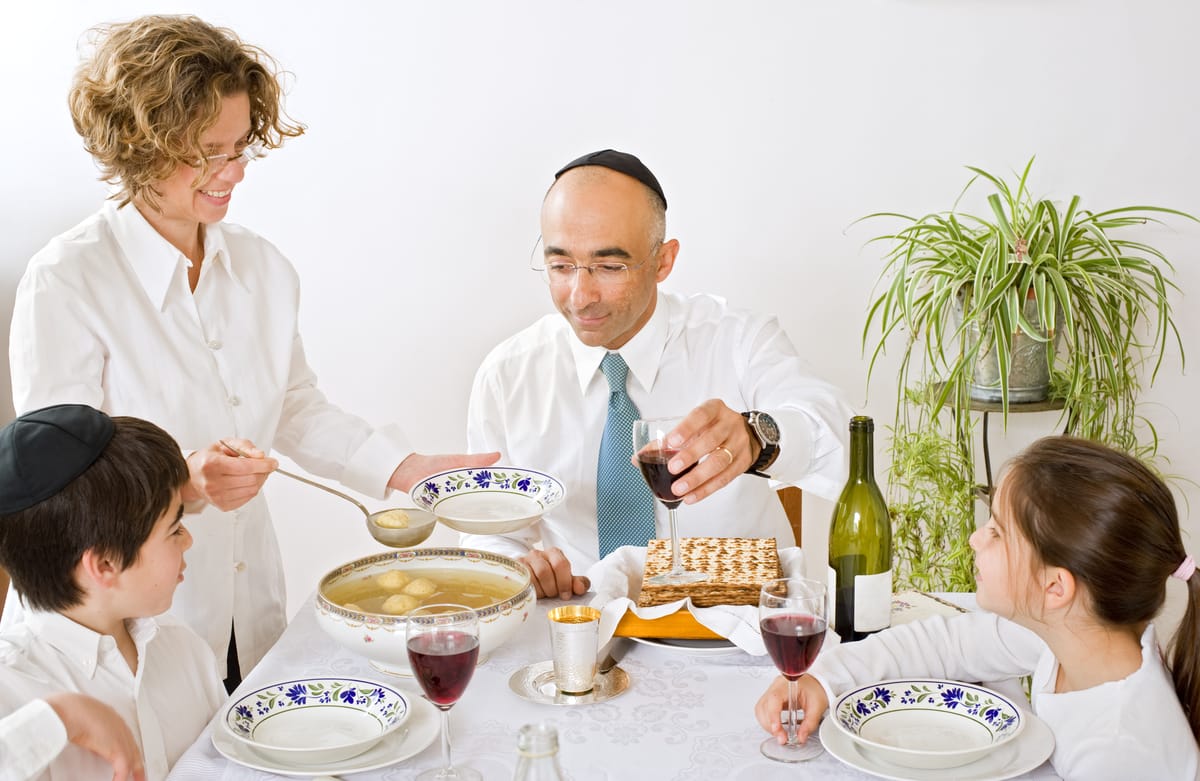
The main and most important action on Seder night is "V'higadta L'vincha" (And you shall tell your son) meaning, quite simply, to tell as much as possible about the Exodus from Egypt. Every action we take during the Passover Seder is part of that same story that only Moses could have written and the craft of storytelling passes from father to son, who becomes a father and passes the story to his children. And if we have reached a ridiculous state where what interests the sons more is how many calories are in the Matzah alongside the Gefilte Fish with horseradish, we can certainly say that somewhere along the way, we missed the essence of the entire story.
It seems that in the days leading up to the Seder, most of the People of Israel dealt with the trivial, and some even denied the fundamental. For between the complaints about shopping prices, the grumbling about never-ending cleaning, the slanders from the elections that wouldn't leave the agenda even after extra-strength verbal bleach, the divisiveness that remained on the negotiation table due to chametz that swelled and refused to accept the platform (or the Matzah) and the cutting into the "living flesh" of food baskets for the needy that harmed the joy of the holiday eve, we did not understand the most important mission placed on the shoulders of every Seder leader wherever they may be: to return the "Fifth Son" to the national "negotiation" table.
On the 11th of Nissan, Jewish communities around the world mark the birthday of the Lubavitcher Rebbe. Regarding the famous Midrash brought in the Haggadah that opens with the words: "The Torah spoke of four sons" (The Wise, The Wicked, The Simple, and The One Who Does Not Know How to Ask) the Rebbe added a "Fifth Son." Unlike the four sons who bothered to sit at the Seder table, this son has distanced himself so far from Jewish tradition that he does not even feel the need to come and participate in this important Jewish event, and he wanders the world without purpose or order.
Our generation's mission, says the Rebbe, is to locate the "Fifth Son," to reach these Jews, to remind them that they too are children of the People of Israel, and to return them to the Seder table and the embrace of Jewish tradition.
And if each of us manages to arrange for the Seder of the Family of Israel a Fifth Son—Dayenu!