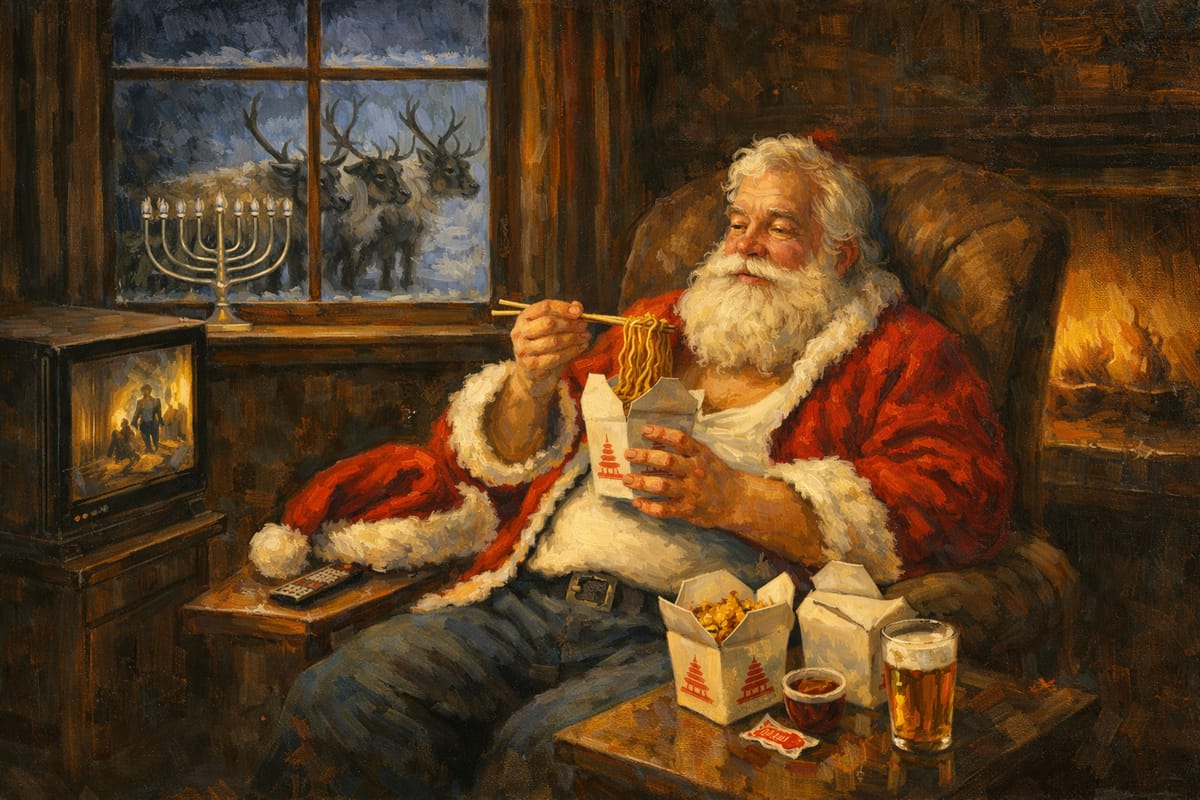
Every December 25, the country splits cleanly in two. One half is unwrapping gifts, juggling family schedules, and pretending they are not already full. The other half is Jewish, vaguely hungry, and deciding between lo mein or fried rice. This is Jewish Christmas, a tradition so reliable that it barely needs explaining anymore. Chinese food, a movie, maybe both. No tree. No hymns. No small talk about Jesus.
Like most American customs that actually stick, Jewish Christmas was not invented on purpose. It emerged from immigration, proximity, and the quiet genius of doing what makes sense. Its roots trace back to New York City’s Lower East Side in the late nineteenth and early twentieth centuries, when Eastern European Jewish immigrants and Chinese immigrants found themselves living side by side. The neighborhood became the largest Jewish population center in the world, crowded, noisy, and constantly reinventing itself.
Jews brought traditions with them from Europe, but those traditions did not remain frozen. They adapted, sometimes awkwardly, to American life. New customs formed not because someone announced them, but because people kept doing the same thing year after year until it felt inevitable.
Chinese restaurants were everywhere. They were close, affordable, and, crucially, open. They also carried none of the cultural baggage that made other restaurants uncomfortable. Italian places might have Christian imagery on the walls. German establishments carried associations Jews were not eager to embrace. Chinese restaurants were neutral ground. There was no shared history of persecution, no religious symbols staring back at you while you ate. That mattered more than anyone probably admitted at the time.
The food itself helped. Chinese cuisine avoided one of the biggest violations of Jewish dietary law: mixing meat and dairy. Pork was an issue, obviously, but it was often chopped up, hidden inside dumplings or sauces, leading to the idea of “safe treyf.” Not kosher, but manageable. Add flavors that felt familiar, onions, garlic, vegetables, and cooking techniques that did not rely on butter or cream, and Chinese food felt approachable even when it was new.
By the end of the 1800s, Jewish newspapers were already complaining about Jews eating in Chinese restaurants, which is usually a good indicator that something has gone mainstream. This was not a fringe behavior. It was common enough to make people uncomfortable. Chinese restaurateurs noticed. They advertised in Jewish papers, stayed open on Sundays, and catered directly to Jewish customers when much of the city shut down.
Eating out itself was part of becoming American. Restaurants were still a luxury. Going to one meant you had the money, the confidence, and the desire to participate in public life. Chinese food became a gateway to that experience, both familiar and foreign at the same time.
Then there was Christmas. Jews did not celebrate it. Chinese immigrants largely did not celebrate it either. Everyone else did. Cities slowed down. Stores closed. Streets emptied. Christmas could feel isolating if you were outside it. Chinese restaurants stayed open, brightly lit islands of activity in an otherwise closed city. Jewish families and friends gravitated there not as a statement, but because it was where life still existed.
Over time, something interesting happened. What began as a largely non-kosher tradition evolved alongside the growth of kosher infrastructure in American Jewish life. As Jewish communities spread to the suburbs and beyond, kosher Chinese restaurants followed. Today, in cities and Jewish population centers across the United States and Israel, fully kosher Chinese restaurants are no longer novelties. They are reliable institutions. Menus now offer kosher versions of once-forbidden classics, from sweet and sour chicken to beef with broccoli, prepared under rabbinic supervision. For some families, Jewish Christmas no longer involves compromise at all. The food is Chinese, the setting is familiar, and the laws of kashrut remain intact, a quiet example of how tradition adapts without losing its shape.
Jewish Christmas was never only about eating. Long before Chinese food became its centerpiece, Jews marked Christmas with volunteerism. Hospitals, soup kitchens, and charitable organizations relied on Jewish volunteers on December 25. It was a day off, a day of goodwill, and a chance to turn exclusion into usefulness. Food and movies came later, adding warmth and pleasure to something that already had meaning.
Movies, in particular, became essential. As early as the 1900s, Jews spent Christmas at nickelodeons, one of the few entertainment options open on the holiday. Sitting in a dark theater required no belief system and no explanations. Over time, the tradition solidified. Jewish filmmakers even leaned into it, releasing major films on Christmas Day, knowing exactly who would show up.
By the time a Supreme Court nominee casually remarked in 2010 that, like all Jews, she had spent Christmas at a Chinese restaurant, the tradition no longer needed defending. It was simply understood.
Today, Jewish Christmas has broadened. Thai, Vietnamese, Indian, Japanese. The cuisine shifts, but the structure remains the same. Eat something comforting. Watch something absorbing. Spend time with people who also have nowhere else to be. Jewish Christmas endures because it works. It is practical, communal, and quietly joyful. It began as a workaround and became tradition the way Jewish traditions often do, through repetition, adaptation, and a refusal to sit alone on a day when the rest of the world is busy.