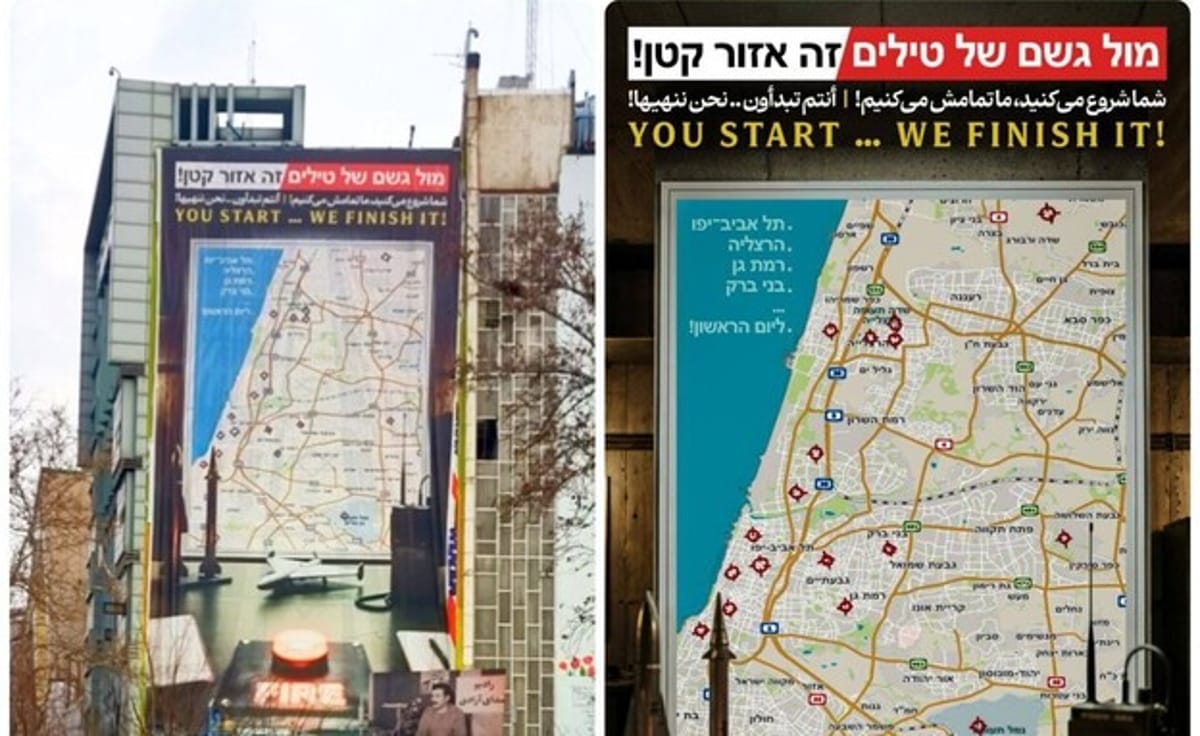
The dual nature of the Iranian regime was on full display this Wednesday as Tehran balanced diplomatic maneuvers in Oman with overt threats of mass destruction directed at the Israeli heartland. While Foreign Minister Abbas Araghchi presented a detailed report on the Muscat summit to the Iranian Parliament, the streets of the capital were adorned with fresh psychological warfare. A massive billboard in Palestine Square, written in Hebrew, warned of a "rain of missiles" targeting the Gush Dan region, specifically naming cities like Tel Aviv, Herzliya, and Bnei Brak as primary targets for the "first day" of a potential war. This aggressive posturing comes as President Masoud Pezeshkian attempts to project an image of regional cooperation, urging domestic media to avoid "insulting or humiliating" neighboring Arab states that have facilitated the talks, even as his military chiefs brag about their readiness to strike the "illegal Zionist entity."
Diplomatic Vetoes and Uranium Red Lines
Foreign Minister Araghchi revealed that during the Friday session in Oman, the Iranian delegation exercised a strict veto over the American guest list. Specifically, Tehran refused a request from Washington to allow Vice Admiral Brad Cooper, a high-ranking official from US Central Command, to participate in the discussions. "We refused the US request for his participation; we made it clear that we do not accept the presence of a military factor in the negotiation process," Araghchi stated. This move was intended to keep the talks strictly within a diplomatic framework, preventing the U.S. from leveraging its military presence in the Gulf during the meeting.
On the technical side, Araghchi remains uncompromising. He asserted that "zero enrichment" is a condition that Iran will never accept. He insisted that the talks must focus on a path where uranium enrichment continues while providing "security" and "assurance" that the program remains peaceful. "No one has the right to tell us what to do," Araghchi added, signaling that despite the pressure of sanctions and the aftermath of the 12-day war, the regime will not dismantle the core of its nuclear infrastructure.
A "Rain of Missiles" and Domestic Unrest
While diplomats talk, the Islamic Revolutionary Guard Corps and the Iranian Air Force are busy fueling the fires of war. Air Force Commander Bahman Bahmord boasted about the "structural transformation" of his forces, claiming that during the war in June 2025, his units achieved one of the largest and fastest aerial deployments in history while conducting offensive operations against Israel. This was echoed by General Abdolrahim Mousavi, the Chief of Staff, who claimed that while Iran does not seek a regional war, it is fully prepared to respond decisively to any aggression. "The consequences of any regional war will fall on the shoulders of the United States and Israel," he warned.
The Hebrew billboard in Palestine Square serves as a map of this intended destruction, listing Tel Aviv, Ramat Gan, and Bnei Brak under the caption: "Against a rain of missiles, this is a small area!" The propaganda even included a biblical verse in Hebrew, mocking Israeli defense capabilities. However, beneath this outward display of strength, the regime faces a brewing crisis at home. Reports have surfaced that a group of merchants in Tehran is calling for a major protest in approximately ten days, potentially reigniting the nationwide demonstrations that have previously choked the country. President Pezeshkian, sensing the internal and external pressure, concluded that "the Iranian nation has always responded to respect with respect, but it will not tolerate the language of force."