
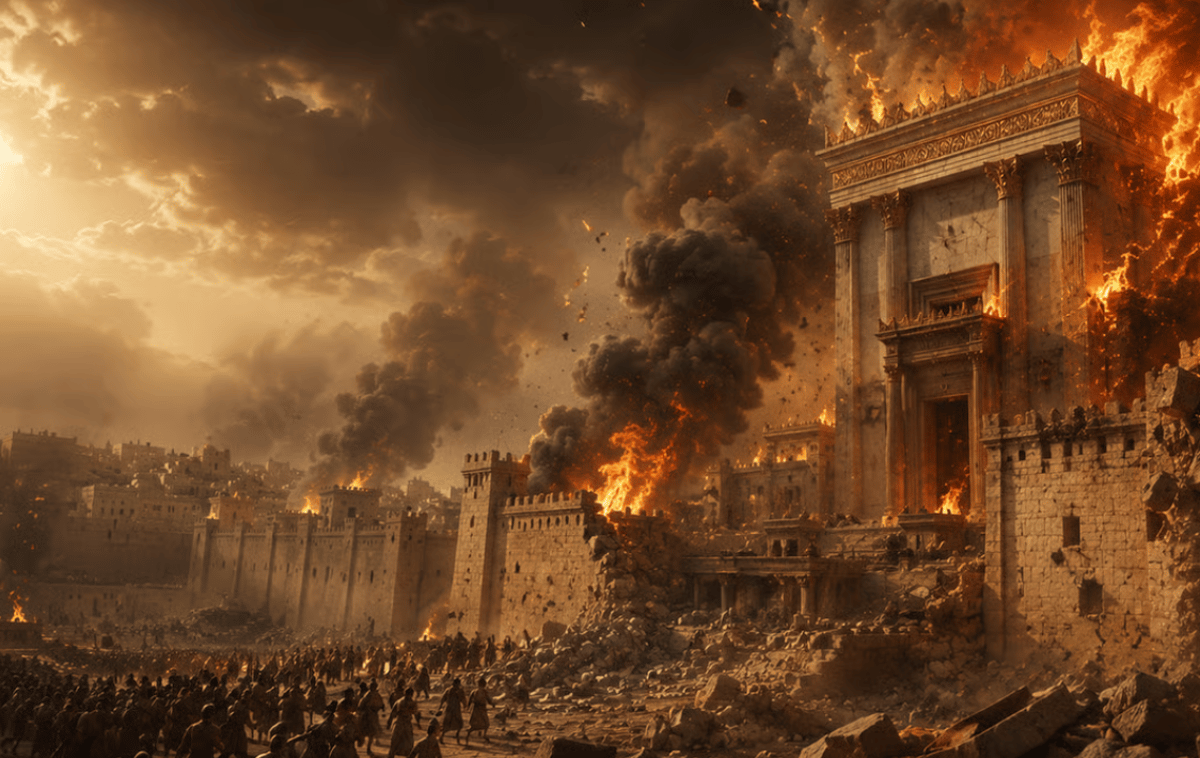
Tisha B'Av has come to represent one day in the Jewish calendar. But while it marks the destruction of both the First and Second Temples, tradition and history have bound to this ninth day of Av a series of catastrophic events that stretched across the centuries and profoundly shaped the Jewish experience, a relay of loss that spans from the wilderness to the twentieth century.
For the Anglo-Jewish diaspora reflecting on this year's fast, understanding these layered tragedies offers perspective on how Jewish memory itself operates: the power to transform a single date into a repository for centuries of exile, displacement, and resilience.
The Sin of the Spies
The arc begins in the desert. When the spies returned with an evil report about the Land of Israel, the people wept and refused to enter. The Sages teach that in response, God declared: "You wept without cause, I will establish weeping for you for all generations." The Midrash connects that act of collective despair, and its cosmic judgment, to Tisha B'Av itself.
The First Temple Falls
In 586 BCE, Nebuchadnezzar of Babylon breached the walls of Jerusalem, burned the First Temple to the ground, and exiled much of the population to Babylonia. The Kingdom of Judah ended not with a whimper but with the iron sound of siege and stone.
The Second Temple Destroyed
Nearly 650 years later, in 70 CE, the Romans under Titus encircled Jerusalem and starved it into surrender. They torched the Second Temple and erased it so completely that most of the population, according to historical accounts, never saw its rebuilding. From that moment, Tisha B'Av became the centerpiece of the Jewish calendar of grief.
The Fall of Betar
In 135 CE, the last stronghold of the Bar Kokhba rebellion fell to Rome. The city of Betar, the last hope of Jewish independence, was leveled. The Talmud records that so many fell in the final assault that the blood ran through the city streets. The date fell on Tisha B'Av.
The Plowing of Jerusalem
After Bar Kokhba's defeat, the Romans symbolically plowed the city of Jerusalem, an act meant to erase it entirely from the earth. In its place, they built Aelia Capitolina, a pagan city with pagan gods. For Jews across the Mediterranean, it was the ultimate erasure: not occupation, but obliteration.
The Expulsion of England
In 1290, King Edward I issued an edict expelling every Jew from England. Hundreds of years of Jewish community life ended on a single day, a catastrophe that reverberated through medieval Christendom as one of the first mass expulsions of European Jewry. Tradition marks it to Tisha B'Av.
The Expulsion of Spain
In 1492, the Spanish Inquisition reached its violent apotheosis. Hundreds of thousands of Jews were given an ultimatum: convert, die, or leave. Those who chose exile, Spain's Sephardic heart, departed en masse, many crossing the Mediterranean just as Tisha B'Av fell that year. The Spanish Expulsion became inseparable from the date. Even now, Ladino-speaking Jews recall the exile with prayers tied to the fast day.
The Warsaw Ghetto Deportations Begin
On July 23, 1942, which coincided that year with Tisha B'Av, the Nazis began mass deportations from the Warsaw Ghetto to Treblinka. Over the next two months, more than 300,000 Jews were transported to the death camp and murdered. It became one of the most brutal chapters of the Holocaust, and its timing cemented Tisha B'Av as a day mourning not just ancient destruction but modern industrial genocide.
A Thread Across Time
What connects these ten calamities, spanning from biblical wilderness to Nazi killing machinery, is not just coincidence of date, but Jewish perception of pattern. A tragedies that occur within days of Tisha B'Av have often been absorbed into its observance, woven into the broader tapestry of collective memory.
The fast itself never changes: no food, no water, no leather shoes, prayers recited in the cadence of deepest sorrow. But the reason for that mourning has become not singular but cumulative, not about one temple but about temples and kingdoms and communities and lives, all held together by the gravity of a single date on the calendar.