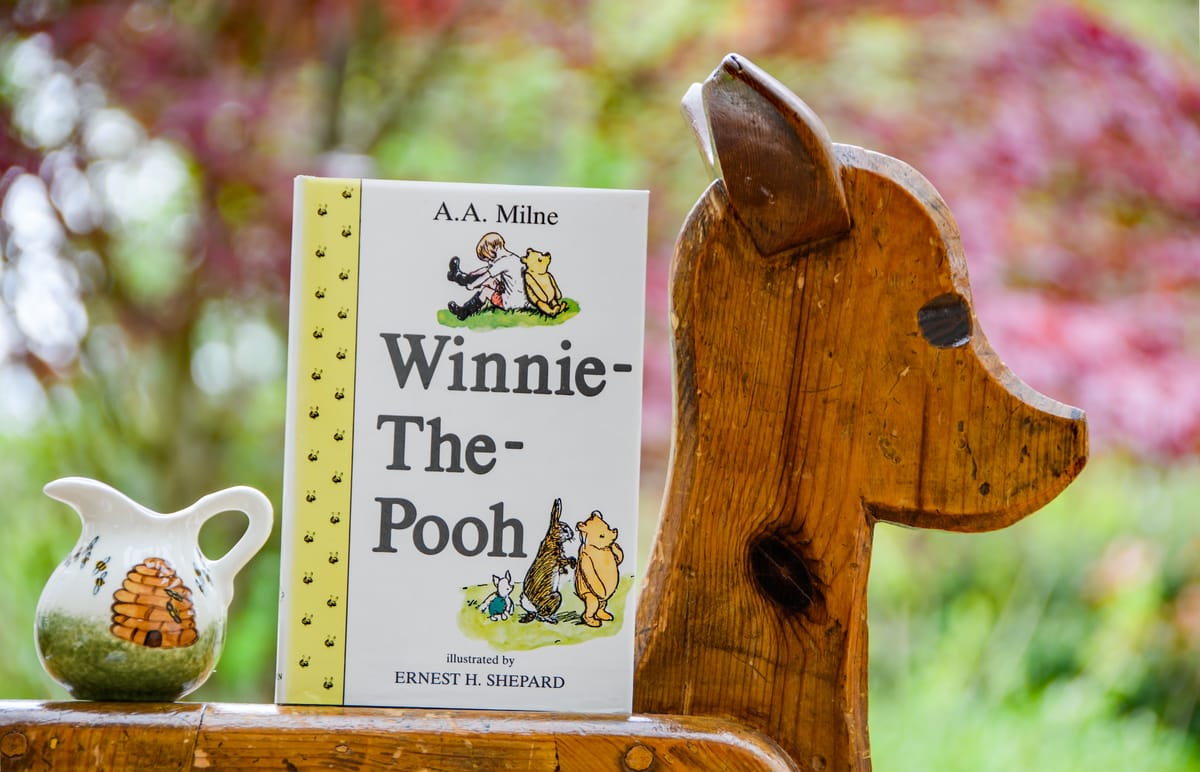
Christmas Eve quietly marks the 100th birthday of one of the most enduring characters in children’s literature. Winnie-the-Pooh first appeared on December 24, 1925, in a short story called The Wrong Sort of Bees, published in a London newspaper. It was a modest debut for a bear who would go on to become a global cultural fixture, quoted by parents, merchandised endlessly, and invoked whenever adults want to remember a version of themselves that felt safer and slower.
Within a year, A. A. Milne expanded that newspaper story into the book Winnie-the-Pooh, published in 1926, followed by The House at Pooh Corner in 1928. Alongside those came books of poems featuring the same cast of characters. The stories were inspired by Milne’s young son, Christopher Robin, and his collection of stuffed animals. That detail has become so familiar that it almost sounds like myth, but it matters. Pooh does not come from a writer inventing a fantasy world. He comes from a parent paying attention to how a child plays, listens, worries, and reasons.
The setting was just as important. The fictional Hundred Acre Wood was based directly on Ashdown Forest in East Sussex, where Milne owned a country home. This was not a symbolic forest or a vague pastoral dream. It was a real landscape, one you could walk through, get lost in, and recognize again on the page. The paths, the bridges, and even the game of Pooh sticks all came from real places and real walks Milne took with his son. That grounding gave the stories a physical calm that has aged unusually well.
Pooh arrived in the world between wars, in a moment when Britain was tired, wounded, and quietly anxious about what came next. The stories did not address any of that directly. Instead, they offered a small world where problems were limited, friendships were reliable, and confusion was treated gently rather than mocked. Pooh is not clever, but he is not stupid either. He thinks slowly, worries about the right things, and accepts help without shame. These are not flashy virtues, which may explain why they have lasted.
Over time, Pooh’s popularity only grew. The characters became household names. Pooh sticks turned into a pilgrimage ritual. The original bridge where the game was invented became so worn down by visitors that it had to be replaced decades later. Even the physical remnants of the stories became valuable, collected, preserved, and auctioned like artifacts from a shared childhood.
The bear took on a different scale of fame in the early 1960s, when Disney acquired the rights and introduced Pooh to a new generation through animation. That version of Pooh is softer, rounder, and more commercial, but the core remained intact. He still worries about honey. He still misunderstands things. He still believes that friendship solves more problems than intelligence. Some literary purists bristle at the Disney version, but it is hard to argue with the result. Pooh became universal without becoming unrecognizable.
Back in England, Pooh never stopped shaping the place that shaped him. Ashdown Forest continues to draw visitors from around the world, many of whom are not looking for literary analysis or historical context. They want to walk where Pooh walked. They want to stand on the bridge. They want to see the forest as it looked when a father and son imagined a bear getting stuck in a doorway. Local communities have long understood that Pooh is not just a story. He is an economy. A century later, public funds are still being invested in events, installations, and walking trails to mark the anniversary and manage the steady flow of visitors.
What is striking, one hundred years on, is how little Pooh feels like a relic. Many children’s characters age poorly. Their language stiffens. Their morals become obvious. Their worlds feel artificial. Pooh does not lecture. He does not explain himself. He does not rush toward a lesson. The stories leave room for silence, for wandering, for conversations that go nowhere and still feel complete.
That may be why adults return to Pooh long after childhood. The books do not demand nostalgia. They reward attention. They remind readers that being unsure is not a failure, that friendship does not require brilliance, and that it is acceptable to pause and think about lunch.
Winnie-the-Pooh turning 100 is not just a literary milestone. It is a quiet reminder that gentleness can endure. That small stories can outlast loud ones. And that a bear who likes honey, walks slowly, and worries about very ordinary things can still matter in a century that rarely slows down long enough to notice him.