
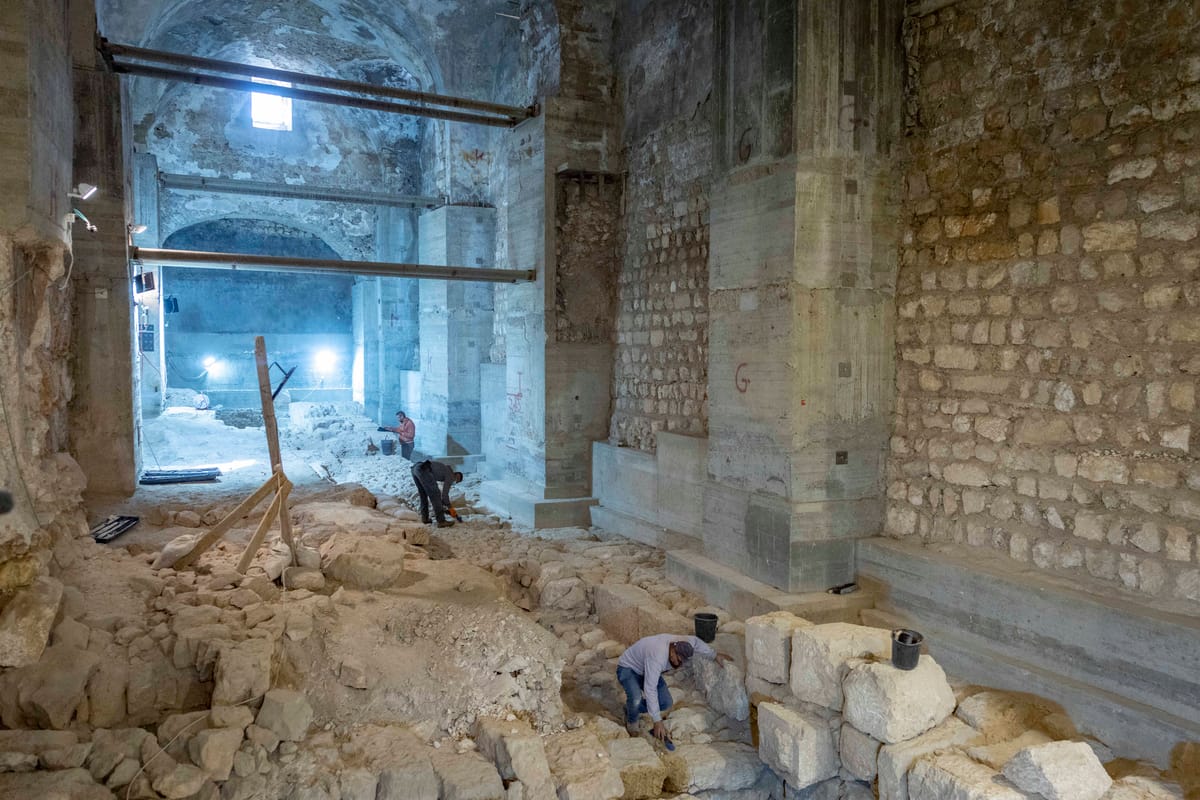
Archaeologists have uncovered one of the most complete and extensive surviving sections of Jerusalem’s Hasmonean period fortifications, revealing more than 40 meters of the ancient city wall in the Tower of David complex. The discovery was made during excavation and development work for the museum’s new Schulich Wing for archaeology, art, and innovation.
The wall segment, located within the historic Kishle compound adjacent to the citadel, dates to the late second century BCE. According to the Israel Antiquities Authority (IAA), the structure was part of the fortification known in historical sources as the “First Wall.” Excavation directors Dr. Amit Re’em and Dr. Marion Zindel said the remains are exceptional in scale and preservation. The exposed section is roughly 5 meters wide and originally stood more than 10 meters high.
Built from large, heavy stones with period characteristic dressing, the wall once encircled key parts of Jerusalem during the Second Temple era, including Mount Zion. Additional remains of the same fortification line have previously been found in Mount Zion, the City of David, the courtyard of the Tower of David, and along the outer western wall of the Old City.
Josephus, the first century historian, described the Hasmonean fortifications as formidable and “unconquerable,” noting that 60 towers lined the wall. Excavators say the newly revealed section bears signs of systematic destruction to its base rather than damage from time or accidental collapse, prompting renewed debate over who dismantled it.
Researchers point to two leading theories. The first is that the Hasmoneans themselves partially demolished the wall as part of a peace agreement with Antiochus VII Sidetes, who besieged Jerusalem between 132 and 134 BCE. Josephus recounts that John Hyrcanus I negotiated the lifting of the siege by offering treasures taken from the Tomb of King David, with the surrender of fortifications included in the terms.
The second possibility is that King Herod deliberately destroyed Hasmonean construction projects, including the wall, as a political statement distancing his rule from that of the earlier dynasty.
Finds from previous excavations support the historical accounts of conflict. In the 1980s, archaeologists uncovered hundreds of ballista stones, arrowheads, sling stones, and lead projectiles at the foot of the First Wall, evidence of Sidetes’s failed siege. Some of these artifacts are now exhibited in the Tower of David Museum.
The museum’s director, Eilat Lieber, said the discovery will be integrated into the new wing, where visitors will stand on a transparent floor above the ancient stones. Heritage Minister Rabbi Amichai Eliyahu called the find “a moving testament to Jerusalem’s strength in the Hasmonean period,” adding that it offers a tangible link between Hanukkah era history and the present.