
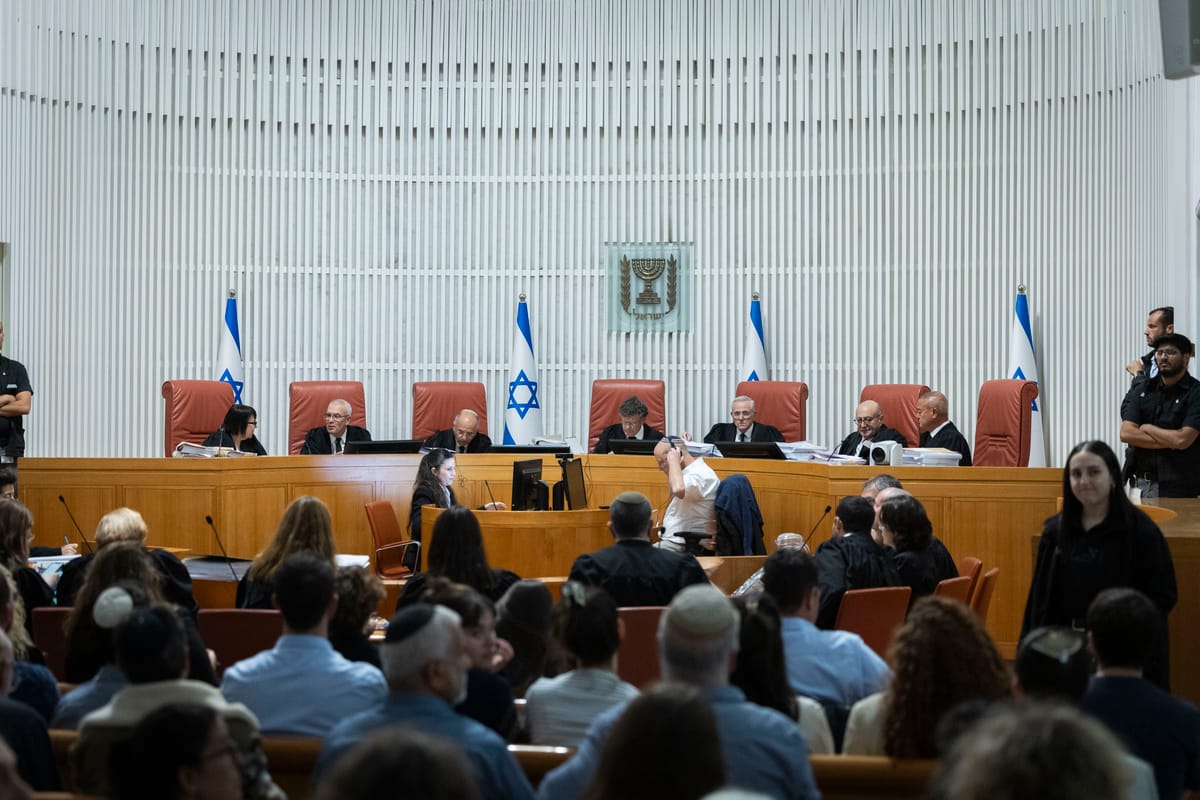
The Supreme Court has reversed an earlier ruling by the Jerusalem District Court and rejected a broad reading of the citizenship law that would have allowed children of immigrants under the Law of Return to receive citizenship through their parents’ status. The decision, handed down in an expanded panel, overturns a majority opinion from last year that interpreted the term “naturalization” in Section 8 of the Citizenship Law to include citizenship obtained through the Law of Return.
That earlier ruling, authored by Justice Ruth Ronen, held that Section 8 should be read expansively in order to keep families unified and prevent status gaps between parents eligible under the Law of Return and their children who are not independently eligible. Ronen argued that maintaining a child in a lesser civil status than a parent who acquired citizenship through conversion would be an unreasonable result that contradicts the core purpose of the provision.
The state petitioned for a further hearing, warning that this interpretation risked “breaking the boundaries” of the Law of Return by granting citizenship “through the back door” to people the legislature never intended to include, such as great-grandchildren of Jews or children born before a parent’s conversion. The Clement family, whose case prompted the dispute, argued that the purpose of Section 8 is to equalize parent and child status and that safeguards in the law prevent abuse.
In the new hearing, five justices sided with Justice Noam Sohlberg, who wrote the principal opinion. He held that the term “naturalization” in the Citizenship Law consistently refers to the specific process of naturalizing inside Israel, not every possible path to citizenship. The Law of Return, he wrote, is designed for those outside the country, while naturalization applies to those already residing in Israel, and the two systems should not be merged.
Justices Alex Stein, President Yitzhak Amit, Daphne Barak-Erez, Yael Mintzef, and Yosef Elron each concurred for their own reasons, ranging from strict linguistic interpretation to concerns about blurring the legal boundaries between the Law of Return and the Citizenship Law. Elron also noted deceptive conduct by the father in the Clement case as an additional reason to reject the broader reading.
Justice Ronen stood alone, reiterating her view that when the text supports more than one meaning, the purpose of the law should decide, and the purpose of Section 8 is to align the status of parents and children. Her position, however, did not prevail.