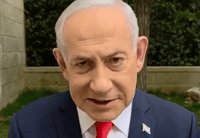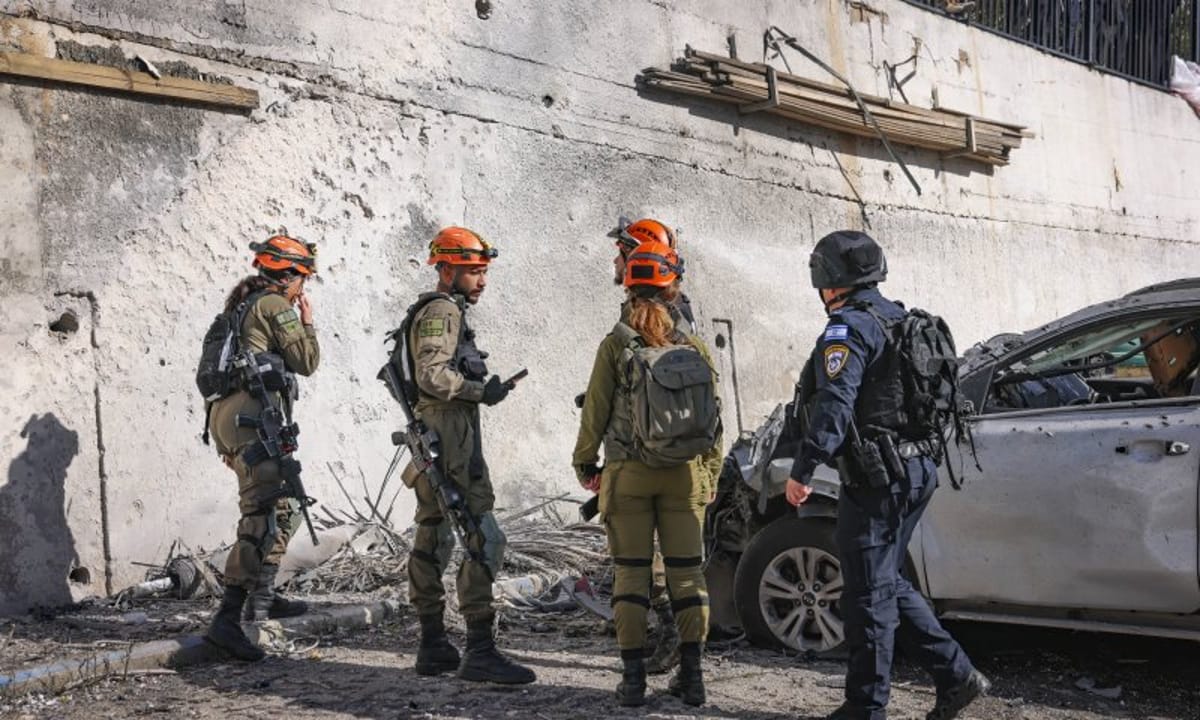
The Rabbi of the Shlomi Council, Rabbi Moshe Elharar, has not left the sector since October 7. He tells Srugim: "The residents are without protection. Does anyone care? No. They don’t care" and shares one chilling story: "I spent the entire night collecting the remains of a soldier who was blown up."
"Does anyone care? No. They don’t care." Rabbi Moshe Elharar, the Rabbi of the Shlomi Local Council, struggles to hide his frustration. For two and a half years, he has been on the northern border almost continuously, without a break. The fire does not stop, but according to him, those who are supposed to handle it mostly just talk. "They speak loftily," he says, "but there is no connection between the talk and reality. Everything is moving at a snail's pace."
Like Sitting Ducks
Shlomi, a small town in the Western Galilee, sits right on the border with Lebanon. Unlike other areas in the country, here there aren't always even a few seconds to react.
"Many times there is an impact and only afterward an alarm," Rabbi Elharar describes. "There is no warning time, you have no way to defend yourself; the residents are like ducks in a shooting gallery." According to him, the problem is not just the security threat but the lack of fortification.
"The state put people on the border, but they don't give them the minimum to live there. There are families without reinforced rooms (mamadim), without functioning shelters. They talk about mental resilience, but the damage is already done."
Politicians Talk from Morning to Night
The Rabbi did not spare criticism of the political echelon: "The politicians talk from morning to night. Standing in front of a microphone and talking is not the same as feeling the pain of the people here, and that, doesn't interest them." According to him, the erosion is already felt on the ground. "People are collapsing. You can talk about resilience as much as you want, but in the end, it wears the residents out, and they have no choice but to stay."
Two and a Half Years Without a Break
Since October 7, Rabbi Elharar has not left the area even for a single day of rest. "I haven't been in a hotel for one day," he says. "The Rabbi of the local council must be here at every moment." He moves between houses, synagogues, and military outposts, strengthening soldiers and civilians, giving lessons, and accompanying families in their hardest moments. But even he admits: "It's not enough. Without real treatment, people will eventually leave."
The Story He Never Told the Family
The most jarring moment in the conversation comes from an old story, from Lebanon during his military service in a search and identification team. For years, Rabbi Elharar avoided meeting the families of the fallen he handled, wanting to spare them the gruesome details. But in one case, he was forced to break the rule.
A bereaved mother from Samaria dreamed repeatedly about her son, seeing a flower in her dream that appeared and disappeared. She became convinced her son was never buried and went on a search mission through every possible channel. Finally, she demanded to meet someone who was there.
"I sat with her alone," the Rabbi says. "No officers, no people. And I told her: I will tell you what happened." Then, in precise detail, he described that night: The son was killed by a direct missile hit to an APC. The Rabbi collected his remains for hours, until the early morning. "With cotton wool, I collected every part until four-thirty in the morning," he says. "That is also the reason the funeral was delayed again and again." After that meeting, the mother calmed down and was able to sleep at night.
"You Can’t Raise Children Like This"
Today, between eight and nine thousand residents are registered in Shlomi. Many of them returned, but not by choice. "They returned because they have no choice," the Rabbi says. "But strong, established families, do not return. You cannot raise children in such conditions. It’s not normal." According to him, if the situation continues, the result is clear: "It will cause a fracture. People will simply leave, and families who could lift the place up and lead it forward, simply won’t come."
Between Despair and Faith
Rabbi Elharar concludes on a note of faith. He mentions the words of Rabbi Ben-Zion Meir Hai Uziel, who wrote decades ago that the People of Israel passed through four exiles, four kingdoms described in the Book of Daniel, but are destined to enter a further stage: a fifth, eternal kingdom, after which there is no destruction.
According to him, we are already within that period. "This is an era like no other, where the People of Israel deal with many forces, but also merit extraordinary Divine assistance. We see miracles that never existed before," he adds, "Divine aid that was unparalleled. But along with that, there is also a heavy price, and there is a harsh reality that cannot be ignored."