Greek Foreign Minister George Gerapetritis issued a firm statement addressing rhetoric from Turkish officials, asserting that Athens is fully prepared to respond operationally to defend its maritime rights in the Aegean and Eastern Mediterranean. Speaking during an interview with Greek television network Skai, Gerapetritis linked Ankara's sharp rhetoric to Greece's growing military, economic, and diplomatic posture, affirming that strategic cooperation with Israel will continue without external interference.
"Real power is not found in words," Gerapetritis stated during the broadcast. "Real power is found in expanding the diplomatic footprint, in defense resilience, and in a strong economy, over the past three years Greece has developed all these areas".
The foreign minister indicated that heightened rhetoric from Turkish political figures reflects Greece's strengthened position on the international stage. "We understand that the increased tension of this type, which we often see from figures in neighboring Turkey, also stems from the fact that Greece has gained real power and a voice that is heard more than ever," Gerapetritis remarked. "The one who shouts is not always the strongest, in fact, it is more likely that he is the weak one".
While assessing that an immediate military clash between the two regional nations remains unlikely, Gerapetritis emphasized that Greek defense planners have prepared complete operational contingencies. "Our assessment is that there is no danger on the ground, of course, we are always on guard," he explained. "We have prepared all scenarios for any tension and any rise in pressure, obviously we are prepared to respond on the ground as well".
Gerapetritis outlined several sovereign measures taken by the Greek government as proof that Athens remains undeterred by threats from Ankara. "We were not afraid to promote maritime spatial planning, we were not afraid to establish marine parks, and we were not afraid to build a force structure that reinforces our islands, despite everything that was said," Gerapetritis declared. "We were not afraid to expand territorial waters, and we were not afraid to sign agreements delimiting maritime borders with neighboring countries, I assure you that the current government does not suffer from a fear syndrome".
Longstanding territorial disputes between Athens and Ankara involve sovereignty rights in the Aegean Sea, maritime jurisdiction limits, island fortification, and energy exploration rights. A primary point of friction involves the potential extension of Greek territorial waters from six to 12 nautical miles in the Aegean Sea, an action Turkey previously warned would be treated as a cause for war.
Gerapetritis reiterated that Greece retains its sovereign right under international law to implement the extension whenever deemed appropriate. "We have said repeatedly that extending territorial waters to 12 nautical miles is a right of the Greek state, deriving from international law of the sea, we have never waived it," he stated. "The Greek state will exercise this right at the time and in the manner it sees fit, I cannot provide a timetable, but it is a unilateral right".
The foreign minister confirmed that construction will proceed on an undersea electrical cable connecting the power grids of Greece and Cyprus despite Turkish opposition to operations in disputed maritime zones. "Of course the implementation orders regarding the marine parks will be published, and of course the power cable connecting Greece to Cyprus will be laid," Gerapetritis affirmed.
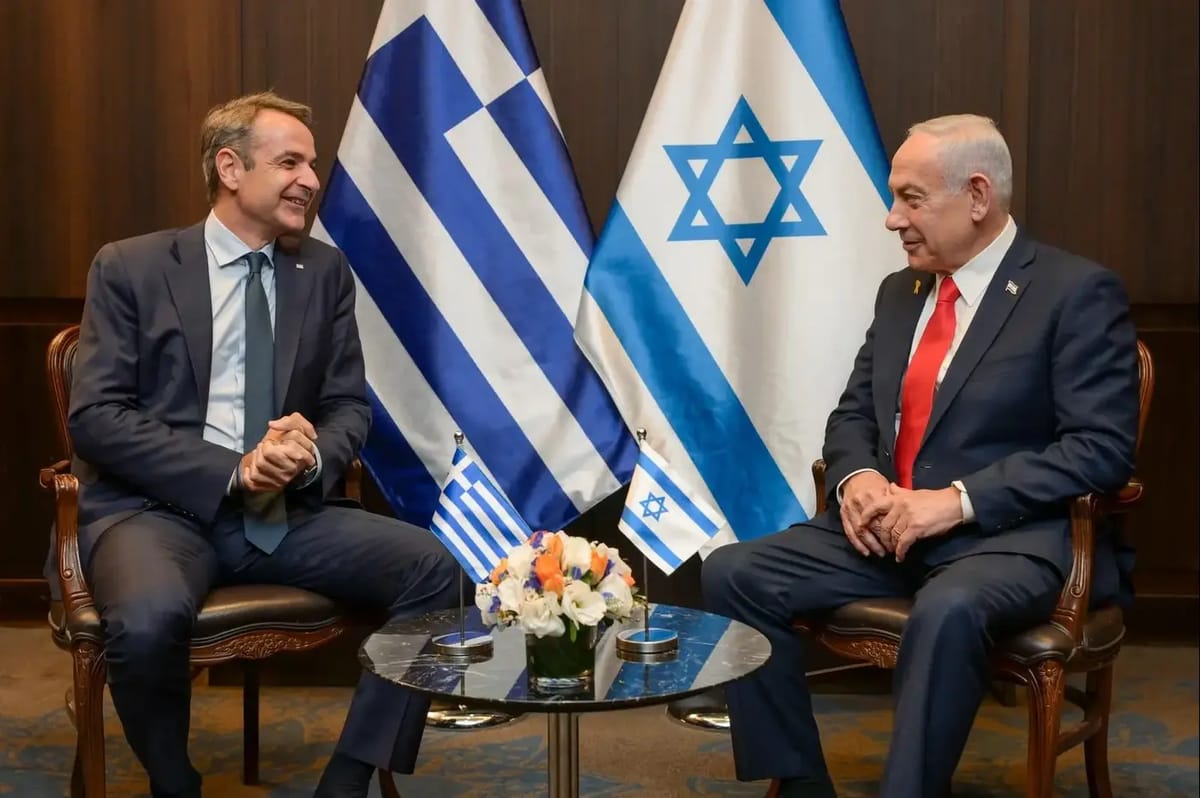
Addressing regional partnerships, Gerapetritis highlighted defense and technological ties with Israel as a core pillar of Greece's strategic posture. "The answer is clear: of course Greece will continue to develop its cooperation with Israel," he declared, noting that bilateral relations have "yielded significant added value, especially in the fields of defense and technology." He noted that alongside ties with Israel, Greece maintains "a dialogue of a true strategic nature with the entire Arab world".
Gerapetritis rejected any attempts by external powers to exert control over Athens' foreign policy decisions. "The only thing that is certain is that we will not determine our international alliances according to the wishes of other countries, that can be forgotten," he remarked. "Stagnation does not generate power, power is generated by strong alliances, a strong economy, and a strong defense system, above all, it is generated by a government that has the credibility and capability to execute the things to which it committed".
The minister clarified that Greek security arrangements with Israel and regional allies remain defensive in nature and do not constitute an offensive posture against Turkey. "All cooperation that Greece maintains in the international arena is defensive in nature," Gerapetritis noted. "Greece does not plot against any country, and above all it cares for our strength".
Despite the firm stance on maritime rights, Gerapetritis emphasized that diplomatic communication channels established under the Athens Declaration three years ago will remain open. "Talking with your neighbor, and especially with a neighbor with whom you have historical disputes, is a necessity," Gerapetritis concluded. "We cannot say on one hand that Greece strives for peace and stability in the region, and on the other hand close the door, whoever thinks we will gain something from closing the negotiation table and avoiding talks is simply completely disconnected from reality, closing the door to dialogue effectively leaves a legacy of war, not peace".