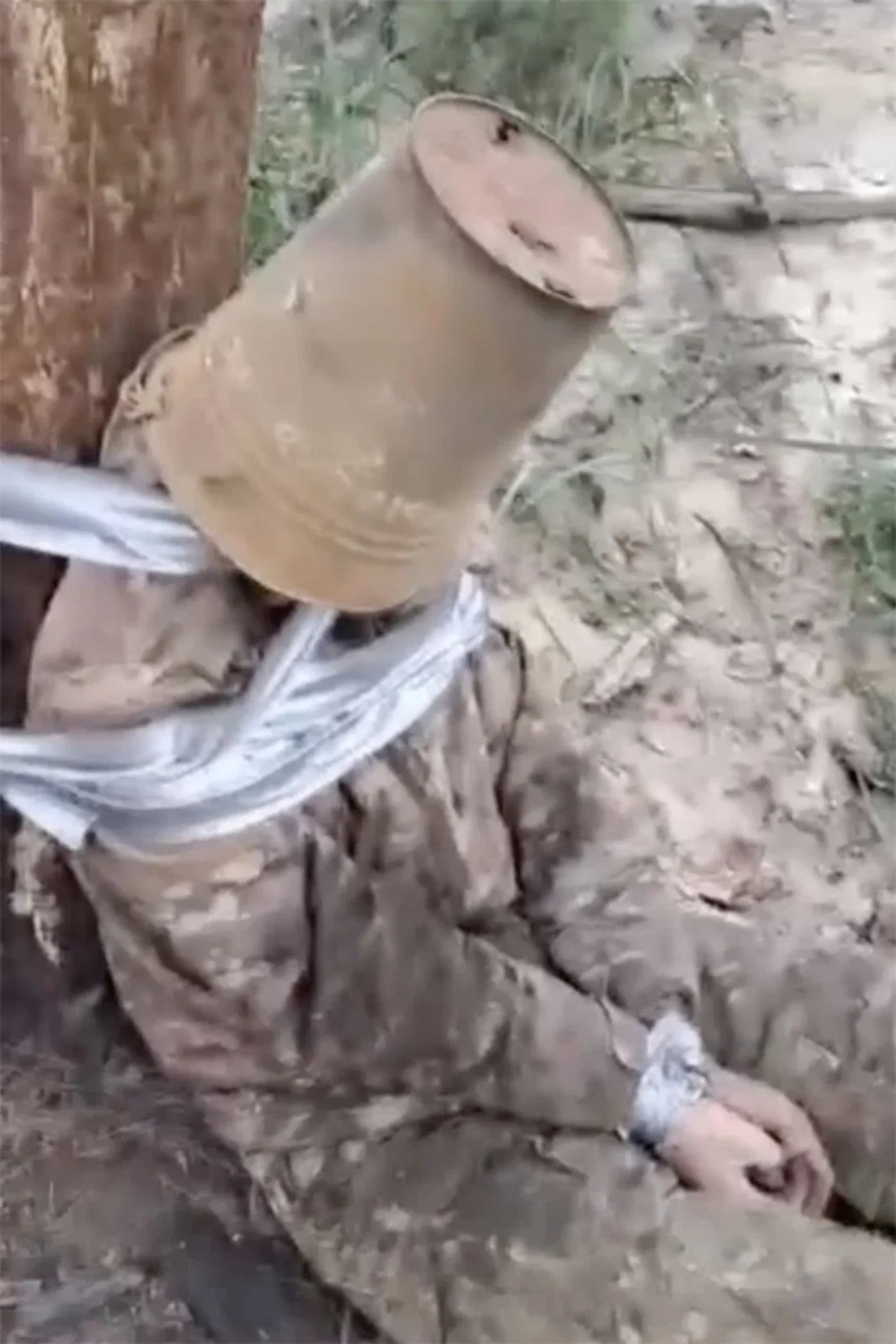
Back to Russia. It's hard to understand if these punishments come from senior command or are initiatives of junior commanders. But what's clear is that the videos not only document reality: they are also tools of intimidation. Every soldier who hesitates knows what awaits him if he dares to desert.
Alongside the videos, there are other voices, documented and filmed. Russian soldiers appeal directly to Putin via Telegram, in pleas that sound like farewell letters. One of them is Yuri Duryagin, who fought in the Donetsk area. In a chilling video, he says that out of 150 fighters in his unit, only 32 survived. According to him, he received only a fifth of the promised salary, and was told by commanders that there's no point complaining.
In his words addressed to Russian President Vladimir Putin, he also testifies to an interesting phenomenon: deaths recorded as absences, just to avoid paying families the compensation due to them, without thinking about the psychological price the family pays, mistakenly believing there's still a chance to find their loved one among the living.
In his letter, the soldier details shocking conduct from the battlefield: According to him, Russian commanders force soldiers to run into the fire, even when it's certain death. Anyone who doesn't agree to commit suicide for Mother Russia, is executed cruelly. In his letter, the soldier wrote: "My commander executed soldiers who refused to go into battle against machine guns."
The Russian army, of course, doesn't talk about deserters. It is silent. But in the field, this silence is full of screams of soldiers begging to escape, families searching for their loved ones, and people who no longer believe in the righteousness of the path. According to Western estimates, more than a million Russian soldiers have been killed or wounded since the start of the war.
In 2025 alone, about 100,000 were killed, according to NATO and the estimate is that the numbers are much higher.
US President Donald Trump, known for his exaggerations, claimed that thousands are killed on the battlefield every week. The number of Russian deserters is estimated in the tens of thousands, some fled Moscow even before recruitment, others left the front at high personal risk.
Grigory Sverdlin, founder of the organization Get Lost, is helping soldiers escape. Operating from Barcelona, it has has helped 1,700 soldiers desert or evade conscription in about two years. According to Sverdin, there are thousands of soldiers in severe mental distress, some without any proper training, some recruited at an older age, and abandoned on the front with faulty equipment.
"Commanders don't treat them as humans," he says. "According to the reports we receive, officers prefer to lose ten soldiers than to lose a tank." He adds: "Soldiers tell us that commanders say to their faces: In a week you'll all be dead, and I'll get a new unit. It's simply a culture of absolute nihilism."
According to Sverdlin, one of the most common sentences he hears from deserters is: "This isn't my war. I don't understand at all what we're doing here." These are young and old, from the center and the periphery, regular soldiers and volunteers, all, according to him, worn down mentally and living under constant terror. This is an army that has lost its sense of justice and morale, holding itself only by the force of fear.
Wars always create traumas, who knows that better than us Israelis. But this war, as reflected in the footage and testimonies, has created not just trauma, but a deep crack in Russian consciousness. When soldiers are tied to trees as sacrifices to an element in the sky, when comrades are required to shoot each other to get out of the front, when a cookie is thrown to a hungry soldier as humiliation, it's a complete collapse of military ethos.
Will these cracks affect the continuation of the fighting? It's hard to know. The Russian army continues to advance slowly but steadily, and Moscow shows no signs of weakness. But if there's one thing clear from this documentation, it's this: Within the ranks of the Russian army, a quiet revolution of despair is building. A war imposed on them from above, light years away from the lives they knew, has become for many a personal survival struggle. And when there's no more faith, no patriotism, and no hope, even a well-armed army doesn't hold for long.
A political revolution against Putin is unlikely to happen soon. The Russian president holds his rule with strength, and he has proven it time and again, even when the most senior tried to betray him militarily. However, if there are people Putin should pay attention to, it's the junior soldiers who hold the Russian war machine. If Putin loses them, he may lose not only the victory, but perhaps also the rule of force at whose head he stands.
In this article, use was made of photographs whose rights holder is unknown or not located, in accordance with the provisions of Section 27A of the Copyright Law.