Lingering Divisions
Syria Commemorates One-Year Anniversary of Assad's Ouster with Parades and Pledges
As Syria enters a four-year transitional period to draft a new constitution and hold elections, humanitarian needs remain dire for 16.5 million people, with rebuilding efforts still small-scale and job opportunities limited.

Thousands of Syrians flooded the streets of Damascus and other cities today to mark the first anniversary of the dramatic fall of Bashar al-Assad's regime, blending jubilation with calls for unity in a nation still grappling with the scars of a 14-year civil war. Interim President Ahmed al-Sharaa, the former rebel leader who spearheaded the offensive that toppled Assad on December 8, 2024, led the commemorations, vowing to rebuild a "strong and just" Syria while acknowledging the challenges ahead.
In a televised speech following the prayers in Damascus' Old City, al Sharaa emphasized reconstruction efforts spanning "from north to south and from east to west," promising a Syria that "supports the oppressed and establishes justice among the people." "No one will stand in our way, no matter how big or powerful they are," al-Sharaa declared, framing the post-Assad era as a transitional phase focused on stability, sovereignty, and inclusive governance.
Central to the festivities was a grand military parade along a major thoroughfare in the capital, where hundreds of personnel from the reorganized Syrian army marched in formation, showcasing the new government's control and military cohesion.
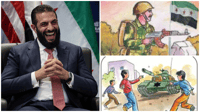
Helicopters thundered overhead as part of an aerial display, with reports of parachutists descending in the colors of the Syrian flag (red, white, black, and green stars).
Umayyad Square, the iconic heart of Damascus, buzzed with energy as crowds waved flags, chanted slogans, and erupted in cheers, transforming the site of last year's chaotic rebel takeover into a hub of organized celebration.
Similar events unfolded in cities like Homs, with fireworks lighting up the night sky in the lead-up to the anniversary.
The atmosphere was one of hope and national pride, a stark contrast to the raw relief and uncertainty that defined Damascus a year ago when HTS-led rebels seized the city, prompting Assad to flee to Russia for asylum.
Since then, al-Sharaa's administration has made some strides, including forging ties with the U.S., Gulf states, and Turkey, lifting Western sanctions, and facilitating the return of 1.2 million refugees and 1.9 million internally displaced people.
Yet, the celebrations highlighted persistent fractures: Alawites, Assad's religious minority, largely boycotted the events, protesting what they call "oppressive" new authorities.
In the Kurdish-controlled northeast, public gatherings were banned for security reasons, reflecting ongoing mistrust.
Sectarian clashes have claimed hundreds of lives over the past year, displacing communities and pointing to the challenges of reconciling a war-torn society that has seen hundreds of thousands killed and millions uprooted since 2011.
For many, today's events symbolize not just victory over tyranny, but the daunting and uncertain road to a unified future.