SHOCKING: Rabin Assassination Witness Breaks 30-Year Silence - 'I Know What Really Happened'
Three decades after conviction, Bar-Ilan student speaks out on Shin Bet interrogations • Claims she possesses knowledge about assassination but 'cannot speak' | Explosive interview reveals trauma of 'white-collar torture' (Israel News)

Thirty years after the assassination of Prime Minister Yitzhak Rabin z"l, Margalit Har-Shefi has broken her decades-long silence in an exclusive interview with BaSheva newspaper and BaSheva Online. The former Bar-Ilan University student, who was convicted of "failure to prevent a crime" following the November 4, 1995 assassination, has opened up about her interrogation ordeal, the public shaming that continues to haunt her, and most explosively, her claim that she possesses knowledge about what truly transpired that fateful night.
Har-Shefi was convicted based on allegations that she knew of Yigal Amir's intentions to assassinate the Prime Minister but failed to prevent the attack. She served five months of a nine-month prison sentence before receiving a presidential pardon. Now, for the first time, she is speaking publicly about the experience that has defined her life for three decades.

"White-Collar Torture" in Shin Bet Custody
In the interview, Har-Shefi provided disturbing details about her interrogation by the Shin Bet, Israel's internal security agency. She characterized the experience with dark cynicism as an "all-inclusive" hospitality package, describing conditions she stated were more suitable for rodents than human beings.
"The cell was admittedly suitable for mice, but fortunately they weren't in it," she recounted. "They subjected me to white-collar violations, humiliations, subtle physical tactics like sleep deprivation and food denial, prevention of access to legal counsel, and other things I cannot detail here."
The trauma from those interrogations, she emphasized, remains seared into her memory. Beyond the physical imprisonment, Har-Shefi asserted that she has endured what she termed a "public imprisonment" that has persisted for thirty years, affecting every aspect of her personal and professional life.
The Bombshell: "I Know What Happened"
The most dramatic moment in the interview came when Har-Shefi was questioned about the various conspiracy theories surrounding Rabin's assassination and the widespread public perception that significant aspects of the event remain concealed. Her response sent shockwaves through the Israeli media landscape.
"I know (what happened), but I cannot speak," she stated bluntly.
When pressed to elaborate, Har-Shefi adopted a cynical, cryptic tone: "How can one suspect an intelligence agency, whose every path is righteousness and truth, of conducting a conspiracy? The Shin Bet and conspiracies are two things that cannot be connected." She added that she does not believe the general public possesses the framework to comprehend the information she claims to hold: "It doesn't align with anything people are familiar with. They don't understand how the intelligence world operates."
Despite the intense curiosity her statements have generated, Har-Shefi made clear that she does not anticipate being able to share what she knows, even in the future. "I don't think that will happen," she concluded.
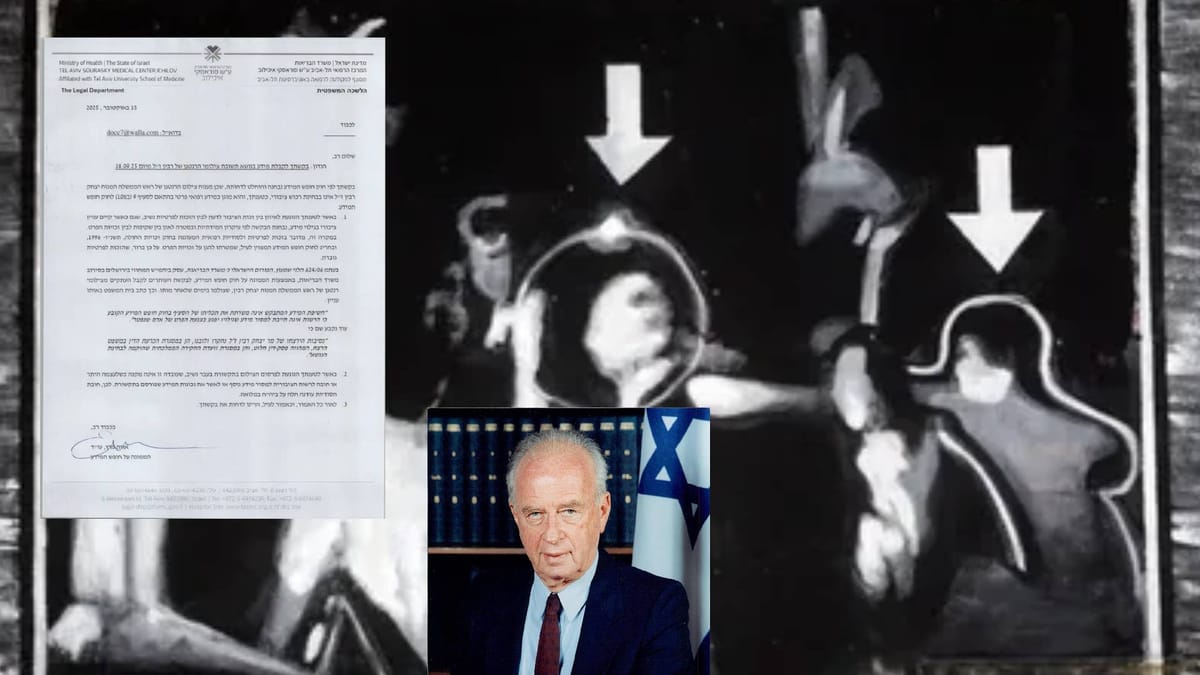
The interview has reignited longstanding questions about the Rabin assassination, which have persisted in certain segments of Israeli society for three decades. A recently leaked medical document from Tel Aviv Sourasky Medical Center has already fueled renewed speculation about potential cover-ups, with conspiracy theories pointing to possible Shin Bet involvement in the events of that November night.
Context: The Rabin Assassination and Its Aftermath
Prime Minister Yitzhak Rabin was shot and killed on November 4, 1995, following a peace rally at Kings of Israel Square in Tel Aviv. Yigal Amir, a far-right Jewish law student, was arrested at the scene and confessed to the murder. However, numerous theories have emerged over the years suggesting deeper involvement by state security apparatus.
The political atmosphere preceding the assassination was highly charged. Critics have pointed to inflammatory rhetoric at opposition rallies, where some protesters burned images of Rabin in Nazi uniforms and chanted for his death. The widow of the slain Prime Minister, Leah Rabin, publicly blamed opposition leaders for creating the climate that led to her husband's murder.
Har-Shefi's conviction stemmed from her acquaintance with Amir at Bar-Ilan University. Prosecutors alleged she had knowledge of his plans but failed to alert authorities. Her case became emblematic of the broader questions about who knew what in the lead-up to the assassination, and whether security failures or deliberate negligence played a role in allowing the attack to succeed.
The full interview with Margalit Har-Shefi is scheduled for publication this weekend in BaSheva newspaper, where she is expected to provide additional details about her three-decade ordeal and the knowledge she claims to possess about one of the most traumatic events in Israeli history.