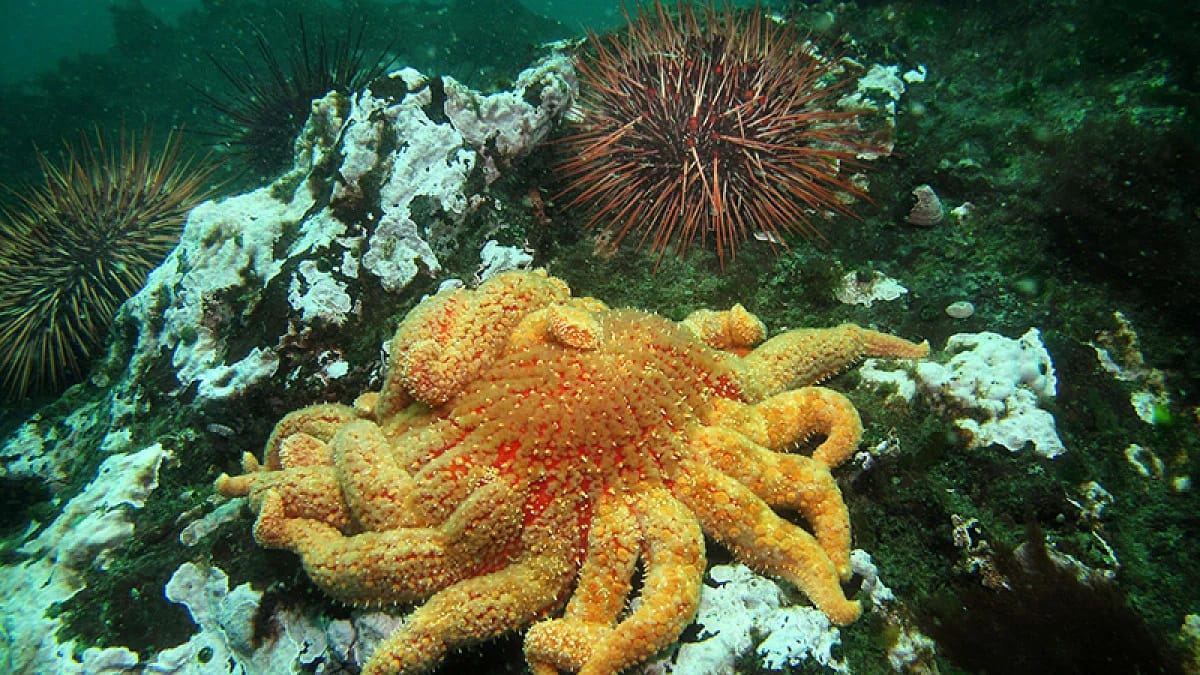
Off the coast of Monterey, California, divers are carrying out an unusual mission: returning a marine creature with up to 24 arms to the ocean floor, in the hope it can save an entire ecosystem from collapse.
The creature is the sunflower sea star, a critically endangered species that was once one of the most important predators in the Pacific coast ecosystem.
Since 2013, a marine heat wave triggered the spread of a devastating disease among sea stars. More than 90% of the Pacific population was wiped out. The coast from Alaska to Baja California once supported an estimated six billion individuals.
The disappearance had catastrophic consequences. Sunflower sea stars fed on purple sea urchins, and without their natural predators, the urchin population exploded. The urchins began devouring kelp forests, giant algae that serve as habitat for thousands of marine species. According to researchers, roughly 95% of the region's kelp forests were damaged or disappeared within a decade.
To save the forests, scientists are now breeding sea stars in special tanks and releasing them in controlled trials to the seafloor.
Researchers have found that a sunflower sea star can consume three to four sea urchins per day, but its most important impact may be the fear it inspires. Urchins can sense its presence through chemical signals in the water, and in response they hide and reduce their feeding activity within a radius of nearly five meters.
Researchers call this phenomenon the "halo of fear." The predator's mere presence may allow young kelp to recover, even without the sea stars consuming every urchin.
As of this report, no sunflower sea stars are known to remain in Monterey Bay. The current trials are designed to test how lab-raised sea stars behave in the natural environment and how urchins respond to them.
If the experiments succeed, scientists hope to return the sea stars permanently to the bay within a few years.