
What its Really Like to Be a Jewish Teen in France in 2026
18-year-old from Rennes won't let teachers know he's Jewish • Nine teens reveal to Ambassador Kushner what it's like hiding identity daily | 'I thought I was the only Jewish girl in my city' (Jewish World)

What was scheduled as a routine diplomatic meeting at the U.S. Ambassador's residence in Paris turned into a searing window into the daily reality facing Jewish youth across France. When Younes, an 18-year-old from Rennes in northwestern France, declined to accept an official letter from the U.S. Embassy explaining his absence from school, Ambassador Charles Kushner pressed him for an explanation. The answer was as simple as it was devastating: Younes didn't want his teachers, or his classmates—to discover he participates in a Jewish youth movement. Apart from his closest friend, nobody at his school knows he is Jewish.
The moment crystallized what would become a two-hour conversation that Ambassador Kushner and his wife Seryl would later describe as among the most impactful of his tenure. Seated in the ornate halls of the official residence on Rue du Faubourg Saint-Honoré, nine teenage leaders from CTeen France, the global Chabad youth network, shared testimonies that painted a portrait of a generation living in what Rabbi Mendy Mutal, CTeen France director, termed "hidden identity."
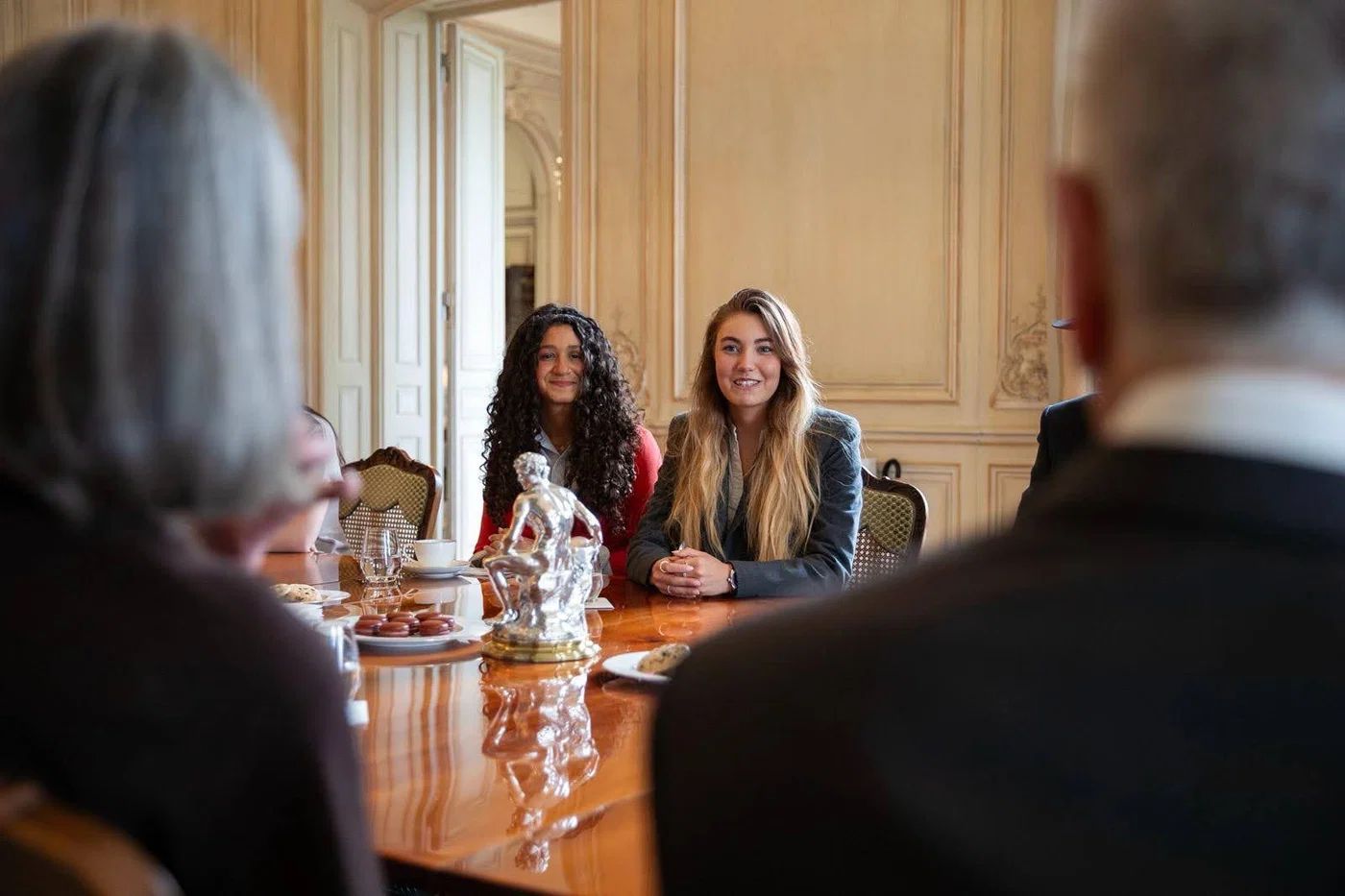

Living a Double Life
Ambassador Kushner, grandson of Holocaust survivors and a longtime supporter of Chabad emissaries worldwide, posed direct questions to the assembled teens: What does it feel like to be Jewish in a secular French school today? The responses revealed a community navigating daily calculations about safety, identity, and belonging. Since the October 7, 2023 attacks and the subsequent surge in antisemitic incidents, many of these students described their schools as social battlegrounds where being visibly Jewish carries tangible risks.
Salome, a teenager from Orléans, shared that until CTeen opened a local chapter in her city, she was convinced she was the only Jewish girl there. "All week at school I'm just waiting for the moment when I can see my Jewish friends," she conveyed to the Ambassador. Her experience reflects a broader isolation felt by Jewish youth scattered across France's smaller cities and towns, where organized Jewish life remains minimal or nonexistent.
The city of Orléans itself made headlines in March 2025 when Rabbi Aryeh Engelberg, the local Chabad emissary, was violently attacked in front of his nine-year-old son as they returned from synagogue, a hate crime that reverberated throughout French Jewish communities and underscored the precarious security situation even in provincial areas.

The Numbers Behind the Fear
France is home to approximately 500,000 Jews, the largest Jewish population in Europe. Yet recent data reveals an alarming deterioration in their sense of security. According to a 2026 Jewish Agency report surveying 1,428 Jewish respondents globally, 78% of French Jews stated they do not feel safe in their country, among the highest rates recorded anywhere. The survey, conducted by Ipsos, found that 43% of European Jews experienced antisemitic incidents in the past year, either personally or through family members.
French government statistics from 2025 documented 1,320 antisemitic incidents nationwide. While this represented a slight decrease from the previous year, the Interior Ministry noted a troubling rise in physical violence: from 106 cases to 126 within a single year. For the teenagers seated in Ambassador Kushner's residence, these statistics translate into lived experience, the careful concealment of Star of David necklaces, the avoidance of Hebrew phrases in public spaces, the constant vigilance required simply to move through their daily routines.
A Mission Rooted in Personal History
For Ambassador Kushner, who assumed his post in Paris last summer, combating antisemitism in France has become his paramount diplomatic priority. His personal connection to the issue runs deep, as the grandson of Holocaust survivors, he understands the historical echoes of Jewish vulnerability in Europe. Following the meeting, Kushner posted on his X account: "I love seeing young leaders with motivation. They're fighting hate through building community."
The Ambassador ensured that every detail of the gathering reflected respect for his guests' religious observance. All refreshments served were certified kosher to the highest standards, and Seryl Kushner personally conducted tours of the historic residence for the teens. At the conclusion of the meeting, each participant received symbolic gifts: a specially designed kippah bearing the U.S. Embassy insignia and an embassy medallion. Ambassador Kushner emphasized that this gathering marked merely the beginning of an ongoing partnership with CTeen France.
Building Community in the Shadows
CTeen France has experienced remarkable growth since its establishment in 2014 with a single chapter. The organization now operates 120 branches spanning from Strasbourg to Marseille, serving thousands among France's estimated 30,000 Jewish teenagers. The network provides what Rabbi Yosef Yitzchak Kotlarsky, CTeen's global chairman based at Chabad headquarters in New York, described as "a place to belong and the courage to lead."
"What CTeen gives them is a space where they don't have to hide," Rabbi Kotlarsky explained. "The fact that the Ambassador sits with them, listens to their stories, and acknowledges the weight they carry on their shoulders—that means something profound to these young people." The organization offers leadership training, summer programs, and most critically, a community where Jewish identity can be expressed openly and proudly—a stark contrast to the concealment many practice during their school weeks.
Rabbi Mutal, who accompanied the delegation, noted that Ambassador Kushner posed searching questions about the daily mechanics of being Jewish in contemporary France. "He wanted to know what actually happens in the hallways, what they feel when they walk into a classroom knowing they might be the only Jews in the room," Rabbi Mutal stated. The conversation revealed that for many of these teens, their Jewish identity exists in two separate spheres: hidden and cautious during weekdays at school, open and celebrated during weekends with their CTeen communities.

A Voice Heard at the Highest Levels
As the teens departed the Ambassador's residence and returned to Paris streets where some would once again tuck their Star of David necklaces beneath their shirts, they carried with them something intangible but significant: the knowledge that their experiences had been heard and validated at the highest levels of diplomatic representation. The meeting represented more than symbolic recognition, it signaled American awareness of and engagement with the challenges facing France's Jewish youth.
The broader context of rising antisemitism across Europe makes such engagement increasingly urgent. Recent incidents in London, where Orthodox Jewish women were attacked with a belt at a bus stop, and in Manchester, where threats invoking Nazi gas chambers were directed at Jews, underscore that France's Jewish community faces challenges shared across the continent. Yet the French situation carries particular weight given the size and historical significance of its Jewish population.
For Younes, the teenager who refused the embassy letter to protect his hidden identity, and for Salome, who spent years believing she was alone in her city, the Ambassador's attention offered validation that their struggles matter. Whether that recognition translates into tangible improvements in their daily security and sense of belonging remains to be seen. But for two hours in an elegant Parisian residence, nine Jewish teenagers didn't have to hide who they are, and someone with power was listening.