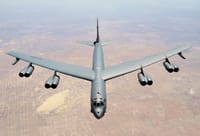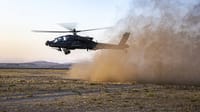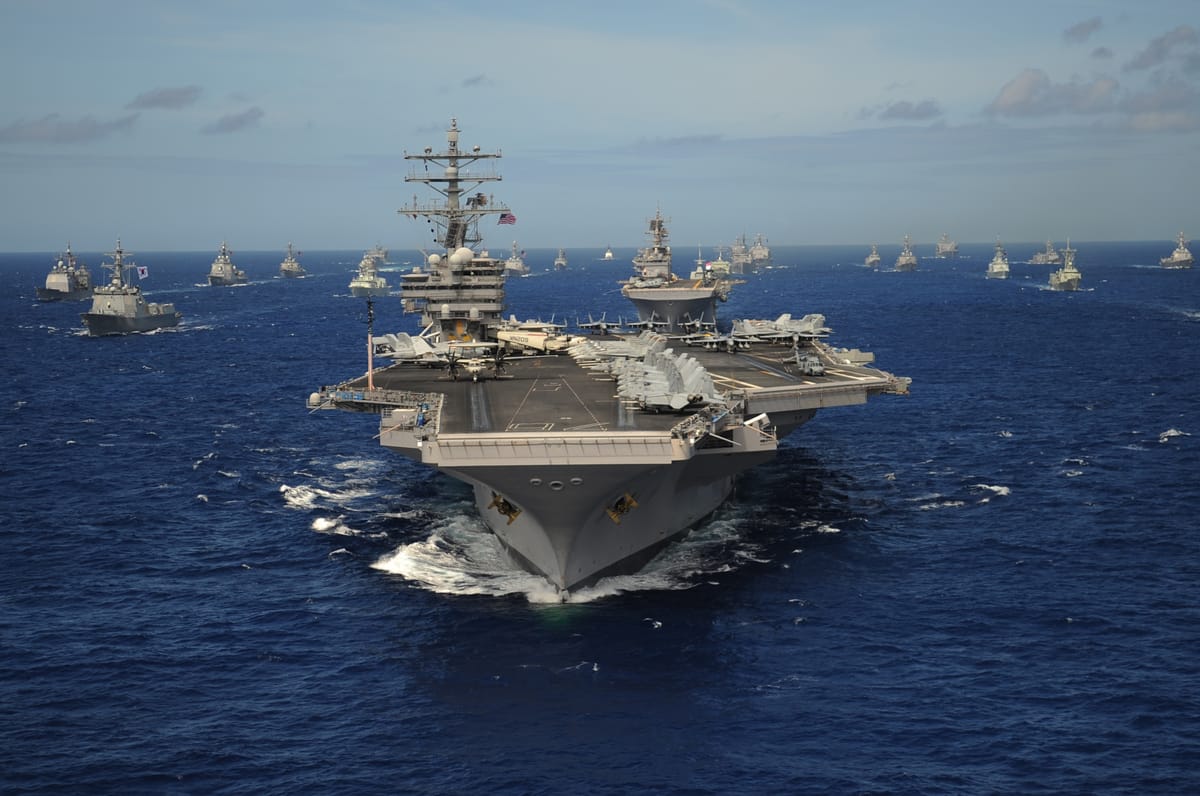
President Donald Trump recently described the growing American military presence in the Middle East as a beautiful armada, a collection of warships, submarines, aircraft, and ground-based defenses positioned to project overwhelming power toward Iran. The buildup includes the carrier strike group centered on the USS Abraham Lincoln, multiple Arleigh Burke-class destroyers, attack submarines, littoral combat ships, and reinforced air wings at regional bases, all amid ongoing signals from Trump that military action against Iran remains a real possibility.
At the core stands the USS Abraham Lincoln, a Nimitz-class nuclear-powered aircraft carrier operating in the Arabian Sea after departing the South China Sea. The ship carries around 5,700 crew members and a full air wing of approximately 75 combat aircraft, including F-35C stealth fighters in the carrier variant, F/A-18E/F Super Hornets, EA-18G Growler electronic attack jets, airborne early warning aircraft, and helicopters for search and rescue. Former Israeli Navy commander Eliezer Marom, known as Cheney, described it as essentially a floating airfield and a very serious formidable force. If the Americans decide to activate the Lincoln, I think the Iranians definitely have something to fear, he said. Unlike land-based air operations that require host-nation approval, the carrier allows the United States to launch full-scale air power independently from any sea position, placing a persistent direct threat on strategic Iranian targets deep inland.
Escorting the carrier are three Arleigh Burke-class destroyers: USS Spruance, USS Michael Murphy, and USS Frank E. Petersen Jr. These versatile warships combine offensive and defensive roles on a single platform. Equipped with the Aegis combat system, powerful radars, and interceptors such as SM-3 missiles, they defend against ballistic missiles, cruise missiles, drones, and aircraft. They also carry dozens of Tomahawk cruise missiles capable of striking targets up to 1,600 kilometers away with meter-level accuracy after flying low to evade radar. Additional Arleigh Burke destroyers patrol the Gulf of Oman, Persian Gulf, Gulf of Aqaba, and Mediterranean to protect U.S. bases and allies including Israel. Marom noted that this strike group brings enormous firepower that can intervene if required in any area of the world.
Attack submarines, often nuclear-powered and from classes such as Virginia or converted Ohio-class boats, operate covertly beneath the surface. They gather intelligence, shadow Iranian naval movements, launch Tomahawk missiles in surprise strikes, and support special operations in complete secrecy. Some Ohio-class submarines carry large numbers of Tomahawk missiles, giving the United States unprecedented strike capacity for special missions, Marom explained.
Three littoral combat ships are stationed in Bahrain for patrol duties, protection of shipping lanes, and operations in shallow waters against fast boats, mines, and attacking drones.