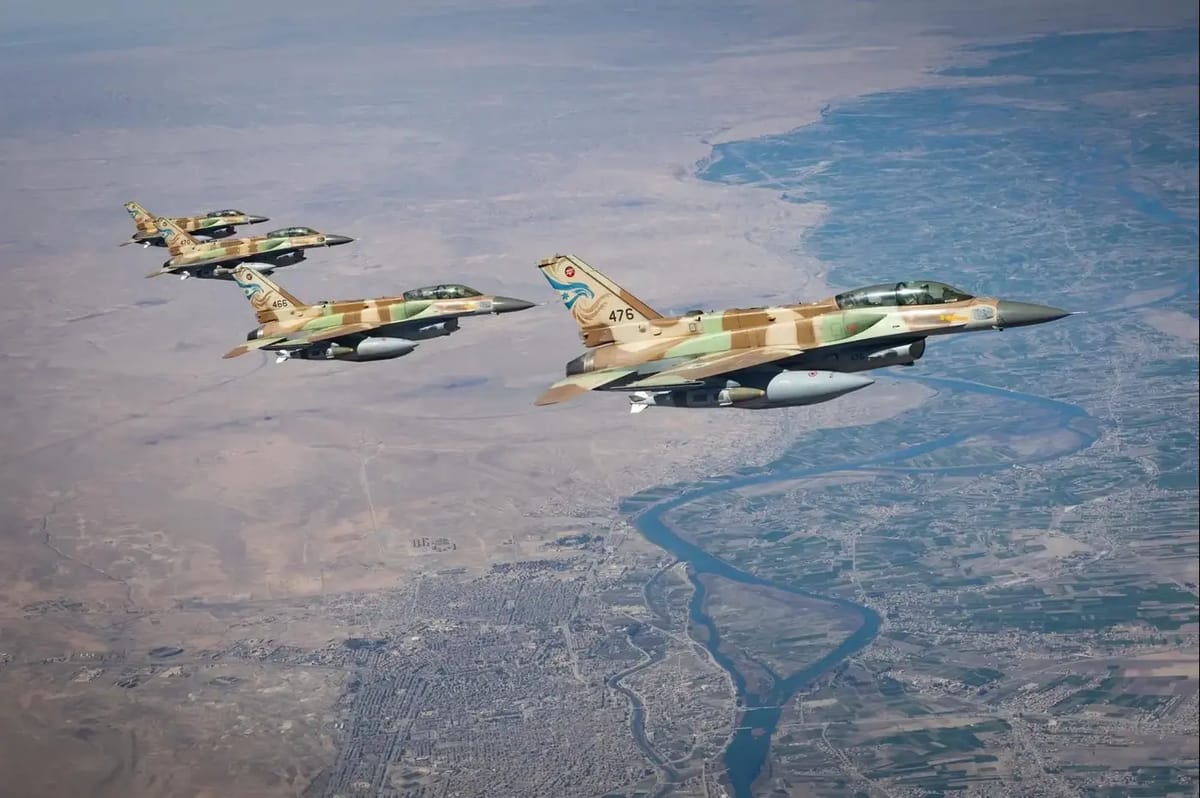
The Israeli Air Force is currently engaged in its most challenging and high tempo aerial campaign in history, operating in the most defended airspace in the Middle East. Over the course of just 18 days, the IAF has flown a volume of missions equivalent to an entire normal year of activity. This effort has been characterized by a new level of operational flexibility and a sophisticated "Metro" strategy that allows for a continuous and multi focal presence over Iranian territory. Working in close coordination with American forces, the IAF has achieved a 90% interception rate against Iranian missiles while simultaneously hunting down and destroying the regime's mobile launch platforms deep within their own borders.
The "Metro" and Spontaneous Strikes
The cornerstone of the current campaign is the "Metro" system, a series of continuous flight patterns that ensure Israeli jets are always present over key regions of Iran. This allows for rapid reaction to emerging threats, such as the movement of mobile missile launchers or the detection of IRGC personnel. Remarkably, the Air Force has embraced a "spontaneous" approach, with roughly 20% of all missions changing their targets while in flight based on real time intelligence updates. This agility has allowed the military to maximize the value of every sortie, using new intelligence gathered by the Intelligence Directorate and the Air Force’s own specialized units.
While the opening "Genesis" raid successfully decapitated the Iranian leadership, the ongoing mission is to "chase" the launchers. Iran entered the war with approximately 470 ballistic missile launchers, and Israeli officials estimate that roughly 200 of these have already been destroyed. Despite this, the regime has managed to launch 887 ballistic missiles, with 285 of them targeting Israeli territory. The vast majority of these were intercepted, though the military warns that Iran's use of "fragmenting" missiles, which split into multiple warheads, remains a significant challenge that spreads shrapnel over wide areas even when the main missile is destroyed.
Coordination and Advanced Tech
The level of cooperation with the United States has reached an unprecedented scale, with American forces embedded within Israeli bases to the point that some installations are "unrecognizable" due to the heavy U.S. presence. During missions, American tankers provide mid air refueling for Israeli jets, allowing them to maintain high altitude flight paths that save fuel and bypass the need for dangerous maneuvers. This partnership has been vital for maintaining the 90% interception rate. Meanwhile, the IAF is also looking to the future, with the "Ohr Eitan" laser defense system expected to become operational in a few months, which will further revolutionize how Israel handles incoming rocket and drone threats.
The war is far from over, as thousands of targets including military industries and nuclear sites remain on the Air Force's priority list. Some targets are so complex they require up to 80 specialized munitions to destroy, while others can be neutralized with a single strike. Officials at the Pentagon and within the IAF emphasize the need for patience, describing the current military effort as a "grinding machine" that is slowly but surely dismantling the Iranian war machine. As the IAF continues to adapt and learn from each day of combat, the pressure on the Iranian regime continues to mount.